
Whether an ostomy can be reversed depends on the reason it was made, what anatomy remains and how the original problem has settled. The tool below shows where you likely stand and what to prepare for.
Ostomy reversal, in short
- What a reversal is, and who qualifies
- Recovery, in two parts: physical and digestive
- Possible complications, in plain words
- When keeping your stoma is the right choice
Either path can lead to a full life.
Reversal outlook: what to expect for your situation
At a glance
| Most often reversed | A loop ileostomy made to protect a new join |
|---|---|
| Usual timing | 8 to 16 weeks for a protective loop ileostomy |
| Hospital stay | Often 1 to 3 days |
| Bowel changes | Frequent at first, settling over 3 to 6 months |
| Usually not reversible | When the rectum or sphincter was removed |
| Your choice | Keeping a reversible stoma is a valid option |
Pull up a chair
There’s a seat saved for you in a private Facebook group where ostomates and caregivers trade what works.
Members share their reversal stories, from getting ready for surgery to the first weeks of recovery.
Pull Up My ChairPrivate group. Ask the questions you’d rather not ask out loud, even anonymously. Only members see what you share.
“Will mine ever come down?” is the question most new ostomates ask within the first few weeks. The answer depends on more variables than most surgeons explain in a 15-minute discharge meeting. This guide walks through who qualifies, what the surgery involves, what recovery looks like, and the clear answer to whether reversal is the right choice even when it is technically possible.

 A peek inside
This is what Thinking About a Reversal looks like: questions for your surgeon and realistic expectations, built from your answers.
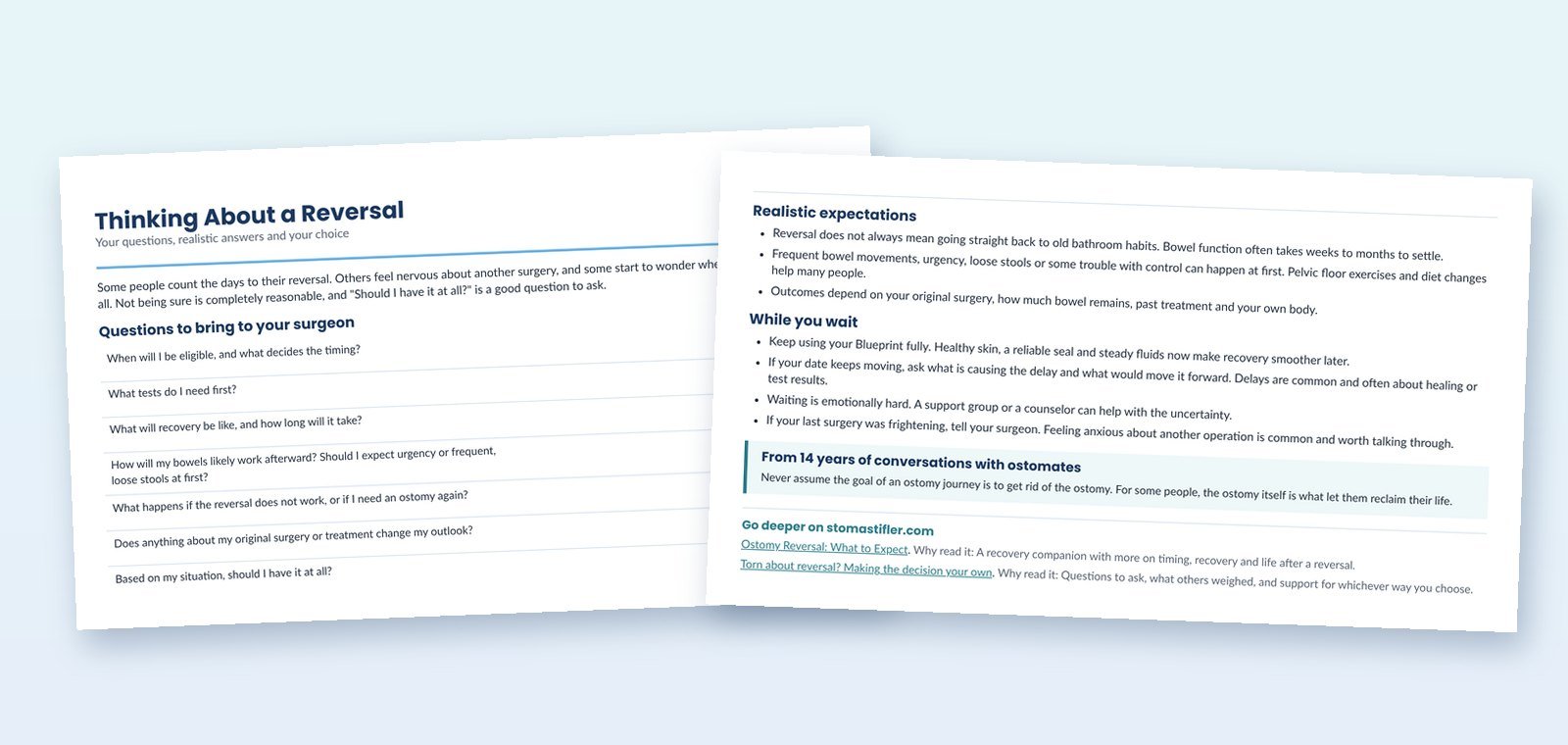
- Questions to bring to your surgeon
- Realistic expectations for life after a reversal
- What to do while you wait
Answer a few questions and see your Confidence Score and top 3 priorities before you decide anything. See more sample pages
What is an ostomy reversal?
Reversal (also called “takedown”) is a surgery that reconnects your bowel and closes the stoma site so that waste once again exits the normal way. The complexity ranges enormously: a loop ileostomy reversal can be a 45-minute outpatient procedure with a single night in hospital.
A more complex reconstruction after extensive surgery can be hours-long with significant recovery time. Whether you qualify, and what version of reversal applies to you, depends on the original surgery, the anatomy that remains, and how the underlying condition has responded.
Who qualifies for an ostomy reversal?
Best candidates (high likelihood of reversal)
- Loop ileostomy created during cancer surgery to “protect” a new bowel connection while it heals. Reversed 8-16 weeks later in most cases.
- Loop colostomy after diverticulitis surgery, with the underlying inflammation resolved.
- Loop ileostomy after J-pouch surgery for ulcerative colitis, reversed once the J-pouch has healed and shown function.
- Trauma cases where the original injury has healed and bowel anatomy is intact.
Candidates with conditions to meet
- Crohn’s disease with a temporary stoma, depends on disease activity, anatomy preserved, and recurrence risk.
- Ulcerative colitis with permanent end-ileostomy, J-pouch reconstruction is sometimes possible.
- Cancer surgery with end colostomy, reversal is technically possible if the rectum and anal sphincter are still intact; rare but considered case-by-case.
Usually not candidates
- Urostomy (bladder removed), reversal would require a separate complex reconstruction (continent diversion or neobladder) and is its own surgery.
- End ostomies where the rectum or anal sphincter has been removed, nothing to reconnect to.
- Active inflammatory disease, usually need remission first.
- Patients whose underlying condition makes continence unlikely (radiation damage, severe sphincter loss, certain neurologic conditions).
Where you land depends on your own surgery, anatomy and recovery. Your Blueprint includes questions for your ostomy nurse, plus a reversal chapter if your ostomy may be temporary. See your top 3 priorities
What does recovery after a reversal look like?
Plan for two distinct recoveries: physical and digestive. Physical recovery from a loop ileostomy reversal is usually faster than the original ostomy surgery, most patients are home within 1-3 days, walking comfortably within a week, and back to normal activities within 4-6 weeks. Heavier lifting and core-engaging exercise should wait 6-8 weeks per surgeon clearance, similar to other abdominal surgeries.
Physical recovery after a loop ileostomy reversal
Digestive recovery takes longer than most people expect. Your bowel has been “resting” for weeks or months and needs to retrain how to absorb water, manage timing, and respond to normal eating. For the first 4-8 weeks after reversal, expect:
- Frequent loose bowel movements, 5-15 per day in the first weeks, slowly consolidating as the colon reabsorbs water normally again.
- Urgency, you may not have much warning. Most people wear protection during the first few weeks.
- Perianal skin irritation, the skin around the anus has not handled stool in months. Use zinc-based protective cream after every wipe.
- Sleep disruption, nighttime bowel movements are common for the first few weeks.
- Slow food reintroduction, you will likely revisit a low-residue or BRAT-style diet for a few weeks, then expand carefully. Our Eating Normal Again 4-week reset guide applies almost identically to post-reversal eating.
Bowel movements a day after a reversal
Most patients reach a “new normal” of 3-6 bowel movements per day within 3-6 months. Some never get back to pre-surgery patterns; others do. Bowel function depends on how much intestine was removed, where the join was made, and your individual anatomy.

A few items most reversal patients reach for
These are the supports that come up most often in recovery conversations, and they are useful during the 6-12 week reset. Skip what does not apply to your situation.
Psyllium husk fiber
 View on Amazon
Bulk-forming fiber gently retrains stool consistency in the first 4-8 weeks. Start with 1 tsp/day.
Redmond Re-Lyte electrolyte packets, unflavored
 View on Amazon
High output is common in the first 2 to 4 weeks. Unsweetened electrolytes with no dyes replace the sodium, potassium and magnesium lost. On high-output days, the oral rehydration drink stays your main drink.
Organic bone broth protein
 View on Amazon
Gentle protein + collagen for gut-lining repair. 1-2 scoops daily in soups or smoothies.
As an Amazon Associate, Stoma Stifler earns from qualifying purchases. Disclosure
What are the possible complications?
Reversal is one of the safer abdominal surgeries when done in appropriate candidates, but it is not without risk. The most common complications include: wound infection at the stoma site (usually mild), anastomotic leak (the new connection comes apart, rare but serious, treated emergently), bowel obstruction from adhesions (can develop weeks to years later), and incisional hernia at the old stoma site (5-15% of patients).
Less common: chronic incontinence that does not improve, low anterior resection syndrome (LARS) after rectal cancer surgery with hard-to-control urgency and frequency.
Some patients regret reversal. About 5-15% in published studies eventually wish they had kept the ostomy, usually because of unmanageable diarrhea, incontinence, or pain. Knowing this in advance makes the decision more informed, not more frightening. Talk to your surgeon about what your specific risk profile looks like based on your anatomy and the original condition.
Is it okay to choose not to reverse?
The default assumption in healthcare is that reversal is the goal. But many ostomates, once they have adapted and got their daily routine working, find that their ostomy provides predictable, manageable function in a way that a reversed bowel cannot guarantee.
What a working stoma can give you
Meals without a restroom plan, full nights of sleep and travel with ease.
What a reversal asks of you
A second surgery, then 6 to 12 months of bowel re-learning and pelvic floor work.
Eating without bathroom anxiety. Sleeping through the night. Travel without scoping every restroom. These are real quality-of-life gains that disappear with reversal in many cases.
If you have an ostomy that is reversible and you are choosing NOT to reverse it, that is a legitimate decision. Some surgeons will push you toward reversal; others will support whichever path you choose. Trust your own sense of what your daily life is like.
The ostomy is a tool, not a punishment. If it is working well for you, that is the answer.

How can you make daily life easier while you decide?
Whether reversal is months away or not on the table, the daily quality of your ostomy life depends on having a system that works. Sound, odor, leaks, skin issues, sleeping comfortably, dressing with ease, and relaxed intimate moments are all solvable problems with the right setup. My Ostomy Compass covers each. The single most-asked-about issue is noise, the Stoma Stifler sound-dampening guard is built specifically for that, and works with whatever appliance brand you currently use.
For the wait, or for the long run: the Stoma Stifler sits over any brand of pouch and quiets the sounds it makes, with protection for the stoma too.
Stoma Stifler
 See the Stoma Stifler →
Sound-dampening guard worn over your appliance. Works with any brand. Solves the noise problem that nothing else does.
For the wait or for the long run
As an Amazon Associate, Stoma Stifler earns from qualifying purchases. Disclosure
The short version
Ostomy reversal is one of the most emotionally weighted decisions in the ostomy journey, and the data clarifies a few points worth knowing. Roughly 1 in 5 temporary ostomies become permanent. The complication profile is meaningfully better for ileostomy reversal than for colostomy reversal in pooled trial data. And recovery isn’t ‘back to normal’ the day you leave the hospital, it’s 6-12 months of bowel re-learning and pelvic floor adaptation. The readers who report the smoothest reversals tend to share three habits: they prepare the pelvic floor BEFORE surgery, they accept the 6-12 month adaptation window, and they keep ostomy supplies on hand just in case the path goes longer than planned.
How did you decide?
If you went through a reversal, or chose to keep your stoma, share what helped you decide by email at info@stomastifler.com. Stories are shared only without your name, to help the next person weighing the same choice.
Evidence Stack, What the Research Shows
Three recent studies clarify what to expect from ostomy reversal:
What we learned. Ostomy reversal is common but not guaranteed, about one in five “temporary” stomas become permanent, and complication risk varies by stoma type. Most everyday stoma issues are managed conservatively in the meantime.
| What the research found | Source |
|---|---|
| Reversal isn’t guaranteed. A 2018 review of intestinal ostomies found that approximately 19% of stomas initially planned to be temporary become permanent due to comorbidities, anastomotic concerns, or patient preference. | According to PubMed (DOI 10.3238/arztebl.2018.0182) |
| Complication profile differs by stoma type. A 2025 meta-analysis of 8 RCTs found significant differences in complication rates between ileostomy and colostomy procedures, with ileostomy generally carrying a more favorable profile (OR 0.43, 95% CI 0.28-0.65). | According to PubMed (DOI 10.3389/fmed.2025.1610213) |
| Stoma-related complications can affect reversal candidacy. A 2023 MISSTO-WSES mapping review documents stoma complication rates of 20-70% with a meaningful subset requiring surgical revision. | According to PubMed (DOI 10.1186/s13017-023-00516-5) |
| Overall ostomy complications. A 2019 review of ostomy-related complications places the broader complication landscape in clinical context. | According to PubMed (DOI 10.1055/s-0038-1676995) |
What it means for you: Use the candidate check to gauge your situation, ask your surgeon about timing and the odds in your case, and plan for a recovery with its own adjustment period. A reversal is a second surgery with its own recovery.
This article covers what most people share. My Ostomy Blueprint is one plan written from your answers, and it goes further:
- A reversal chapter with questions for your surgeon
- A treatment-week planner when it applies
- A 30-day tracker and refresh
Plus everything else you ask for help with, from food and hydration to sleep and travel, in one place.
Build My BlueprintFrequently asked questions
How long after my ostomy can I have it reversed?
For loop ileostomy after cancer surgery, the standard window is 8-16 weeks. For other types, the timing depends on the underlying condition. Reversal can be done years later in many cases, though longer waits sometimes mean more adhesion buildup that makes surgery more complex. There is no universal expiration date on reversibility.
What is the success rate of ostomy reversal?
Technical success rate for loop ileostomy and loop colostomy reversal is 95% or higher. Functional satisfaction (the patient is glad they had it done) ranges from 75-90% depending on the original condition, anatomy preserved, and individual recovery. Lower satisfaction is mostly in patients with rectal cancer surgery who develop LARS (low anterior resection syndrome).
Is reversal surgery painful?
Most patients report less pain than the original ostomy surgery. The incision is small (usually just around the old stoma site, sometimes with a small extension). Pain is typically well-controlled with oral medications by day 2-3. Most people stop opioids within a week.
Will my bowel function return to normal after reversal?
“Normal” is rarely identical to pre-surgery. Most people settle into 3-6 bowel movements per day at 6 months, with some urgency that improves slowly over time. Diet adjustments make a major difference, the same low-residue principles that helped you adapt to your ostomy apply during the first months after reversal.
Can I have reversal if I have had my ostomy for years?
In most cases, yes, provided your anatomy is intact and your underlying condition has remained controlled. Longer-duration ostomies sometimes have more adhesions or atrophy in the unused bowel segment, which can make surgery slightly more complex but rarely impossible. Get a fresh consultation with a colorectal surgeon to evaluate your specific case.
Last updated November 2026. Written from 14 years of conversations with people living with an ostomy and the people who care for them.