

If you have sipped water all day and feel drained, dizzy when you stand and a little scared anyway, you may be facing dehydration with an ileostomy. There is a clear reason it happens, and the short check below reads how your body is handling fluids today.
Dehydration with an ileostomy, in short
- Without the large bowel, more water and salt leave in your output
- Plain water alone can slip straight through
- Small sips all day, with a salty or starchy snack where salt is allowed
- An oral rehydration drink your care team recommends, and a few thickening foods
It is one of the most common reasons people with a new ileostomy go back into hospital, and one of the most preventable.
How is your body handling fluids today?
At a glance
| How it happens | Without the large bowel absorbing water and salt, more of both leave in your output |
|---|---|
| Early signs | Thirst, dry mouth, darker urine, headache, looser or higher output |
| Call your care team today | Dark urine, little urine, dizziness when standing, cramps, unusual tiredness, watery output that keeps coming |
| Get help now | Cannot keep fluids down, high watery output for hours, little or no urine for 8 hours or more, confusion, fainting, fast heartbeat |
| What helps | Small sips all day, a salty or starchy snack where salt is allowed, an oral rehydration drink your care team recommends |
| Thickening foods | Applesauce, bananas, white rice, pasta, oatmeal, potatoes, smooth peanut butter |
| If you limit salt | With heart or kidney conditions or a salt limit, follow your care team’s fluid and salt advice |
Pull up a chair
There’s a seat saved for you in a private Facebook group where ostomates and caregivers trade what works.
Members with an ileostomy swap the drinks, pinches of mineral salt and daily habits that keep them hydrated.
Pull Up My ChairPrivate group. Ask the questions you’d rather not ask out loud, even anonymously. Only members see what you share.
Why do you feel drained when you have been drinking all day?
Feeling confused makes complete sense, and many people with an ileostomy have stood in the same spot. You did what you were told, and your body came up short anyway.
It feels backwards. You have filled glass after glass, and you feel washed out, light-headed and thirsty all the same. The reason lies in a job your bowel used to do quietly for you.
Where the water and salt go
- Small bowel
- Colon, the large bowel: absorbs much of the water and salt from digested food
- That water and salt go back into your body
- Small bowel
- Stoma: output leaves here, into the pouch
- More water and salt leave each time you empty the pouch
- The colon is skipped entirely
Your colon, the large bowel, used to absorb much of the water and salt from digested food. With an ileostomy, output leaves from the small bowel and skips the colon entirely, which is the key difference explained in ileostomy vs colostomy. As a result, more water and salt leave each time you empty the pouch, and your body has to make up the difference from what you eat and drink.
Plain water carries almost no salt, and with an ileostomy much of it can pass straight through. What helps is the right rhythm and mix, more than a larger amount of water:
- Small sips through the day
- A little salt or starch alongside where your care team allows it
- An oral rehydration drink (made to replace water and salt together) when your care team recommends one
A note on salt and your health
If you have been told to limit salt or fluids, often because of a heart or kidney condition, follow your care team’s fluid and salt advice over any general tip in this guide, and ask them how to balance it with your ileostomy.
What does dehydration with an ileostomy feel like?
Dehydration often creeps in quietly. You may first notice that you just do not feel right: heavier, slower, a little foggy. Knowing the signs helps you act early, when catching up is far easier.
Common signs to watch for
- Dark urine, closer to amber than pale yellow
- Passing only a little urine, or going much less often than usual
- Thirst and a dry mouth
- Dizziness or light-headedness when you stand up
- A headache
- Muscle or stomach cramps
- Unusual tiredness or weakness
- High, watery output, or emptying the pouch much more often than usual
Pale yellow urine and regular trips to the bathroom are some of the best everyday signs that fluids are keeping up. A glance at your urine color in the morning and again in the afternoon is one of the simplest checks you have.
Your urine color, at a glance
Ordinary tiredness or something more?
Healing tiredness
In one MeetAnOstoMate discussion, people recovering from ostomy surgery described feeling better one day, doing more, and then needing extra rest the next. That up-and-down tiredness is a familiar part of healing from major surgery.
Tiredness with other signs
Tiredness that arrives along with dark urine, dizziness when you stand, cramps or watery output is different. That pattern points toward dehydration, and it deserves a call to your care team rather than another nap.
 A peek inside
This is what a Hydration Plan looks like: a sip-between-meals rhythm, a urine color check and a 7-day fluid check.
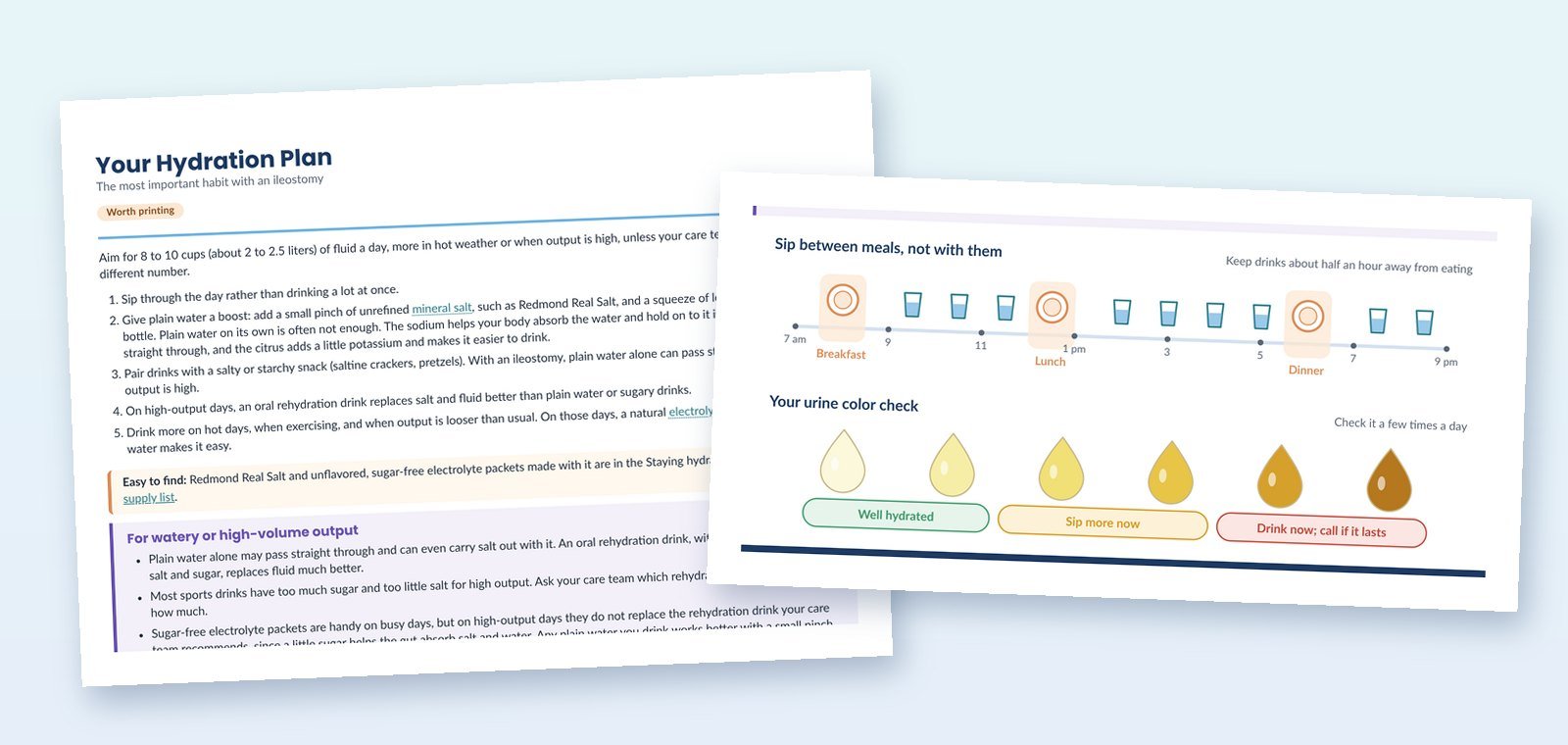
- A sip-between-meals rhythm set to your day
- A urine color check to keep close
- A 7-day fluid check, so your pattern shows up on paper
Answer a few questions and see your Confidence Score and top 3 priorities before you decide anything. Staying hydrated is already ticked for you. See more sample pages
Why are the first weeks after surgery the riskiest time?
Research on people with a new ileostomy keeps finding the same pattern: dehydration is one of the most common reasons for going back into hospital in the first weeks after surgery.
How often dehydration leads back to hospital
From Paquette et al., Diseases of the Colon and Rectum, 2013 and Loria et al., Colorectal Disease, 2022
Three parts of daily life are in motion in those weeks:
- Output is often higher and less predictable while the bowel adjusts
- Appetite may be low
- You are learning your new routine
It can be tempting to drink less to slow how fast the pouch fills, especially while emptying feels new and tiring. That can backfire, because output keeps coming whether you drink or not. Steady sipping is the safer path.
From 14 years of conversations with ostomates
When people talk about the first week home, one piece of guidance stands out for anyone with a new ileostomy: stay alert to dehydration. Unusually high output, dizziness, dark or reduced urine and growing weakness are reasons to call your care team promptly, not to wait and see.
If you are in those early weeks, your first 30 days with an ostomy covers the rest of the basics gently, one day at a time. The United Ostomy Associations of America also keeps a helpful ileostomy information page, including a guide to living with an ileostomy.
What should you drink when water seems to pass straight through?
The goal is fluid your body can hold on to, and a few simple shifts make a clear difference.
Sip through the day
Small, steady sips from morning to evening tend to stay with you better than large glasses all at once. A bottle within reach, by your chair, bed or desk, turns sipping into a habit. Ask your care team what daily fluid goal fits you, since needs vary with your output, your body and your health.
Pair drinks with a salty or starchy snack
Salt helps your body hold on to the water you drink. If salt is allowed for you, a few crackers or pretzels, a cup of broth or some salted potatoes alongside a drink help it count for more. Starchy foods such as crackers, toast and white rice can also help thicken output.
Ask about an oral rehydration drink
An oral rehydration drink has a balance of salt and sugar that helps the small bowel absorb water. Many people with an ileostomy do better with one than with water alone, especially on high-output days. Ask your care team which one they recommend and how much to take, and keep some at home before you need it.
What is in the glass
Sports drinks are a different kind of drink, and many carry more sugar and less salt than an ileostomy needs. Juice, soda and other sweet drinks can also loosen output for some people.
Coffee is a good example of how individual this is. Some ostomates say their morning coffee makes their stoma much more active, while others drink it without any trouble.
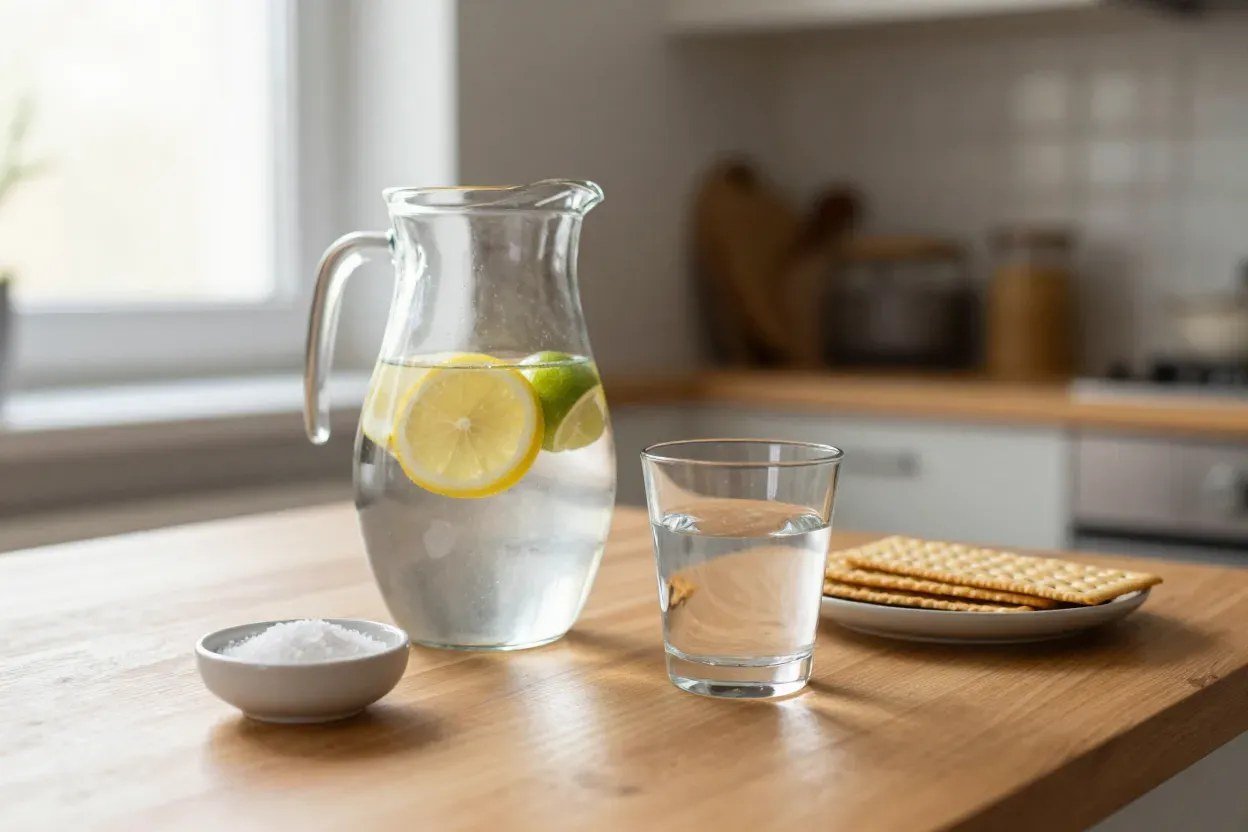
Soups and broths count toward your fluids too, and they bring salt with them. For a deeper look at fluids on high-output days, the guide to high-output ostomy hydration includes an output tracker.
Two small helpers make sipping through the day easier to keep up. A glass bottle with measurement marks shows your daily goal at a glance, and by mid-afternoon you know whether you are on pace. If your care team agrees extra electrolytes would help, a few drops of a sugar-free add-in bring sodium, potassium, magnesium and chloride to any drink. It works alongside your care team’s plan, not in place of an oral rehydration drink they recommend. Anyone told to limit salt, or living with a heart or kidney condition, should ask their care team first.
KIVY Glass Water Bottle with Measurements
 View on Amazon
Borosilicate glass with measurement marks and a protective sleeve, which makes a daily fluid goal easy to see.
elete Electrolyte Add-In
 View on Amazon
A few drops add sodium, potassium, magnesium and chloride to any drink, with no sugar. Anyone told to limit salt should ask their care team first.
As an Amazon Associate, Stoma Stifler earns from qualifying purchases. Disclosure
Which foods help thicken ileostomy output?
Thicker output usually means more water is staying in your body. Some foods are known for gently thickening ileostomy output, and they are good to keep on hand for looser days.
Seven foods that gently thicken output
In support-group discussions, one person swears by bananas for thicker output, while another finds they make almost no difference. Bananas and potatoes come up again and again as foods that are easy to tolerate.
Bodies differ. Try one food at a time and notice what it does for you. Smaller meals more often can also help keep output steadier.
Chew slowly and well, since some foods, such as popcorn, nuts, mushrooms, raw vegetables and certain fruit skins, can cause a blockage with an ileostomy, especially in the early months.
If output stays high even with these changes, your care team has other options, including medicine that can slow output. Take only what they advise. The ileostomy diet guide walks through foods stage by stage as you heal.
Tracking a few days of what goes in and what comes out
When you feel drained and unsure, a few days of simple notes turn guesswork into a pattern. They also give your care team exactly what they need if you call.
- 1Each drink
- 2Each time you empty
- 3Urine color
- 4How you feel
- 5Look for patterns
- 6Share your notes
- Each time you drink, jot down roughly how much and what it was.
- Each time you empty the pouch, note the time and whether output was thick, loose or watery.
- Note your urine color two or three times a day: pale, darker or dark.
- Add a word or two on how you feel: fine, thirsty, dizzy, crampy or tired.
- After three or four days, look for patterns, such as watery afternoons after certain drinks or darker urine on busy days.
- Share your notes with your care team or ostomy nurse, especially if signs keep returning.
A page of notes, ready to fill in
A notebook by the bathroom or a note on your phone works well. If your care team asked you to measure output, use the method they showed you.
From 14 years of conversations with ostomates
One of the most practical habits ostomates recommend is a simple diary. A few lines a day about food, drinks and output show what your body is telling you far sooner than memory can.
What teaching, a rehydration drink and follow-up changed
The Hydration Plan in My Ostomy Blueprint turns notes like these into a 7-day fluid check, alongside a urine color check and a sip-between-meals rhythm. See your top 3 priorities
Why do heat, exercise and illness raise your fluid needs?
On hot days, during exercise and when you are unwell, your body loses extra water and salt through sweat, fever or vomiting, on top of what leaves in your output. With an ileostomy, that extra loss adds up faster.
Three ways water and salt leave
- Start sipping before you head out on a warm day, and carry a bottle with you.
- Drink before, during and after exercise, and add a salty snack afterward if salt is allowed for you.
- Keep your recommended oral rehydration drink on hand in summer and when traveling.
- If you have a stomach bug, a fever or vomiting, call your care team early, because fluids can drop quickly.

Movement belongs in your life. Once your surgeon clears you, exercise after ostomy surgery explains how to build back gently. Planning a trip? Traveling with an ostomy covers packing and fluids on the road.
When should you call your care team, and when should you get help now?
Knowing where the line sits takes a lot of fear out of the moment. Keep this list on the fridge or saved on your phone.
Call your care team today if you notice
- Dark urine, or passing only a little urine
- Dizziness or light-headedness when you stand
- Cramps, a headache or unusual tiredness that do not ease with extra fluids
- Output that is higher or more watery than usual and is not settling
- Thirst and a dry mouth that keep coming back despite steady sipping
Get help right away if
- You cannot keep fluids down
- Your output stays high and watery for hours
- You pass little or no urine for 8 hours or more
- You feel confused or faint, or you pass out
- Your heart is racing or beating fast
If you feel faint or confused, or your heart is racing, call emergency services (911 in the United States) rather than driving yourself. Tell the staff you have an ileostomy, and bring your notes if you can.
Separately, no output at all for several hours along with cramps and swelling can be a sign of a blockage, which also needs prompt help. The guide to ostomy blockage explains those signs. Calling early is always a sound choice. Dehydration is easiest to turn around when it is caught soon.
Is it normal to feel scared after a dehydration scare?
Yes. Realizing your body slipped behind, even while you were trying so carefully, can shake your confidence. You may find yourself watching every sip and every pouch. That reaction is common, and it tends to soften as you learn your own signals.
One man came home alone after emergency surgery and emptied his pouch by himself for the first time that night. It turned into a mess, and he became so overwhelmed that he cried, then shared his fears online. Experienced ostomates answered with their own challenging beginnings, and he later came back to thank them for helping him feel less alone.
Challenging first weeks do not predict a challenging life. Each time you notice a sign and act on it, you build the skill that keeps you well. With practice, checking your urine color and sipping through the day can become as ordinary as brushing your teeth.
- 1Notice a sign
- 2Act on it
- 3Learn your own signals
- 4It becomes routine
From 14 years of conversations with ostomates
Many of the experienced ostomates who now reassure newcomers once stood in their own bathrooms feeling overwhelmed, wondering how they would ever manage. Feeling shaken today says nothing about how capable you will become.
If you live alone or care for someone
Living alone
If you live alone, it can feel easier to wait and see than to ask for help. Reach out anyway. Ask a friend or neighbor to check in by phone on high-output days, and keep your care team’s number in sight.
Caring for someone
If you care for someone with a new ileostomy, keep their bottle filled and within reach, help with the daily notes, and watch for confusion or unusual sleepiness, which the person may not notice in themselves.

Share what helped you stay hydrated
If you have lived through a dehydration scare with an ileostomy, or helped someone through one, what you learned could steady the next person who feels drained and confused. Email info@stomastifler.com with the drink, snack or habit that helped, or what you wish you had known sooner. Stories are shared only without your name, to help someone just starting out.
Research that backs up this guidance
Dehydration is common in the first weeks after a new ileostomy, it is a leading reason for going back into hospital, and it can strain the kidneys. One large review of 22 studies found it more than three times as likely after a diverting ileostomy, a temporary ileostomy made to protect a healing join lower in the bowel.
The hopeful part is how much of this can be prevented. Hospitals that added teaching, an oral rehydration drink, tracking of output after discharge and early nurse follow-up saw far fewer dehydration readmissions. A 2026 review found that oral rehydration drinks support hydration after an ileostomy, while calling for clearer standard plans.
| What the research found | Source |
|---|---|
| Among 201 people whose surgery included a new ileostomy, 17 percent went back into hospital within 30 days for dehydration or kidney failure. | Paquette et al., Diseases of the Colon and Rectum, 2013PubMed ID 23838866 |
| Of 262 people with a new ileostomy, about one in five had a sudden drop in kidney function during their surgery stay, and 11 percent went back into hospital with dehydration, with high output among the predictors. | Loria et al., Colorectal Disease, 2022PubMed ID 34536959 |
| A review of 22 studies of bowel cancer surgery, covering more than 19,000 people, found dehydration more than three times as likely with a diverting ileostomy, linked to kidney injury and, in some studies, longer-term decline in kidney function. | Borucki et al., Colorectal Disease, 2021PubMed ID 33783976 |
| After a hospital added stoma care teaching and structured follow-up with a hydration scale after discharge, dehydration readmissions fell from 22 percent to 2 percent, and higher output before discharge was the strongest predictor. | Ozata et al., International Journal of Colorectal Disease, 2024PubMed ID 39243310 |
| Giving people with a new ileostomy an oral rehydration drink plus nurse-led visits that reviewed fluids in and output out cut emergency visits and readmissions for dehydration and kidney injury, and overall readmissions fell from about 24 to 11 percent. | Westfall et al., Diseases of the Colon and Rectum, 2024PubMed ID 37703205 |
| A scoping review of 6 studies found that oral rehydration drinks appear to improve hydration and reduce complications after an ileostomy, and called for standard, evidence-based regimens. | Hoeg et al., Journal of Parenteral and Enteral Nutrition, 2026PubMed ID 41508901 |
What this means for you: dehydration with an ileostomy is common, and it is also one of the most preventable reasons for going back to hospital. Steady sipping, the rehydration drink your care team recommends, a few days of simple notes and an early call when signs appear mirror what helped in these studies.
This article covers what most people share. My Ostomy Blueprint is one plan written from your answers, and it goes further:
- A sip-between-meals rhythm
- A 7-day fluid check with a urine color check
- Foods that may thicken your output
Plus everything else you ask for help with, from food and hydration to sleep and travel, in one place.
Build My BlueprintFrequently asked questions
Why can you get dehydrated with an ileostomy even when you drink a lot of water?
Your colon used to absorb much of the water and salt from digested food. With an ileostomy, output leaves before reaching it, and more water and salt are lost. Plain water carries almost no salt and can pass straight through. Many people do better sipping through the day, pairing drinks with a salty or starchy snack where salt is allowed, and using an oral rehydration drink their care team recommends.
What are the first signs of dehydration with an ileostomy?
Early signs include thirst, a dry mouth, darker urine, passing less urine than usual and a headache. Dizziness when you stand, cramps, unusual tiredness and high, watery output mean your body is running lower. Act on early signs with steady sips and a rehydration drink, and call your care team the same day if dizziness, cramps or dark urine appear.
What is the best drink for dehydration with an ileostomy?
For many people, an oral rehydration drink their care team recommends works better than plain water, because it replaces water and salt together. Sports drinks, juice and soda are not the same, and they can carry more sugar and less salt than you need. Broth and soups help too. If you have been told to limit salt, or have a heart or kidney condition, follow your care team’s advice.
When should you go to the hospital for dehydration with an ileostomy?
Get help right away if you cannot keep fluids down, your output stays high and watery for hours, you pass little or no urine for 8 hours or more, or you feel confused or faint or notice a fast heartbeat. If you feel faint or confused, call emergency services rather than driving. For dark urine, dizziness or cramps, call your care team the same day.
Last updated November 2026. Written from 14 years of conversations with people living with an ostomy and the people who care for them.