

If you have ever counted your last few wafers the night before a holiday weekend, you know the particular panic of running out of ostomy supplies. A handful of habits keeps the shelf full, and the tool below shows where you stand today and which calls to make first.
A full shelf, in short
- A one-page supply record anyone at home can use
- Two weeks on hand, counted in changes
- Reorder when you open your last box
- Who to call if you are about to run out
The guide also covers insurance limits, switching suppliers, storage and travel.
How close are you to running out of ostomy supplies?
At a glance
| Keep on hand | At least two weeks of supplies, counted in changes |
|---|---|
| Reorder | When you open your last box, not your last wafer |
| Write down | Manufacturer, product numbers, sizes, supplier contact and order dates |
| Insurance | Many plans set monthly limits. Ask your supplier what yours covers and what paperwork you need for more |
| In a pinch | Your hospital’s ostomy nurse, local medical supply stores, some pharmacies and manufacturer samples |
| Store | Cool and dry, away from heat, sunlight and hot cars |
| Travel | Pack double, split between at least two pieces of luggage, including your carry-on |
Pull up a chair
There’s a seat saved for you in a private Facebook group where ostomates and caregivers trade what works.
Members share how often they change, how they keep count of supplies and how they reorder before running low.
Pull Up My ChairPrivate group. Ask the questions you’d rather not ask out loud, even anonymously. Only members see what you share.
When counting your last few wafers feels heavy
Supplies are not just boxes on a shelf. They are what stand between you and leaving the house, sleeping through the night or saying yes to a weekend away. So when the stack gets thin, every change starts to feel rationed.
Part of the strain is how many pieces sit outside your control. Some people discover that insurance approvals, prescription requirements and delivery schedules are more complicated than they expected. Holidays slow everything down, and a supplier who does not call back can turn an ordinary Tuesday into a countdown.
One caregiver described being overwhelmed by the process of getting supplies for her husband. In support groups, obtaining supplies is one of the concerns caregivers raise most often, alongside pouch changes and leaks.
Caregivers also describe the nights that drain them most: supplies scattered around the house, nobody sure when the wafer was last changed, and a leak in the middle of the night that ends with the discovery that an essential product has run out.
The encouraging part is that this is one of the most fixable stresses in life with an ostomy. It takes a few habits that do the remembering for you, so your mind can rest.
What should go in your ostomy supply record?
A written supply record is the most useful page you can make this week. When a supplier asks for a product number, when a family member steps in, or when you call a pharmacy in a pinch, everything you need is on one page instead of in your head.
- Manufacturer and product name, exactly as printed on the box.
- Product numbers(reference or catalog numbers), since one maker can sell dozens of similar wafers.
- Sizes: your stoma measurement, the wafer size (cut-to-fit or pre-cut) and the pouch size.
- Accessories, such as barrier rings, adhesive remover or disposal bags, with their numbers.
- How many you usein a typical week or month.
- Supplier contact: company, phone number, account number and the best time to call.
- Order dates: ordered, shipped and arrived, plus who you spoke with.
- Prescription details: who prescribes your supplies and when it needs renewing.
An easy start is to photograph each product label with your phone, then copy the details onto a page kept where everyone in the household can find it. Update it whenever your stoma size or products change, which is common in the first weeks after surgery as swelling goes down. If you are building your kit, the ostomy supply list groups the everyday extras by the concerns they help with.
Caregivers describe how exhausting it is to keep track of which products to order, which adhesive remover works and how often to change the wafer. An organized record turns that weight into something anyone in the family can pick up.

My Ostomy Blueprint keeps your supplies on one page with a wallet card and a hospital care sheet, and adds a shopping list picked from your answers with one-tap links. See your top 3 priorities
How many ostomy supplies should you keep on hand?
Aim to keep at least two weeks of supplies on hand at all times. That buffer absorbs what goes wrong: a late shipment, a holiday closure, a stretch of leaks or a prescription that needs renewing before the next box can ship.
Count your two weeks in changes, not boxes
Boxes hold different amounts, so think in changes. If you change your wafer every three days, two weeks is about five changes.
If you change every five days, it is about three. With a two-piece system, count pouches separately, since you may go through them faster than wafers.
Two weeks of supplies, counted in changes
Order when you open your last box, not your last wafer
This one habit does most of the work. The moment you break the seal on your last box, place the next order. With a two-week buffer behind it, the new box arrives while you have changes left.
Order at the last wafer
The new box sits in a warehouse while you ration changes and watch the mail.
Order at the last box
The new box arrives while you have changes left, and the two-week buffer stays whole.
Leaks change the math fast. Many people leave the hospital with one pouching system, and when it starts leaking they add tape, add adhesive or change more often, without realizing the pouch itself may not be the best fit for their body. That burns through supplies and patience.
If you are changing more often than your nurse planned, call your ostomy nurse rather than ordering more tape. The guide to ostomy pouch leaks covers what helps.
How do insurance limits on ostomy supplies work?
Many insurance plans set a monthly limit on how many wafers, pouches and accessories they cover. Plans may also require a current prescription and a supplier in their network. The details vary from plan to plan, so the most useful step is to ask directly instead of guessing.
Call your supplier or your insurance plan and ask:
- How many of each item your plan covers per month
- Which suppliers are in your plan’s network
- What paperwork is needed if you need more than the usual amount, for example during a stretch of leaks or skin problems
- When your prescription needs renewing, and who sends it
- How early in the month you can reorder
If you need more than your plan usually allows, your supplier may ask for documentation from your doctor explaining why. For every call, write down the date, the name of the person you spoke with and what they said. It saves retelling the story and gives you something solid to point to if an order goes missing.
Supply and insurance calls are a wonderful job to hand off: one relative taking charge of insurance calls and supply orders can lift an enormous amount of pressure. UOAA’s product and supply information page explains the main kinds of suppliers and notes that you can change suppliers, insurance permitting.
 A peek inside
This is what Supplies and Wallet Card looks like: a shopping list picked from your answers, a supply record and a wallet card.
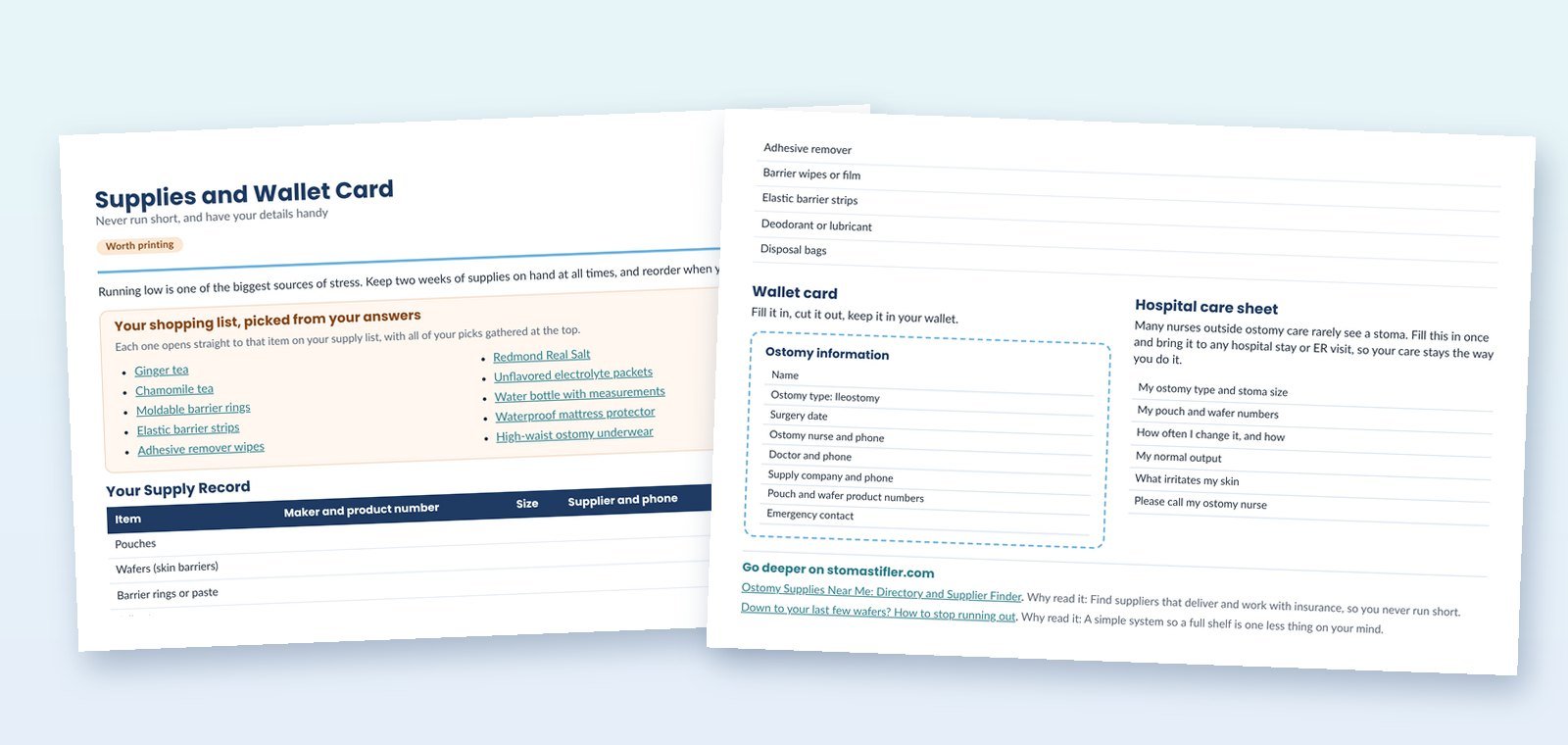
- A shopping list picked from your answers, one tap per item
- A supply record with every product number in one place
- A wallet card and a hospital care sheet
Answer a few questions and see your Confidence Score and top 3 priorities before you decide anything. See more sample pages
Calendar reminders that remember for you
Your mind already carries enough. Let a calendar on your phone or the wall hold the dates instead.
Reminders that remember for you
- Order dayA repeating reminder on the day you usually reorder.
- Has it shipped?A reminder three or four days after ordering, to check for a tracking number.
- Prescription renewalA few weeks before it runs out, so the doctor’s office has time.
- Shelf checkA quick monthly count, compared with your record.
- Holidays and tripsTwo weeks ahead, to order early while suppliers and offices are open.

People going through treatment have described planning around the days they know will be challenging. Before those days, they organize their ostomy supplies, prepare meals and finish essential tasks while they have the energy. The same thinking works for holidays: do the supply work before the slow days arrive.
What can you do if you run out of ostomy supplies?
If you are down to your last change or two, take a breath. There are more places to turn than most people realize, and you do not have to solve it all with one call.
- Call the ostomy nurseat the hospital where you had surgery, or your surgeon’s office, and say plainly that you are about to run out. They may have a few pieces to tide you over or know where to get them.
- Call local medical supply stores and independent pharmacieswith your product numbers. Some keep common ostomy products in stock or can order them.
- Ask your supplier for the fastest shippingthey offer, and a tracking number.
- Call the manufacturer’s customer lineand ask for samples of your products. They take a few days, so they help with the days ahead rather than tonight.
- Ask a local support groupSome UOAA-affiliated groups run donation or supply closets.
UOAA keeps a page of emergency supply resources, including asking local hospitals, visiting nurse associations and clinics whether they keep a donation closet, and dialing 2-1-1 to find help in your area.
If a leak starts and you are almost out
Do not tape over a leak and leave it. Output sitting on the skin makes it sore, and sore skin leads to even more changes. Use your next wafer if you have one. If you are completely out, call your ostomy nurse or your surgeon’s after-hours line and ask where to go.
When is it time to switch ostomy suppliers?
You have options. You can change suppliers, insurance permitting, and the pouching system you went home with is not the only one you can use. It may be time to look elsewhere if you notice a pattern like this:
- Orders arrive late more than once, or arrive with the wrong items or sizes.
- Calls and messages go unanswered for days.
- No one can tell you clearly what your plan covers or why an order is on hold.
- You cannot get the products or sizes that work for your body.
Before you switch, ask your ostomy nurse or insurance plan which suppliers they work with, and check that the new one is in your plan’s network. A new supplier will usually need your prescription and insurance details. Place one last order with the old supplier, or make sure the new one can ship before you drop below your two-week buffer. The guide to finding ostomy supplies near you covers local options too.
How should you store ostomy supplies?
Wafers rely on adhesive, and adhesive does not like heat or humidity. Store your supplies in a cool, dry place, away from direct sunlight, radiators and heaters. A closet shelf usually works better than a steamy bathroom cabinet.
- Do not keep your stock in a car for long. Heat can damage some ostomy products, so carry what you need for the day and bring it back inside.
- Keep products in their original boxes, so the product number and expiration date stay with them.
- Use the oldest box first, and check dates when a new order arrives.
- Keep one complete change set aside as an emergency kit, separate from your everyday stock.
Many people keep the next few changes in one spot they can see and the rest on a shelf, so a glance tells you how many are left and your record tells you when to order.
Two small helpers make that glance easier. A clear standing case stays open on the counter, so every piece of your next change is in sight and you notice right away when it is time to open the last box and place the next order. Adhesive remover belongs on your supply record too, and Safe n’ Simple wipes, from an independent, family-run maker in Michigan, loosen the wafer so it lifts off gently, without pulling the skin.
LISINUO Clear Standing Toiletry Bag
 View on Amazon
A clear case that stands open on the counter, so every piece of a change kit is in sight.
Safe n’ Simple Adhesive Remover Wipes
 View on Amazon
Loosens the wafer so it lifts off gently, without pulling the skin. Safe n’ Simple is an independent, family-run maker in Michigan.
As an Amazon Associate, Stoma Stifler earns from qualifying purchases. Disclosure
How many supplies should you pack for a trip?
Pack double what you expect to use. Travel brings heat, new food, long days and delays, and any of them can mean an extra change. Split your supplies between at least two pieces of luggage, including your carry-on, so a lost suitcase does not leave you without.
- Cut wafers to size at home before you leave. For domestic flights in the United States, UOAA notes that scissors are allowed in carry-on luggage if the cutting edge is no longer than 4 inches.
- Bring a copy of your supply record, so a pharmacy or supply store far from home can match your products.
- Keep supplies out of hot cars and direct sun along the way.
UOAA’s air travel tips walk through airport screening, and the guide to traveling with an ostomy and the packing list in the Stoma Stifler printables help with the rest.
The calm of a full shelf
There is a particular quiet that comes from opening the closet and seeing enough. You stop counting. You say yes to the weekend away. A supplier’s slow week becomes an inconvenience instead of a crisis.
Many experienced ostomates say they carry emergency supplies for years and rarely need them. One person explained that after four years of living with an ostomy, they had not once needed to change their entire appliance while out. The supplies themselves were not the point. Knowing they were there was.

That is what a supply record, a two-week buffer and a few reminders give you at home: not just boxes, but room to breathe. If you are in your first 30 days with an ostomy, setting these habits up now means the months ahead start steadier.
From 14 years of conversations with ostomates
The people who stop counting wafers tend to have done three simple steps. They set up a reliable supplier early, they kept a reasonable backup on the shelf, and they wrote their product numbers down once, where anyone could find them. When something kept going wrong, such as leaks eating through their supplies, they called their ostomy nurse early instead of quietly ordering more tape.
Your supply lesson could steady someone else
If you have found a rhythm that keeps your shelf full, or learned something the long way about suppliers, insurance or a holiday weekend, share it by email at info@stomastifler.com. Stories are shared only without your name, to help the next person counting their last few wafers.
Research that backs up this guidance
Research backs up what ostomates describe: supplies are a steady, ongoing cost, and pouch problems make that cost climb. In a Canadian survey, most people spent more than $1,000 a year on supplies and more than half paid part of it themselves, while those who turned to a specialized ostomy nurse when problems came up spent significantly less.
Leaks are the other half of the story. Leakage was the most common stoma problem even years after surgery, and skin problems from leaks raised the cost of care. Support helps too: self-management training was linked to fewer in-person visits.
| What the research found | Source |
|---|---|
| In a survey of 467 Canadians living with an ostomy, 76% spent more than $1,000 a year on supplies and 58% paid part of the cost themselves, and those who sought help from a specialized ostomy nurse for problems spent significantly less on supplies. | LeBlanc et al., Journal of Wound, Ostomy and Continence Nursing, 2019PubMed ID 31651800 |
| Among 2,262 long-term rectal cancer survivors living with a stoma, leakage (58%) was the most common stoma problem, and leakage, odor, skin problems and frequent appliance changes were all linked with feeling restricted in daily life. | Krogsgaard et al., Supportive Care in Cancer, 2022PubMed ID 35930059 |
| Applied to data from more than 3,000 people with a stoma, a cost model found that skin problems around the stoma raised the cost of care, including appliances and accessories, and that more frequent leakage pushed that cost higher. | Meisner et al., PLoS One, 2012PubMed ID 22679479 |
| In a randomized trial with rural cancer survivors in the United States, a five-week, peer-led telehealth self-management program was linked to fewer in-person nurse and doctor visits right after the sessions. | Maeng et al., The Journal of Rural Health, 2025PubMed ID 41383087 |
What this means for you: A full shelf comes from a few calm habits: a written record, at least two weeks on hand, reordering when you open your last box, and calling your ostomy nurse early when leaks start using up supplies faster than planned. Each one protects your skin, your budget and your peace of mind.
This article covers what most people share. My Ostomy Blueprint is one plan written from your answers, and it goes further:
- A supply record, wallet card and hospital care sheet
- A shopping list picked from your answers
- Your emergency kit, laid out piece by piece
Plus everything else you ask for help with, from food and hydration to sleep and travel, in one place.
Build My BlueprintFrequently asked questions
How far ahead should you order ostomy supplies?
Order when you open your last box, not when you reach your last wafer, and keep at least two weeks of supplies on hand at all times. Before holidays or trips, order a week or two earlier than usual, since suppliers, shipping and doctors’ offices often slow down. If your supplier needs a new prescription, ask your doctor’s office to send it the same day you order.
Can you buy ostomy supplies at a pharmacy?
Some pharmacies, often independent ones, keep common ostomy products in stock or can order them, and local medical supply stores may carry them too. Call ahead with your manufacturer, product numbers and sizes so they can check before you make the trip. For regular orders, many people use a medical supply company or a mail-order supplier that works with their insurance plan.
What if you need more ostomy supplies than your insurance covers?
Many plans set monthly limits, and some will cover more when there is a documented medical reason, such as a stretch of leaks or skin problems. Ask your supplier exactly what paperwork is needed, often a note or updated prescription from your doctor. If you regularly need more, see your ostomy nurse too, since a better fit can mean fewer changes.
Do ostomy supplies expire?
Yes. Many wafers and pouches have an expiration date printed on the box, and the adhesive can lose its hold with age, heat and humidity. Keep products in their original boxes, store them somewhere cool and dry, and use the oldest box first. If an older wafer does not stick the way it should, set it aside and use a fresh one.
Last updated November 2026. Written from 14 years of conversations with people living with an ostomy and the people who care for them.