

Ostomy pouch ballooning often shows up at night: you wake to a pouch puffed up like a balloon under the covers, or to output (what comes out of the stoma) packed at the top, and lie there embarrassed and tired. Ballooning and its cousin, pancaking, are among the most common pouch troubles, and the tool below finds the likely cause of yours from your own answers.
Ballooning and pancaking, in short
- Ballooning: gas fills the pouch faster than the filter lets it out
- Pancaking: the sides of the pouch cling together and output stays at the top
- Both have clear, practical causes you can work with
- Small evening habits and a simple bedtime routine bring calmer nights
If this sounds familiar, you are in good company. This guide also covers when to call your ostomy nurse.
What is making your pouch balloon or pancake?
At a glance
| The feeling | Embarrassed, worn out and on edge at night when the pouch puffs up or output gathers at the top |
|---|---|
| Ballooning | Gas filling the pouch faster than the filter can let it out |
| Pancaking | Output stuck at the top because the sides of the pouch cling together |
| Common causes | Swallowed air, gassy foods, late meals, a wet or blocked filter, thick output |
| First steps | Empty before bed, release gas where your pouch allows it, keep the filter dry, eat your biggest meal earlier |
| For pancaking | A few drops of lubricating deodorant, or a little air left in the pouch |
| Call your nurse | Leaks most nights, sore or broken skin, or no output with cramps and swelling for several hours |
Pull up a chair
There’s a seat saved for you in a private Facebook group where ostomates and caregivers trade what works.
Members compare the filters, pouch tricks and timing that help when ballooning or pancaking shows up.
Pull Up My ChairPrivate group. Ask the questions you’d rather not ask out loud, even anonymously. Only members see what you share.
What is ostomy pouch ballooning, and why does it happen at night?
Ballooning is gas filling the pouch faster than the filter can release it. The pouch puffs up, presses against your clothes or the sheets, and pulls at the seal. The gas comes from two places: air you swallow, and gas your gut makes as it digests food.
The parts of a pouch
What happens after dark
Several causes line up after dark.
- An evening meal is being digested while you sleep.
- Lying flat lets output move up toward the filter, where it can wet or clog it.
- And because you are asleep, the pouch can fill for hours before you notice.
Many new ostomates describe lying awake wondering whether the pouch will fill up, whether they will roll onto it, or whether it will leak while they sleep. Some check it again and again through the night. Others say they began sleeping far better once they settled into an emptying routine and found a pouch that suited them.
Ballooning and pancaking happen with colostomy and ileostomy pouches, which collect stool. Urostomy pouches collect urine and work differently.
Why does a ballooning pouch feel so embarrassing?
Little feels as private as a pouch that suddenly puffs up.
In daylight
By day you may picture it showing through your shirt.
After dark
At night it can mean broken sleep, a partner who stirs when you get up, and a tired dread about the morning laundry.
Because an ostomy has to do with waste, people often feel an embarrassment they would not feel about a heart condition, and these conversations rarely flow freely outside ostomy groups. So many people keep ballooning to themselves and assume they are the only one.
How common it is
First figure: Nugent et al., Diseases of the Colon and Rectum, 1999. Second and third figures: Perrin et al., British Journal of Nursing, 2013.
One man, home alone after two weeks in the hospital, emptied his colostomy pouch by himself for the first time that night. It turned into a mess, and he ended up in tears. When he shared it online, other ostomates answered with their own messy beginnings and how much easier it all became. He later came back to thank them for helping him feel less alone.
A messy night is part of learning to live with an ostomy. Ballooning is common and well understood, and each cause has steps that help.
Some people even meet it with humor, naming their stoma and gently telling it to settle down when it gets noisy. Others carry on. Both are fine.
If sound keeps you on edge too, see what makes a stoma so loud.
What is pancaking, and why does output stay at the top?
Pancaking often shows up in the same pouch as ballooning. Instead of dropping to the bottom, output stays at the top, gathering around the stoma in a flat layer like a pancake. From there it can push under the wafer, which leads to leaks and sore skin.
Sliding down, and pancaking
The cause is a vacuum. When there is almost no air inside the pouch, its front and back cling together, and output has no room to slide down. It tends to happen when the filter works too well and pulls out nearly all the air, or when output is thick and pasty. Lying down makes it more likely, because gravity is no longer helping.
- 1Almost no air inside
- 2Front and back cling
- 3No room to slide down
- 4Output gathers at the top
Signs pancaking is reaching your skin
- Itching or burning under the wafer
- A damp feeling or an unexpected odor around the seal
- A wafer that keeps lifting at the top edge
- Red, sore skin around the stoma when you change
These signs can mean output is getting underneath the wafer. Change the pouch sooner rather than later, and see a simple routine for the skin around the stoma for gentle care between changes.
 A peek inside
This is what a Leak Plan looks like: the causes in order for where your leaks start, built from your own answers.
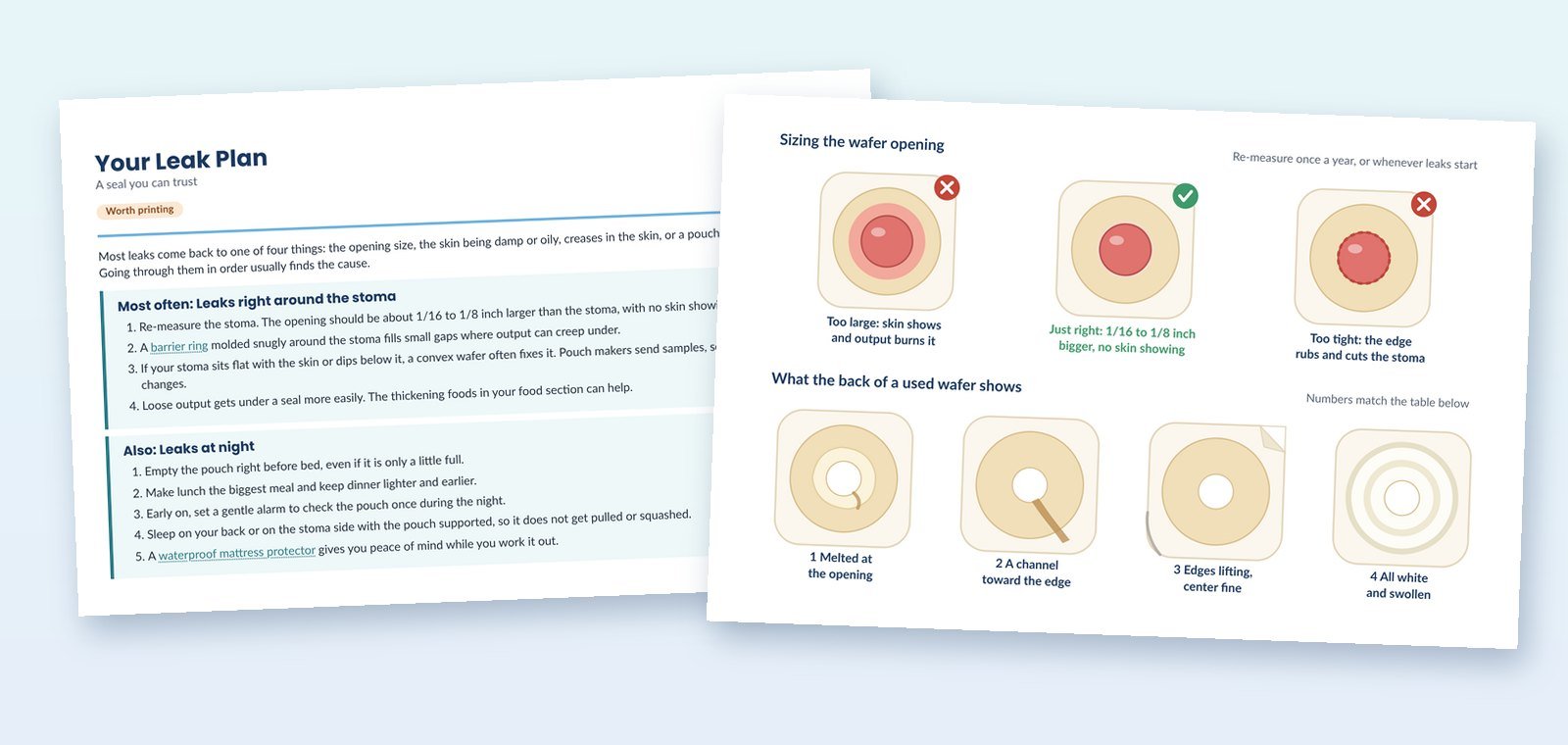
- The leak causes in order for where your leaks start
- Steps for leaks at night, if that is when yours happen
- Sketches that show what the back of your used wafer is telling you
Answer a few questions and see your Confidence Score and top 3 priorities before you decide anything. Ballooning or pancaking is already ticked for you. See more sample pages
How can you swallow less air and make less gas?
Swallowed air is one of the most common causes of a ballooning pouch, and often the easiest to change. With a bowel stoma, much of the air you swallow ends up in the pouch.
Habits that let extra air in
- Drinking through straws, which pulls air down with each sip.
- Fizzy drinks, including soda, sparkling water and beer.
- Chewing gum, which keeps you swallowing air as you chew.
- Eating fast or talking while you eat, which sends gulps of air down with your food.
- Smoking, which makes you swallow air with each puff.
Try changing one habit at a time for a week and watch how the pouch behaves. Sitting down to eat, taking smaller bites and chewing well also eases gas.

Foods that make more gas
Some foods produce more gas as they digest.
The foods ostomates mention most
One person described eating a salad for the first time in years. Nothing unusual happened, apart from some extra gas.
You do not have to give up the foods you love. Keep a simple food diary for a couple of weeks, noting what you ate and how the pouch behaved that night, and patterns usually become clear.
A simple food diary, for a couple of weeks
Many people move their gassiest favorites to lunch. Regular meals help too: some ostomates find their stoma gets noisier after long gaps without food.
Three guides for more on gas and food:
- Easing the embarrassment of colostomy gas: more on gas.
- Colostomy diet: food with a colostomy.
- Ileostomy diet: food with an ileostomy.
How do you keep the filter working and let gas out safely?
The filter lets gas out slowly and traps odor.
One filter, two outcomes
Keep the filter dry
Filters stop working once they get wet, whether from shower water, a swim or output splashing up. Many pouches come with small filter covers or stickers for exactly this. Put one on before you shower or swim, then peel it off afterward. If output often reaches the filter, tell your ostomy nurse, since a different pouch or filter may suit your output better.
- 1Cover on the filter
- 2Shower or swim
- 3Peel the cover off
If your pouch has no filter, ask your nurse whether one with a filter would suit you. It will not silence gas leaving the stoma, but it can make a pouch more comfortable.
Burping the pouch, where your pouch allows it
Letting gas out of the pouch is called burping it. How you do it depends on your pouch, so check its instructions or ask your nurse first.
Letting gas out, by type of pouch
Do not lift the wafer itself away from your skin to let gas out, and avoid poking a hole in the pouch. Both break the seal and let odor escape.
That sense that the pouch might pop is common. A tight, full pouch strains the seal, and it can lift the edge of the wafer or loosen a two-piece pouch. Releasing gas early, while the pouch is only slightly puffed, and emptying before bed take much of the edge off.
How do you stop pancaking?
Because pancaking comes from a vacuum, every helpful step brings back a little space or a little slip, so output can slide down.
A little space
Air left in a fresh pouch, or a filter cover for a while.
A little slip
A few drops of lubricating deodorant, and softer output from more fluids through the day.
Add a few drops of lubricating deodorant inside the pouch after emptying or when you put on a fresh one, and rub the outside gently to spread it. The slick film helps output slide down instead of collecting at the top.
Leave a little air in the pouch. Before applying a fresh pouch, open it and let some air in, or puff gently into it, so the sides do not cling together.
Try a filter cover for a while. Some people place one over the filter so a little air stays inside. Watch for ballooning, and find the balance that suits your output.
Ease output down by gently pressing it from the outside of the pouch when you notice it gathering at the top.
Soften thick output by drinking more fluids through the day, where your care team agrees. Thick, pasty output is the most likely to pancake. In the glass, a small pinch of unrefined mineral salt and a squeeze of lemon or lime help the body absorb the water and hold on to it (the citrus alone if you have been told to limit salt).
With an ileostomy, plain water is not always the whole answer for hydration, so ask your care team before making big changes. See hydration with a high-output ostomy for the basics.
What bedtime routine helps you sleep through the night?
Most of the relief comes from small, steady evening habits rather than one big change.
- 1Main meal at lunch
- 2Light, early supper
- 3Empty and burp
- 4A dry filter
- 5Night kit by the bed
Eat your biggest meal earlier. Make lunch the main meal when you can and keep supper lighter, finishing a few hours before bed, with gassy foods and fizzy drinks saved for earlier in the day.
Empty the pouch right before bed, and burp it over the toilet if your pouch allows, so you start the night flat and light.
Check that the filter is dry, and add a few drops of lubricating deodorant if pancaking is part of your nights.
Keep a small night kit by the bed: a spare pouch, wipes and a disposal bag, so a night change is calm and close at hand.
With an ileostomy, keep up your fluids through the day, and ask your care team how to balance evening drinks with staying hydrated rather than cutting back on your own. Some people with higher output also plan one emptying during the night.
From 14 years of conversations with ostomates
One bedtime pattern comes up again and again. While you are getting used to sleeping with your stoma, slip a waterproof protector under your sheets so the stress of staining the mattress is off the table. Make the last pouch change of the day in the evening, and avoid eating or drinking right before sleep, within the fluid plan your care team has given you.
Two gentle choices make this routine easier. Hollister Adapt Lubricating Deodorant is the natural answer to pancaking: a few drops in the pouch keep emptying fresh, and its water-based lubricant helps output slide down instead of collecting at the top. The Ruili bamboo waterproof mattress protector has a soft bamboo rayon top over a quiet waterproof backing that stays silent when you turn over, so a rough night means a sheet change, not a ruined mattress.
Hollister Adapt Lubricating Deodorant
 View on Amazon
A few drops in the pouch keep emptying fresh, and the lubricant helps output slide down instead of collecting at the top (pancaking). Water-based lubricating formula.
Ruili Bamboo Waterproof Mattress Protector
 View on Amazon
A soft bamboo rayon top over a quiet waterproof backing that stays silent when you turn over.
As an Amazon Associate, Stoma Stifler earns from qualifying purchases. Disclosure
When ostomates share the good moments, the first night they slept comfortably is often among them. For more on resting easy, see sleeping well with an ostomy.

If nights are when output reaches the seal, the Leak Plan in My Ostomy Blueprint gives you night leak steps and lists the causes in order for where your own leaks start. See your top 3 priorities
When should you call your ostomy nurse or care team?
Ballooning and pancaking are usually everyday troubles you can manage at home. Some signs mean it is time for help, and calling early is part of good care.
Call your ostomy nurse if
- Your pouch leaks or fails most nights, or the wafer keeps lifting despite these steps
- The skin around your stoma stays red, sore, broken or weepy
- Ballooning or pancaking keeps coming back however you adjust
Get medical help right away if
- There is no output, along with cramps and a swollen belly, for several hours, especially with an ileostomy, since these can be signs of a blockage
- You have nausea or vomiting with little or no output
- Your stoma turns dark red, purple, black or unusually pale
- You notice signs of dehydration, especially with an ileostomy: dark urine, dizziness, dry mouth, passing much less urine than usual, or cramping
- You have severe or worsening belly pain
A leaking pouch or damaged skin is a reason to ask for help, not something to put up with. Your stoma and belly can change shape over time, and another product may work far better. See what to do about an ostomy pouch leak.
A sudden stop in gas and output matters more than a pouch that puffs up. Learn the signs of an ostomy blockage so you can act with confidence if it ever happens.
Share what helped your nights
If you have found a way to calm ballooning or pancaking, your experience could help someone lying awake tonight. Email info@stomastifler.com with what happened and what finally helped. Stories are shared only without your name, to help the next person sleep a little easier.
Research that backs up this guidance
Research matches what ostomates describe. Ballooning has long been one of the most common pouch problems, especially with an ileostomy, and a recent review linked ballooning and odor with anxiety and lower quality of life. Pancaking is just as familiar to people with a colostomy, and many change their pouch more often to cope.
Nights and leaks carry weight too. People with frequent leaks felt more emotionally affected and less in control, and the feeling after a leak onto clothes can linger. The encouraging side is that filter design, food habits, the right products and support all help.
| What the research found | Source |
|---|---|
| A review of a decade of research found that stoma odor and pouch ballooning are frequent and linked with anxiety, low mood and lower quality of life, and that diet changes, the right products and emotional support help. | Xiu et al., Journal of Multidisciplinary Healthcare, 2026PubMed ID 41783599 |
| In a survey of 391 people with a stoma, 90 percent of those with an ileostomy reported ballooning, and leakage and skin rashes were also common problems. | Nugent et al., Diseases of the Colon and Rectum, 1999PubMed ID 10613475 |
| In a survey of people living with a colostomy, 82 percent were likely to experience some degree of pancaking, and 58 percent changed their pouch more often to manage it. | Perrin et al., British Journal of Nursing, 2013PubMed ID 26198184 |
| In the Ostomy Life Study 2019, people with frequent leaks felt more emotionally affected and less in control, and the emotional impact of a leak onto clothes appeared to last up to a year. | Jeppesen et al., British Journal of Nursing, 2022PubMed ID 35333558 |
What this means for you: embarrassment and broken nights over ballooning or pancaking are widely shared and well understood. Gentle changes to how and when you eat and drink, a dry filter, a little slip inside the pouch and a nurse who reviews your fit are the steps that help.
This article covers what most people share. My Ostomy Blueprint is one plan written from your answers, and it goes further:
- Steps for leaks at night
- Used-wafer sketches that show what each change is telling you
- Sleep guidance in Everyday Life
Plus everything else you ask for help with, from food and hydration to sleep and travel, in one place.
Build My BlueprintFrequently asked questions
Is it normal for an ostomy pouch to balloon at night?
Yes, it is common, especially with an ileostomy. Gas from the day’s meals keeps moving while you sleep, and lying flat can let output reach the filter and block it. Emptying before bed, eating your biggest meal earlier and keeping the filter dry usually help. If the pouch balloons or leaks most nights anyway, ask your ostomy nurse to review your pouch.
How do you burp an ostomy pouch?
It depends on your pouch. With a drainable pouch, open the outlet over the toilet, let the gas out, then wipe and close it. Some two-piece systems let you gently open a small section where the pouch meets the wafer. Closed pouches cannot be burped, so change them instead. Do not lift the wafer off your skin, and check your pouch’s instructions first.
What stops pancaking in an ostomy pouch?
Pancaking happens when the sides of the pouch cling together and output cannot slide down. A few drops of lubricating deodorant inside the pouch, or a little air left in a fresh pouch, usually helps. Thick output pancakes most, so drinking more through the day may help where your care team agrees. Leaks under the wafer or sore skin are reasons to call your nurse.
Does a wet filter cause ballooning?
Often, yes. Filters stop letting gas through once they get wet from shower water, swimming or output splashing up. Many pouches come with small filter covers or stickers to put on before you shower or swim and remove afterward. If output keeps reaching the filter, or your pouch has no filter, ask your ostomy nurse whether a different pouch would suit you better.
Last updated November 2026. Written from 14 years of conversations with people living with an ostomy and the people who care for them.