

The first time you sleep through the night with an ostomy without checking the pouch is the moment your nervous system starts to relax. Most ostomates hit it between night nine and night fourteen, but only if the right night routine is in place.
Last updated: October 2026
Sleep after ostomy surgery is its own challenge. The body wants rest. The brain wants to make sure nothing leaks. Both are reasonable. The trick is putting a routine in place that quiets the brain enough to let the body do its job.
This is the four-step Stoma Stifler night routine, plus the gear that makes leaks rare and the small mindset shift that helps you actually fall asleep instead of staring at the ceiling.

Step 1: Empty before bed (every time)
The single most powerful lever on overnight comfort is emptying the pouch right before you brush your teeth. Not after dinner. Not at 9pm. Right before bed, last thing.
This sounds obvious, most ostomates know it intellectually, but the night-after-night habit is what makes the difference. An empty pouch at 11pm gives you a clean six-to-eight hour runway. A half-full pouch at 11pm means you’re checking it at 3am.
If you’re an ileostomate with high overnight output, consider a slightly larger overnight pouch (an extended-wear or high-capacity option) to extend your runway. Talk to your stoma nurse about a night-specific appliance if your day pouch isn’t holding up.

Step 2: Position the pouch (down and to one side)
Pouch position matters more than most ostomates are taught. The two rules:
- Down, not up. Output should drain by gravity into the bottom of the pouch, not pool against the wafer. If you sleep on your back, position the pouch so it lies flat against your hip, not your belly.
- To the side opposite your stoma. If your stoma is on the right, sleep on your left side or your back, never on your right. Sleeping directly on the stoma compresses the wafer seal and is the leading cause of overnight leaks.
If you’re a side sleeper, this becomes a habit pretty quickly. Side sleepers on the stoma side often need a body pillow to reliably stay positioned overnight, see Step 3.
Step 3: The body pillow strategy
A long body pillow is the most underrated piece of ostomy sleep gear. Two roles it plays:
- Side-sleep support. Pillow between knees keeps the hips aligned and reduces the urge to roll onto the stoma side overnight.
- Pressure relief. Tucking it against the abdomen prevents you from accidentally pressing the pouch against the bed during back-sleep.
Long body pillows work; pregnancy pillows (the C-shaped or U-shaped ones) work even better because they wrap around you. If you sleep with a partner, this also creates a small physical buffer that prevents accidental compression while one of you turns.
Find My Stoma Stifler Setup
Step 4: Bed protection that doesn’t feel medical
The fear of leaks is what keeps most ostomates from sleeping. Solid bed protection short-circuits that fear, which short-circuits the insomnia.
The two-layer protection most ostomates land on:
- Waterproof mattress protector, the kind that fits under the bottom sheet, doesn’t crinkle, doesn’t make the bed feel like a hospital. Modern ones are basically invisible. Quality quiet mattress protectors are worth the spend.
- An older set of sheets you don’t mind. Or a designated “ostomy sheet” set that lives in rotation. The rotation matters because if a leak happens, you can strip and remake the bed in 5 minutes instead of staring at a 30-minute laundry problem at 3am.
That’s it. Two layers, both invisible to anyone but you, and the worry drops dramatically.
What to do when you wake up to a leak
It will happen at least once. When it does, the system you have determines whether it’s a 10-minute pause or a 90-minute spiral.
The 10-minute version:
- Grab the bedside 10-second-grab kit. Change the appliance in the bathroom.
- Pull off the soiled sheet and the waterproof protector layer (which kept the leak off the mattress). Throw both in the bathtub for the morning.
- Pull a clean sheet from the rotation pile, remake the bed, get back in.
Total time: 10 to 12 minutes. Most ostomates can get back to sleep right after.
The Stoma Stifler night-routine difference
The four-step routine above handles leaks. The other side of overnight comfort is sound, the rumbles and pops that wake you (and your partner) at 4am.
That’s the problem Stoma Stifler was designed for. The molded cup-and-band system absorbs the pressure-release moments that would otherwise be audible bursts through the stoma, converting them to silent dispersion. Most ostomates who add the kit report fewer overnight wake-ups within the first week, both for them and for their partner.
The full kit is at /product/stoma-stifler-includes/, molded cup, anchor plate, snug bands, hypoallergenic tape. See how it works for the mechanism, or reviews from ostomates who sleep with it.
The hydration paradox
One thing nobody tells you: drinking too much water right before bed makes ileostomy output watery, which makes overnight leaks more likely. The fix isn’t to dehydrate, it’s to front-load your hydration to earlier in the day, then taper after dinner.
The pattern that works for most ileostomates:
- Heavy hydration through 7pm (water + electrolytes)
- Light fluid intake 7pm-9pm
- Sips only after 9pm
- Final empty at 10:30-11pm before bed
This keeps total daily fluid where it needs to be while letting overnight output stay thicker and more predictable.
The mindset shift that finally lets you sleep
The structural stuff above handles the mechanics. But the deeper barrier to sleep for most new ostomates is the underlying belief: this might leak and ruin everything.
Two reframes that help:
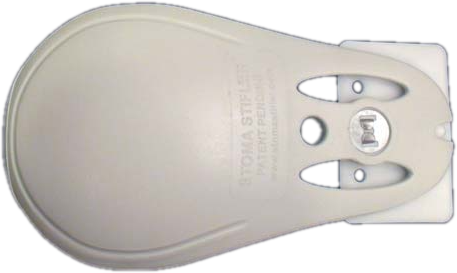
Stoma Stifler™, The Sound Suppressor + Stoma Guard Most Ostomates Wish They’d Found Sooner
- “A leak is not a catastrophe. It is a 10-minute task.” When you have the routine and the gear, that’s literally true. Your brain stops treating it as a danger when your hands have proven they can fix it quickly.
- “My body is doing its work overnight, just like it always did.” The output is your gut digesting. It’s not failing. It’s working. Most ostomates who can frame nighttime as “my body is doing its job, my appliance is doing its job, my routine is doing its job” report falling asleep within a week of adopting that mantra. Sounds soft; works.
The one-week sleep reset
If sleep has been the worst part of ostomy life for you, here is the structured plan:
Sleep quality is a key QoL marker in the ostomy literature:
- Ostomy nurse support drives QoL outcomes. A 2018 review confirms that the involvement of an ostomy nurse and proper preoperative preparation significantly improve quality of life, acceptance, and complication rates. According to PubMed (DOI 10.3238/arztebl.2018.0182).
- Complications are mostly conservative. A 2019 review documents that most ostomy-related challenges, from skin issues to bag adherence to lifestyle adaptation, respond to technique and product adjustment before requiring intervention. According to PubMed (DOI 10.1055/s-0038-1676995).
- Type-specific differences matter. A 2025 meta-analysis demonstrated meaningful differences in daily-life patterns between ileostomy and colostomy patients, with implications for lifestyle adaptation strategies. According to PubMed (DOI 10.3389/fmed.2025.1610213).
- Step-up management. A 2023 mapping review confirms a step-up approach from conservative ostomy care through to surgical revision when needed, relevant whenever a lifestyle pattern stops working. According to PubMed (DOI 10.1186/s13017-023-00516-5).
- Night 1: Install the waterproof mattress protector. Empty before bed.
- Night 2: Add the body pillow. Sleep on the side opposite your stoma.
- Night 3: Set up the bedside 10-second-grab kit so you don’t have to think if you wake.
- Night 4-5: Front-load hydration earlier. Light sips only after 9pm.
- Night 6: Add the Stoma Stifler kit if you haven’t already, for sound suppression in the bedroom.
- Night 7: Practice the mindset reframe before lights out. “A leak is a 10-minute task. My body is doing its job.”
By the end of week one, most ostomates report sleeping six to eight hours without checking the pouch. That’s the threshold. Once you cross it, sleep stops being the hardest part of ostomy life and becomes the part where your body finally rebuilds.
For the broader recovery framework, see the first 30 days guide and the first-year framework.
Affiliate disclosure: Some links in this article are Amazon affiliate links. If you purchase through them, Stoma Stifler may earn a small commission at no extra cost to you. See our full affiliate disclosure.
More from the Ostomy Library
- Prolapsed stoma: Why a stoma prolapses, when it is urgent, and what helps.
- Preventing a parastomal hernia: How to lower your risk, with a hernia risk timeline.
- Ostomy blockage: Warning signs, safe home care and when to go to the ER.
- Exercise after ostomy surgery: A 12-week plan to return to exercise safely.
Browse all Care and Complications guides or the full Ostomy Library.
Further reading on The Wellthie One
- How to fall asleep faster, naturally: A calm-body routine for easier nights.
- How to calm anxiety naturally: Simple ways to settle a stressed nervous system.
Frequently Asked Questions
Is what I'm experiencing normal after ostomy surgery?
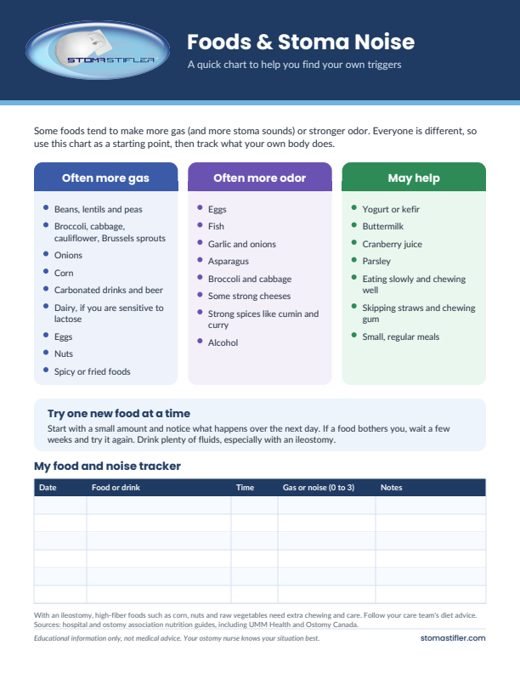
Most concerns ostomates have, bag noise, gas, occasional leaks, skin irritation, body-image adjustment, are normal in the first 6-12 months. The frequency and intensity drop significantly as your body adapts and your routine settles. Reach out to your ostomy nurse if anything feels worsening rather than improving.
Sleeping confidently with an ostomy is mostly about the right setup, pillow positioning, bag type, eating schedule. The readers who report sleeping through the night within a month of surgery tend to share a pattern: they invested in a wedge pillow, they switched to nighttime drainables, they finished eating 3+ hours before bed, and they emptied the bag right before sleep. The folks who report chronic sleep anxiety usually skipped one or two of those steps.
When should I call my ostomy nurse or doctor?
Call promptly for: peristomal skin that's painful, bleeding, or breaking down; stoma color changes (dusky, purple, pale); no output for 4-6 hours with cramping (possible blockage); high output that won't slow despite reducing fiber and adding electrolytes; or a hernia bulge that becomes painful or won't reduce. Most other concerns can wait for your next scheduled appointment.
Does the Stoma Stifler help with this?
The Stoma Stifler is a stoma guard and noise suppressor in one. Its dense foam cup muffles stoma sounds and shields the stoma from bumps and pressure, without restricting output. It works with your existing pouching system and doesn't interfere with skin care or wafer adhesion. Pairing it with the basics, good skin routine, hydration, and any complementary supplies above, covers most daily-comfort challenges.
Helpful complementary supplies
A few items most ostomates keep on hand. These pair with your Stoma Stifler for an easier daily routine.




Research that backs up this guidance
- García-Manzanares ME, et al. (2024). Proof of concept of an experimental prototype for the prevention of parastomal hernia. Updates in Surgery, 76(5):1997-2009. [DOI]Pilot study of a peristomal support device used with a compression binder found parastomal hernia incidence of only 10% over 12 months (typical rates run 30-60% in the first 2 years). Confirms the value of intentional peristomal support during the high-risk first year after surgery.
- Bozkul G, et al. (2024). Nursing interventions for the self-efficacy of ostomy patients: A systematic review. Journal of Tissue Viability, 33(2):165-173. [DOI]Systematic review of 15 studies found that structured education, telephone follow-up, and peer-support interventions measurably increased self-efficacy, decreased stoma complications, improved adaptation, and raised quality of life.