Five minutes of skin care a day prevents 80% of stoma skin problems. The other 20% are issues that need a stoma nurse, but the right routine catches almost all of them in the small-and-fixable stage instead of the painful-and-expensive stage. Here is the routine.
Last updated: October 2026
Skin around the stoma is the part of ostomy life that quietly determines whether your appliance stays sealed for 5 days or 2, whether you have leaks, and whether you experience the kind of low-grade daily discomfort that wears down your confidence over time.
Almost all of it is preventable. Almost none of it requires anything fancy. Five minutes a day, the right products, and a willingness to pay attention to small redness before it becomes a small problem.
The 5-minute morning routine
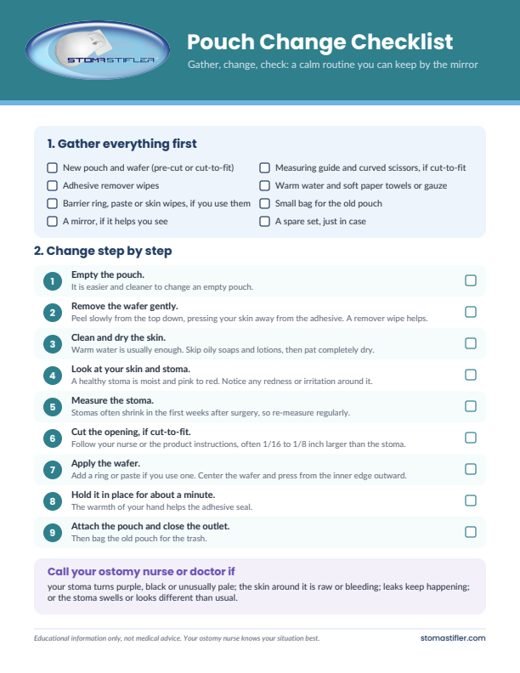
Do this every morning if you change daily, or on every change day if you change every 3-5 days. The whole sequence:
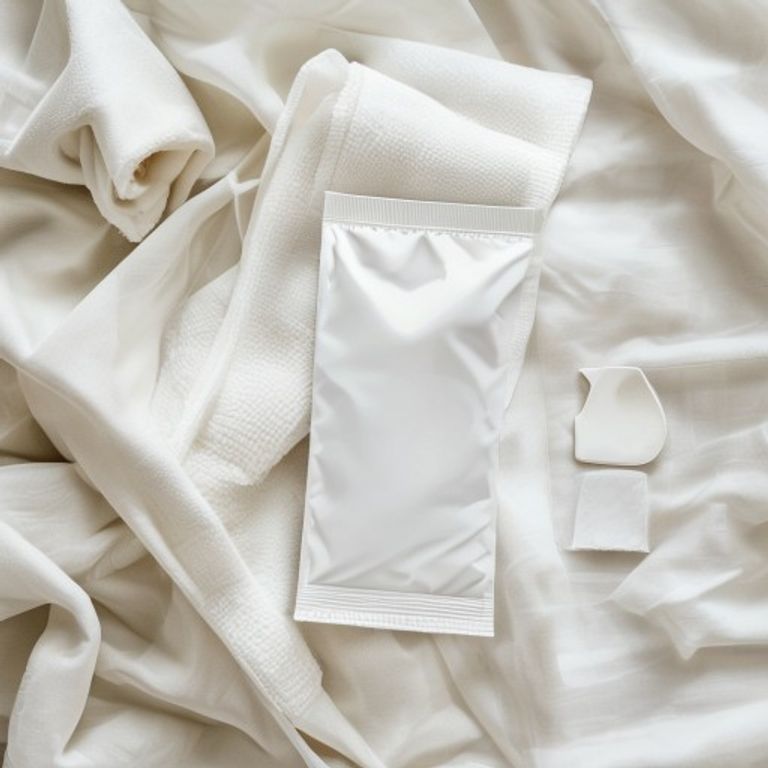
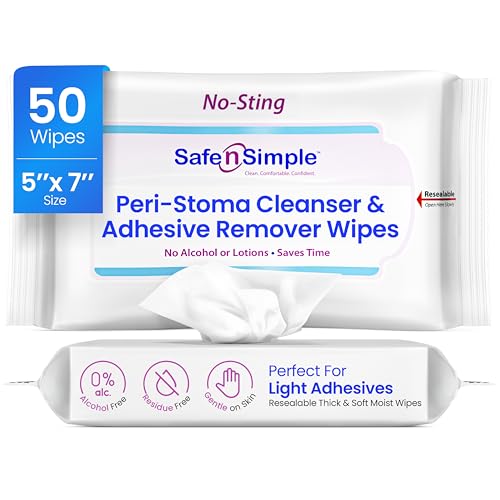
Step 1: Remove the old appliance gently (60 seconds). Use an adhesive remover wipe or spray as you peel. Don’t yank, peeling causes a stripping injury called MARSI (medical adhesive-related skin injury), and it accumulates over months. The remover wipe dissolves the adhesive bond so the wafer lifts away cleanly.
Step 2: Clean the skin (60 seconds). Plain warm water and a soft washcloth. Skip soap, especially scented soap, soap residue interferes with the next wafer’s adhesion. If you really want to use soap, choose a fragrance-free, non-moisturizing one like Cetaphil and rinse thoroughly. Pat dry, don’t rub.
Step 3: Inspect (60 seconds). Look at the skin around the stoma. Healthy skin looks like the rest of your abdomen, same color, no redness, no weeping, no rash, no broken skin. If you see anything different, address it now (see “common skin problems” below) before the new wafer goes on.
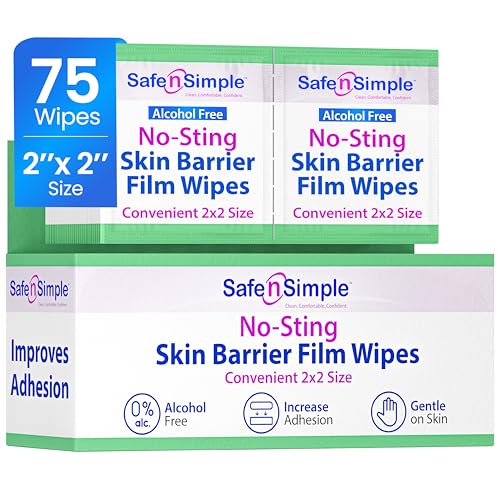
Step 4: Treat any small problem (90 seconds, only if needed). Stoma powder for moisture or weeping. Barrier ring for an uneven surface or skin gap. Skin barrier wipe for redness. Whatever the small issue is, treat it before applying the new wafer.
Step 5: Apply the new appliance (90 seconds). Apply the wafer to clean, dry skin. Press it firmly with your hand for 30 seconds, body heat helps activate the adhesive. Add any additional barrier rings or paste as needed for your specific stoma shape.
Total time: 5 minutes if no problems, 6-7 minutes if you’re treating something small. Both are massively shorter than what a real skin problem will eventually cost you.
The 3 most common skin problems and their fixes
If you stay on top of these three, you’re handling 80% of what comes up.
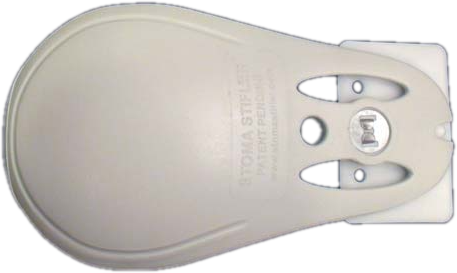
Stoma Stifler™, The Sound Suppressor + Stoma Guard Most Ostomates Wish They’d Found Sooner
Problem 1: Redness or rash where the wafer was sitting. Caused by leaks (output sitting on skin) or by adhesive sensitivity. Fix: identify whether it’s wet (leak) or dry (allergy). For a wet/leak rash, apply stoma powder on the damp skin, brush off the excess, then apply a skin barrier wipe over the powder, let dry, then apply the new wafer. The powder absorbs moisture; the barrier wipe seals it. This combination, sometimes called the “crusting technique”, is the single most powerful skin-recovery tool. For a dry/allergy rash, switch wafer brands; the adhesive chemistry differs by manufacturer.
Problem 2: Weeping skin (clear or yellow fluid coming from the skin around the stoma). Skin is broken at a microscopic level and is producing serum to heal. The crusting technique above is also the answer here. Crust until the weeping stops (usually 2-4 changes). If it doesn’t stop in 4 changes, call your stoma nurse, there may be infection or a more significant breakdown.
Problem 3: Itching under the wafer. Almost always caused by trapped moisture or by adhesive irritation. Fix: change the appliance immediately if it itches more than mildly. Don’t tough it out, itching often means the seal has failed and output is reaching the skin. After change, apply the powder + barrier wipe combination if any redness is present.
What to do at the first sign of redness
The single most important habit: treat redness today, not Wednesday. Small skin problems become big skin problems within 48 hours. A 30-second application of powder and a barrier wipe at the first sign prevents 90% of escalations.
Three things that need a same-day stoma nurse call rather than home treatment:
- Skin breakdown that has gone past redness into raw, weeping, or bleeding
- A persistent rash that hasn’t responded to 2-3 days of crusting technique
- Any sign of infection, yellow/green discharge with foul smell, fever, increasing pain
The rest is workable from home with the routine and products in the kit.
The skincare kit (build once, restock as needed)
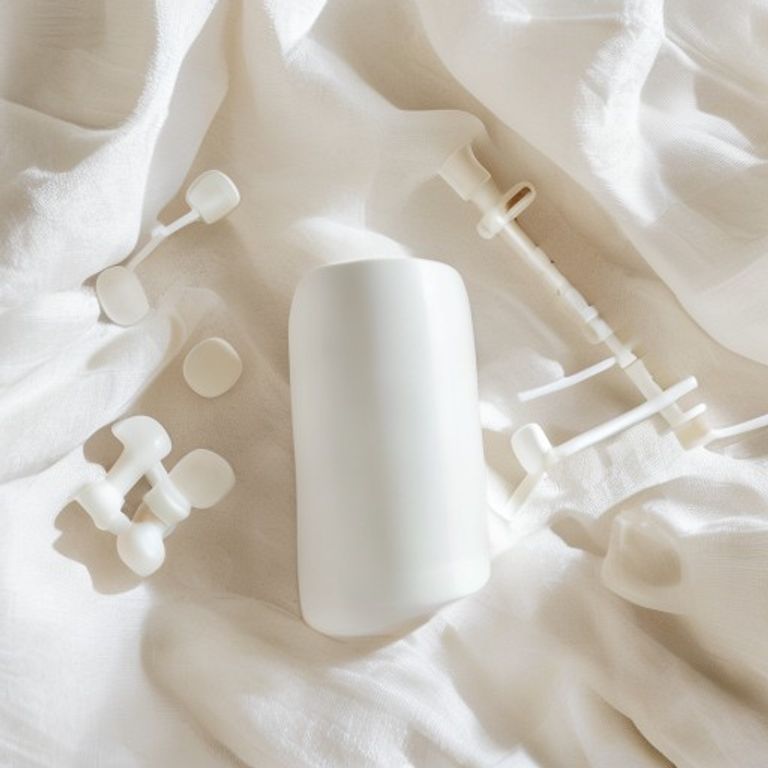
Everything you need lives in a small box near where you change the appliance. The full kit:
- Adhesive remover wipes, for clean removal every change
- Stoma powder, for any skin moisture or weeping
- Skin barrier wipes, for the second step of the crusting technique
- Barrier rings, for filling skin contour gaps and extending wear time
- Stoma paste, for irregular skin surfaces (use sparingly; rings are usually better)
- Plain warm water and a soft washcloth (not in the kit but on standby)
- Soft cotton clothing to avoid friction-irritation between changes
That’s it. Six products, all available at any pharmacy or via Amazon, and the routine itself is the value.
Specific situations
If you sweat a lot. Sweat is a leading cause of MARSI and wafer lifting. Fix: shorter wear times (every 2-3 days), use of a natural, aluminum-free deodorant spray on the skin around the stoma before applying the wafer (let it dry fully first), and consider using barrier rings for additional adhesion in the high-sweat zone.
If your skin is dry or sensitive. Skip soap entirely. Use only warm water. Apply a non-greasy barrier cream a few inches away from the stoma site (not directly on the wafer area) to keep surrounding skin healthy.
If you’ve started new medications. Some medications (steroids, certain chemo agents, blood thinners) make skin more fragile. Be more conservative with adhesive removal during these periods, extra remover wipe time, gentler peel, more frequent crusting prophylactically.
If you’re losing or gaining weight. Body shape changes affect wafer fit. Recheck wafer cut size every 4 weeks during weight changes; a wafer that’s too large lets output sit on skin, a wafer that’s too small chokes the stoma and causes irritation.
The “appliance wear time” target
Most modern wafers are designed for 3-5 day wear. If you’re changing every day, you’re working too hard and may be over-irritating the skin with constant adhesive removal. If you’re going past 5 days, you may be waiting too long and risking leaks.
The sweet spot for most ostomates is 3-4 day wear. Achievable wear time is a function of: skin health, output type and consistency, sweat level, and whether you’re using barrier rings to extend the seal.
If your wear time is shorter than this, the routine above usually fixes it within 2-3 weeks.
The bottom line
Skin care around the stoma is one of those quiet daily routines where doing it well doesn’t feel like much, but skipping it accumulates into real problems within weeks. Five minutes a day. The crusting technique for any redness. Same-day attention for anything beyond that. With these three rules, most ostomates report skin that looks the same as it did before surgery, which is the goal.
For the broader recovery framework, see our first 30 days guide. For the discreet daily life that healthy skin enables, see the Stoma Stifler kit, built for ostomates whose skin is doing well and who want the noise and discretion piece handled too.
Peristomal skin care has been studied extensively:
- Most common early complication. A 2018 review reports peristomal skin issues at 25-34% combined incidence, making it the most common early complication for new ostomates. According to PubMed (DOI 10.3238/arztebl.2018.0182).
- Skin complications cluster with technique issues. A 2019 review confirms that proper pouching technique is the primary preventive measure, with skin barrier products as adjuncts. According to PubMed (DOI 10.1055/s-0038-1676995).
- Conservative management succeeds in most cases. A 2023 mapping review confirms most peristomal skin issues respond to wafer adjustment, barrier products, and crusting technique before requiring intervention. According to PubMed (DOI 10.1186/s13017-023-00516-5).
Affiliate disclosure: Some links in this article are Amazon affiliate links. If you purchase through them, Stoma Stifler may earn a small commission at no extra cost to you. See our full affiliate disclosure.
Helpful complementary supplies
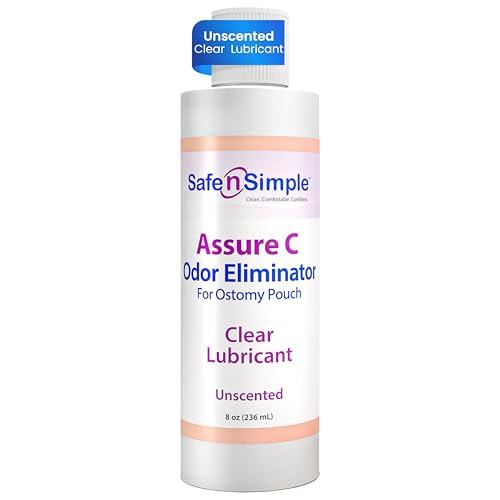
A few complementary items most ostomates keep on hand. These pair with your Stoma Stifler for an easier daily routine.

Research that backs up this guidance
- D'Ambrosio F, et al. (2022). Peristomal Skin Complications in Ileostomy and Colostomy Patients. International Journal of Environmental Research and Public Health, 20(1):79. [DOI]Systematic review of 23 studies found peristomal skin complications occur in 36-73% of ostomy patients, erythema, papules, erosions, and ulcers being most common. The data underscores why a proactive skin routine matters more than reactive treatment.
- Murken DR, Bleier JIS. (2019). Ostomy-Related Complications. Clinics in Colon and Rectal Surgery, 32(3):176-182. [DOI]Comprehensive review of common stoma issues, peristomal skin complications, retraction, stomal stenosis, prolapse, bleeding, dehydration from high output, and parastomal hernia. Covers prevention and recommended management strategies for every issue an ostomate typically faces.
More from the Ostomy Library
- Exercise after ostomy surgery: A 12-week plan to return to exercise safely.
- Sleeping with an ostomy: How to sleep comfortably and stop worrying about leaks at night.
- Prolapsed stoma: Why a stoma prolapses, when it is urgent, and what helps.
Browse all Care and Complications guides or the full Ostomy Library.
Further reading on The Wellthie One
- Keeping a health journal: What to track (food, symptoms, changes) and what to show your doctor.
Frequently Asked Questions
Is what I'm experiencing normal after ostomy surgery?
Most concerns ostomates have, bag noise, gas, occasional leaks, skin irritation, body-image adjustment, are normal in the first 6-12 months. The frequency and intensity drop significantly as your body adapts and your routine settles. Reach out to your ostomy nurse if anything feels worsening rather than improving.
Peristomal skin care is mostly a pouching-technique problem with skin care products as the supporting cast, not the headline act. The single highest-leverage move readers report: a 30-minute session with a stoma nurse to watch ONE wafer change. That session typically catches the 2-3 small technique issues that are causing 80% of the skin problem. Crusting technique, skin barrier wipes (not sprays), and proper wafer sizing handle most of the rest. The readers with chronic peristomal skin problems are almost always the ones who never had a nurse watch their change technique. The ones with smooth skin are the ones who got that observation early and adjusted.
When should I call my ostomy nurse or doctor?
Call promptly for: peristomal skin that's painful, bleeding, or breaking down; stoma color changes (dusky, purple, pale); no output for 4-6 hours with cramping (possible blockage); high output that won't slow despite reducing fiber and adding electrolytes; or a hernia bulge that becomes painful or won't reduce. Most other concerns can wait for your next scheduled appointment.
Does the Stoma Stifler help with this?
The Stoma Stifler is a stoma guard and noise suppressor in one. Its dense foam cup muffles stoma sounds and shields the stoma from bumps and pressure, without restricting output. It works with your existing pouching system and doesn't interfere with skin care or wafer adhesion. Pairing it with the basics, good skin routine, hydration, and any complementary supplies above, covers most daily-comfort challenges.