
If you feel embarrassed by stoma noise, that hot flush when your stoma gurgles in a silent church, a quiet meeting or a waiting room, you are far from alone. Stoma sounds are one of the most common concerns people living with an ostomy share, and a few small, steady habits can help quiet rooms feel calmer again.
Stoma noise, in short
- A stoma is the small opening on your belly where the bowel empties into a pouch
- With no muscle to hold gas back, sounds come when they come
- That can feel exposing, and many people quietly start choosing the back row
- Small steps, a good seat and a calm line help quiet rooms feel like yours again
Start with the short tool below to see when noise tends to show up for you.
When is stoma noise most noticeable for you?
At a glance
| How stomas make sounds | Air and gas move through the bowel all day, and a stoma has no muscle to hold them back |
|---|---|
| Common triggers | Swallowed air, fizzy drinks, chewing gum, long gaps between meals and some foods |
| Small steps that help | Regular small meals, a light snack before a quiet event, a hand or forearm resting gently over the pouch |
| Where to sit | An aisle seat, the end of a pew or a chair near the door |
| If someone notices | A calm, simple line, or nothing at all. You do not owe anyone an explanation |
| When to call your care team | A sudden change with pain, or no output with cramps and swelling for several hours |
Pull up a chair
There’s a seat saved for you in a private Facebook group where ostomates and caregivers trade what works.
Members talk about the moments their stoma spoke up in public, and what helped them laugh it off or quiet it down.
Pull Up My ChairPrivate group. Ask the questions you’d rather not ask out loud, even anonymously. Only members see what you share.
That hot flush when the room goes quiet
It might happen in the pause before a prayer, in a meeting while everyone reads the same page, in a doctor’s waiting room or across the table on a first date. Your stoma gurgles, squeaks or rumbles, and the sound seems to fill the whole room. Your face goes warm, your shoulders tighten, and you wait to see who turns around.

That feeling makes sense. Stoma sounds come from the bowel, a part of the body most people are raised to keep private, so they carry a different kind of embarrassment than a cough or a sneeze. Because the subject is not easy to bring up, many people carry it alone and assume everyone else with an ostomy is coping better than they are.
Embarrassment often arrives alongside gratitude. You might be thankful that surgery helped you and also dread the next quiet room.
Two feelings, side by side
One person who had lived with a stoma for 40 years described spending decades focusing on gratitude and resilience, while rarely allowing themselves to acknowledge that they disliked having an ostomy.
Their experience is a reminder that you do not have to feel positive about every part of your stoma to live well with it. Some ostomates say stoma sounds embarrass them even after years; others have learned to laugh about them. Wherever you are today is a fine place to start.
Why does a stoma make noise?
Your bowel is always moving. Its muscles squeeze in slow waves to push food, fluid and gas along, and the gas comes from air you swallow and from the way gut bacteria break down food. Before surgery, most of those sounds stayed muffled inside you, and the ring of muscle at the end of the bowel let you hold gas until a private moment.
- 1Air is swallowed and food breaks down
- 2Slow waves move the gas along
- 3Gas reaches the stoma
- 4A gurgle, a squeak or a small pop
A stoma works differently. It is a piece of bowel brought to the surface of your belly, and it has no muscle you can tighten to hold anything back.
Before surgery and with a stoma
When gas reaches the stoma, it comes out, sometimes with a gurgle, a squeak or a small pop as it passes into the pouch. That is how a stoma works, and a gurgle is often just a sign that your bowel is doing its job.
Most stoma sounds come from a colostomy or ileostomy, where the stoma carries stool and gas. The sounds can change with your output (whatever comes out of the stoma), your meals and the time of day. Some people find their stoma grows quieter as the body settles after surgery, while others keep having unpredictable sounds for years. For a closer look at the most common causes, this guide to a loud stoma walks through each one.
Everyday sounds
- Gurgles, squeaks and small pops
- More sounds after long gaps between meals or after fizzy drinks
- Sounds that change with your output, your meals and the time of day
Call your ostomy nurse or care team
- The pattern changes suddenly, along with pain
- Your stoma goes quiet with no output, plus cramps and swelling for several hours, which can signal a blockage
- Your stoma turns dark red, purple, black or much paler than usual
- Signs of dehydration, such as dark urine, dizziness or a dry mouth
What makes stoma noise louder?
Every body is different, but the same few triggers come up again and again when ostomates compare notes.
- Swallowed airEating quickly, talking while you chew, drinking through a straw and chewing gum all add air that has to come out somewhere.
- Fizzy drinksSoda, sparkling water and beer add extra gas that has to travel through the bowel.
- Long gaps between mealsMany people notice more gurgling when they have gone hours without eating, often early in the morning or late in the afternoon.
- Some foodsBeans, cabbage, broccoli and onions are common gas makers, and so is dairy for some people. Coffee makes some stomas noticeably more active and has little effect on others.
A simple food and noise diary for a week or two can show your own pattern: what you ate, when you ate it and when the sounds came.
A food and noise diary, for a week or two
You do not need to give up favorite foods forever. Many people save the gassier ones for evenings at home and choose gentler foods before a quiet event. This guide to colostomy gas has more on food and timing.
For evenings at home
The gassier foods: beans, cabbage, broccoli and onions, and dairy if it is a trigger for you.
Before a quiet event
Gentler foods, such as a few crackers, toast or a banana. In the glass, plain water with a small pinch of unrefined mineral salt and a squeeze of lemon or lime (the citrus alone if you have been told to limit salt).
One caution matters more than any of these: do not cut back on drinking to quiet your stoma. Fluids matter for everyone with an ostomy, and especially with an ileostomy, where the risk of dehydration is higher. Choose plain water, broth or a caffeine-free tea over fizzy drinks instead.
The Quiet Plan in My Ostomy Blueprint includes a trigger finder built around when your sounds happen, plus quick fixes for the moment a rumble starts. See your top 3 priorities
Do other people notice stoma noise as much as you think?
Usually, no. You are tuned to your own body, so every gurgle sounds loud to you.
One room, many thoughts
And when someone does hear a sound, they rarely know what it is. Every stomach growls, especially before a meal, so most people assume it is an ordinary rumble and move on within seconds. The moment that replays in your mind all evening has often been forgotten by everyone else before the meeting ends.
How long one sound lasts
From 14 years of conversations with ostomates
In 14 years of conversations with ostomates, one pattern stands out: for many people, the most challenging part of stoma noise is not how loud it is. It is the uncertainty. You do not know when a sound will come, you cannot hold it back, and you wonder who heard. Some people who rarely have a leak feel far more anxious about noise than anything else. Naming that uncertainty, and having a plan for it, often takes away much of its power.
It also helps to notice the gap between what you feared and what happened.
- After your next quiet room, ask yourself: did anyone react?
- Did it change how the morning went?
Over time, those small notes build a truer picture than the one your nerves paint in advance.
Small steps that make quiet rooms easier
None of these steps promise silence, and you do not need silence to feel calmer. Together they lower the odds of a loud moment and give you something to do when one comes.
- 1Small, regular meals
- 2A light snack
- 3Empty your pouch
- 4A seat near the aisle
- 5A gentle hand
- 6Breathe, carry on
Before you go
- Eat small, regular meals through the day rather than one or two large ones, so your bowel is not running on empty.
- Have a light snack a little while before a quiet event, such as a few crackers, toast or a banana, instead of arriving hungry or straight from a big meal.
- Skip the fizzy drink and the gum that morning, and sip plain water instead.
- Empty your pouch before you leave, so it starts the event flat and comfortable.
Where you sit
Choose an aisle seat, the end of a pew or a chair near the door. You can step out for a moment like anyone else, without explaining, and knowing you can often takes the edge off your nerves.
Three seats with an easy way out
When a sound starts
Many ostomates rest a hand or forearm gently over the pouch, through their clothing, when they feel a rumble building. Light pressure can be enough to soften the sound.
Do not press firmly or block the stoma, since output needs to move freely into the pouch.
Softening a sound
One student described carrying a hoodie or jacket to classes, so there was always an extra layer on hand to help muffle stoma sounds.

Then breathe, and carry on with what you were doing. For the full how-to on diet, routine and pouch habits, how to stop stoma noise goes step by step, and these ideas for ostomy pouch noise in meetings cover the workday.
 A peek inside
This is what a Quiet Plan looks like: a 5-step plan, quick fixes for the moment a sound starts and a trigger finder.
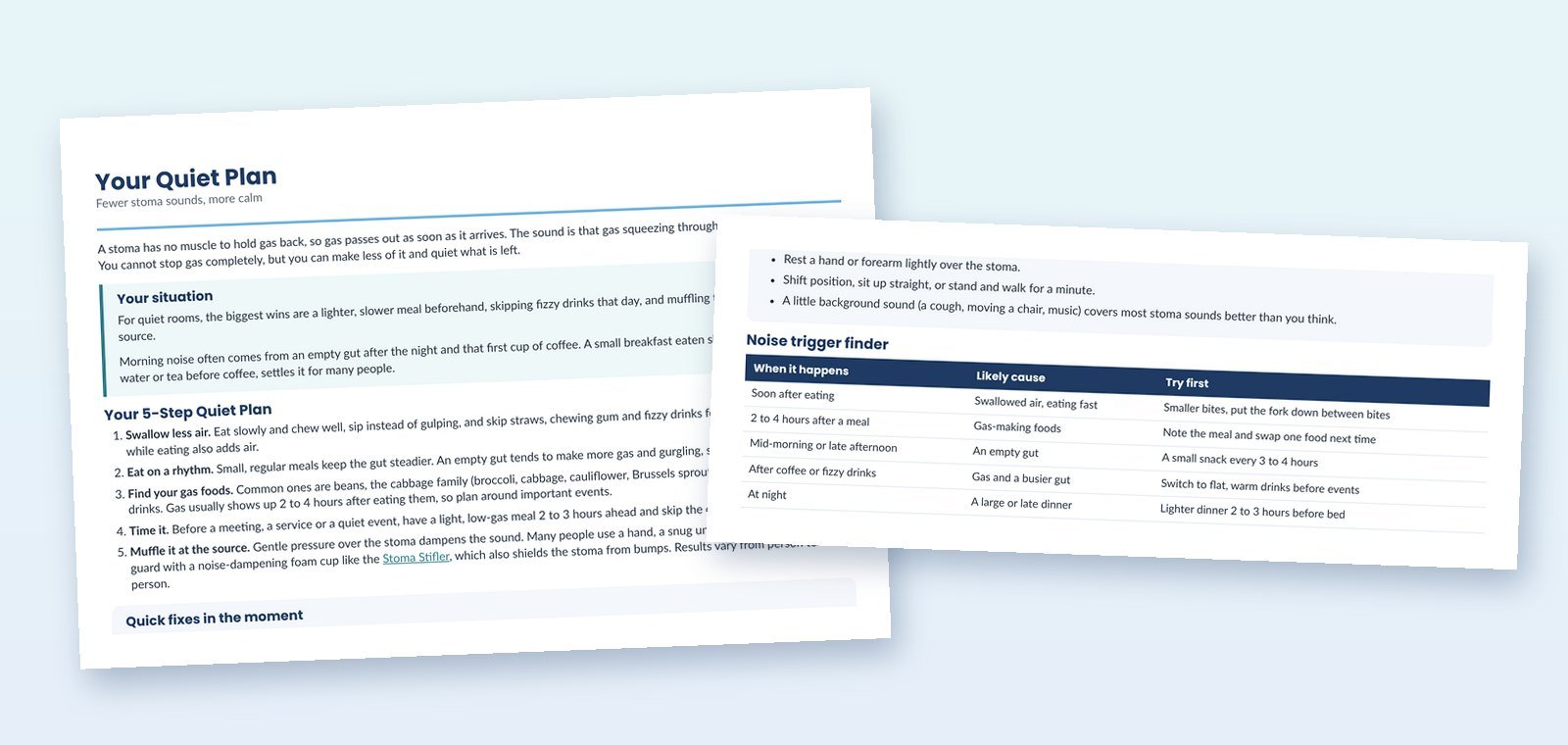
- A trigger finder built around when your sounds happen
- A 5-step plan for less gas and quieter output
- Quick fixes for the moment a rumble starts
Answer a few questions and see your Confidence Score and top 3 priorities before you decide anything. Stoma noise is already ticked for you. See more sample pages
What can you say if someone hears your stoma?
Most of the time, nothing at all. You do not owe anyone an explanation for a sound your body makes. If you would like a line ready, keep it calm, short and a little light. People take their cue from you, so a relaxed tone tells them there is nothing more to it.
Lines to keep ready
In one lighthearted online conversation, ostomates shared how they jokingly talk to their stomas when they start making noises. Some have given their stomas names and gently tell them to be quiet, while others laugh along with friends and family. Others let the sound pass and keep the conversation going.
Every one of those responses is valid. Humor suits some people and not others, and quietly carrying on is just as strong a choice.
If the quiet room is a first date or a new relationship, you get to decide when and how much to share. Some people mention their ostomy early and casually, treating it as an ordinary part of life; others wait until they feel ready. Intimacy after an ostomy covers those conversations gently.
How do you keep stoma noise from shrinking your world?
Avoidance often starts small. You sit in the back row, then skip the quiet part of the service, then stop going. You turn down the meeting, then the dinner invitation. Each choice feels sensible in the moment, and together they can slowly shrink your life to the places where noise feels safe.
Researchers who interviewed people living with a permanent ostomy heard the same pattern: many held back from people and places to keep their stoma private. If that sounds familiar, it is a common response to a common feeling, and it can be gently reversed, one room at a time.
Name one place you miss
A church service, a book club, the library, a concert or lunch with a friend.
Start with a shorter visit
Go for part of it, sit near the aisle and give yourself permission to leave early.
Bring someone who knows
A friend or family member beside you can share a glance and a smile if your stoma speaks up.
Prepare, then go
Use the small steps above, then let the plan do its work.
Notice what happened
Afterward, compare it with what you feared, then choose the next place.
When one person shared online that they were too anxious to leave home for more than a couple of hours, experienced ostomates answered with small first steps: a drive around the neighborhood, a coffee at a familiar spot, a visit to a friend. One person wrote that they had spent their own first month scared and crying, and had since become much more comfortable going out.
Widening the circle, one room at a time

Being with people who understand helps too. In an ostomy support group, everyone knows stoma sounds, and a gurgle in that room is met with a knowing smile. The UOAA Support Group Finder lists groups near you and online. If embarrassment or anxiety keeps you at home even when your pouch is working well, talking with a counselor can help alongside that support.
Quiet rooms can feel like yours again
The feeling you are carrying has been shared by many people before you, and some of the most helpful answers have come from someone who listened.
The Stoma Stifler began with one woman who had an ostomy and noticed it made noises at the worst moments. Her son, an engineer who worked on reducing buzz, squeak and rattle in cars, made her a quiet guard. Others in her support group had the same concern, and she loved giving one to each person who needed it. Nine versions later, it became the Stoma Stifler: a firm, quiet guard sized to your pouch, so there is nothing to measure, worn under an elasticized undergarment or attached to your own undergarments, ostomy belt or hernia belt with the optional kit pieces. It softens stoma sounds in quiet rooms and protects the stoma from bumps, seat belts and hugs. If evenings are when you notice sounds most, swapping an after-dinner coffee for a caffeine-free cup of WZY organic chamomile is a gentle change that is calming and easy on the stomach.
Stoma Stifler
 See the Stoma Stifler
A firm, quiet stoma guard that fits all one-piece and two-piece pouch systems, so there is nothing to measure. Protects the stoma from bumps, seat belts and hugs, and softens stoma sounds. Wear it under an elasticized undergarment, or attach it to your own undergarments, ostomy belt or hernia belt with the optional kit pieces.
WZY Organic Chamomile Tea
 View on Amazon
Caffeine-free chamomile flowers, calming in the evening and gentle on the stomach.
As an Amazon Associate, Stoma Stifler earns from qualifying purchases. Disclosure
One customer described feeling more comfortable in quiet meetings because they no longer felt they had to keep a hand pressed against their belly. Not everyone wants an accessory, and every other step in this article works on its own. What matters most is finding the mix that lets you walk back into the room you have been missing, and sit down.
- Small, regular meals
- A seat near the aisle or the door
- A gentle hand over the pouch
- A calm line, or none at all
- Someone who knows, beside you
Your quiet-room story could help the next person
Has stoma noise ever made you want to stay home, or have you found a step, a line or a laugh that helped you walk back into a quiet room? Email info@stomastifler.com. With your permission, your words may be shared without your name to help the next person who feels that hot flush and thinks they are the only one.
Research that backs up this guidance
What two of the studies counted
First figure: Yuan et al., Psychooncology, 2018. Second figure: Koneru et al., ANZ J Surg, 2024.
Research backs up what ostomates describe. People interviewed in the weeks after ostomy surgery talk about embarrassment from noise, odor and leaks, and a review of studies of people living long term with a colostomy lists gas and concerns about noises among the everyday problems that shape quality of life.
Studies also show how embarrassment can quietly shrink a life, as people hold back and keep to themselves to keep their stoma private. The hopeful part is that confidence in coping, family acceptance and time spent with other people who have a stoma are linked with less stigma, and that the ways people adapt are personal, often found through trial and error.
| What the research found | Source |
|---|---|
| In interviews with people a few weeks to three months after ostomy surgery for colorectal cancer, many described distress and anxiety about embarrassment from leaks, odors or noise, which led some to fear going out in public and to pull back from daily life. | Soelling et al., J Gastrointest Surg, 2025PubMed ID 39824243 |
| A systematic review of 14 studies of people living long term with a colostomy found it affected quality of life, with gas and concerns about noises among the ostomy-related problems described. | Vonk-Klaassen et al., Qual Life Res, 2015PubMed ID 26123983 |
| In focus groups with people living with a permanent ostomy, participants described feelings of stigma, concerns about others finding out and self-imposed limits, and isolating themselves was often chosen as a way to avoid disclosing the stoma. | Danielsen et al., J Wound Ostomy Continence Nurs, 2013PubMed ID 23820473 |
| Among 209 people with a stoma, 44 percent reported high levels of stigma, and lower stigma was linked with greater confidence in coping, family acceptance of the stoma and taking part in activities with other people who have a stoma. | Yuan et al., Psychooncology, 2018PubMed ID 29508500 |
| Among long-term colorectal cancer survivors with an ostomy, ostomy-related concerns often continued five or more years after surgery, and the ways people adapted were individual and found through trial and error. | Sun et al., J Wound Ostomy Continence Nurs, 2013PubMed ID 23222968 |
| In 64 people with a permanent colostomy, embarrassment and difficulty with interpersonal interaction were among the issues linked with lower satisfaction with their stoma, and only about one in six had sought healthcare advice for stoma problems. | Koneru et al., ANZ J Surg, 2024PubMed ID 38761003 |
What this means for you: the hot flush you feel in a quiet room is shared by many people, and it is a reason to build a plan. Try one small step at a time, notice what works for your body, and bring it up with your ostomy nurse, since many people do not ask for help with stoma concerns like this one.
This article covers what most people share. My Ostomy Blueprint is one plan written from your answers, and it goes further:
- A 5-step plan for quieter days
- A trigger finder built around when your sounds happen
- Quick fixes for the moment a sound starts
Plus everything else you ask for help with, from food and hydration to sleep and travel, in one place.
Build My BlueprintFrequently asked questions
Is it normal for a stoma to make noise?
Yes. A stoma has no muscle to hold gas back, so air and gas leave whenever they reach it, often with a gurgle, squeak or small pop. Most people with a colostomy or ileostomy hear their stoma at times, and many notice it most in quiet rooms, after long gaps between meals or after fizzy drinks. A sound on its own is usually just a sign that your bowel is working.
Will stoma noise get better with time?
Some people find it eases as the body settles after surgery and they learn their own triggers, so sounds become more predictable and less frequent. Not every stoma grows quiet, though, and some people keep having unpredictable sounds for years. That is the reason small habits help: regular meals, fewer fizzy drinks, less swallowed air, a hand resting gently over the pouch, and a seat where you can step out if you need to.
Does a pouch with a filter stop stoma noise?
Not reliably. A gas filter lets some gas escape slowly from the pouch, which helps with ballooning (a pouch puffing up with gas) and odor, and can make the pouch less noticeable under clothes. The sound itself is made as gas passes through the stoma, before it ever reaches the filter. Softening that sound comes from fewer triggers, a gentle hand or an extra layer over the pouch, or a firm guard.
When is stoma noise a sign something is wrong?
Everyday gurgles and pops are normal. Call your ostomy nurse or care team if the pattern changes suddenly along with pain, or if your stoma goes quiet with no output plus cramps and swelling for several hours, which can signal a blockage. Also call if your stoma turns dark red, purple, black or much paler than usual, or if you notice signs of dehydration such as dark urine, dizziness or a dry mouth.
Last updated November 2026. Written from 14 years of conversations with people living with an ostomy and the people who care for them.