

Many people with an ostomy enjoy corn again, and the part to plan around is the thin skin on each kernel, which passes through the bowel mostly unchanged. Polenta, corn tortillas and creamed corn are usually the easy way back, while whole kernels and corn on the cob take a little more care, especially with an ileostomy.
Corn with an ostomy, in short
- Colostomy: whole kernels often come back after the first 4 to 6 weeks, in small amounts
- Ileostomy: smooth corn foods first, whole kernels later, with your care team on board
- Kernels showing in the pouch are common and normal
- The signs to stop and call your ostomy nurse
With a urostomy, food takes its usual path, and corn is yours to enjoy as before surgery.
Corn and your ostomy

Your Blueprint brings back the foods you miss, in the right order, as part of a plan written from your own story.
Start My BlueprintAt a glance
| Colostomy | Whole kernels usually fine after the first 4 to 6 weeks, in small amounts |
|---|---|
| Ileostomy | Smooth forms first; whole kernels and corn on the cob later, with your team on board |
| Urostomy | Enjoy it as before surgery, with plenty to drink alongside |
| The tricky part | The skin of each kernel, which the body passes mostly unchanged |
| Easiest forms | Polenta, grits, corn tortillas and blended corn soup |
| Most care | Whole kernels and corn on the cob |
| First try | A spoonful of tender kernels at lunch, chewed well, with a drink |
| Call your ostomy nurse | Cramps in waves with little or thin output, nausea, a swollen stoma |
Can you eat corn with a colostomy?
Yes, most people with a colostomy can eat corn again. The colon keeps doing its work, and the thicker, slower output carries the kernel skins along.
The first 4 to 6 weeks after surgery are for soft, simple foods while the bowel heals. After that, corn can come back one small portion at a time, starting with the smooth forms and moving on to whole kernels.
Can you eat corn with an ileostomy?
Yes, many people with an ileostomy enjoy corn again. Output leaves the small bowel through a narrower opening, and whole kernels are on the short list of foods most often linked to a blockage.
With a colostomy
Thicker, slower output carries the kernel skins along. Whole kernels often return after the first 4 to 6 weeks.
With an ileostomy
Output leaves through a narrower opening. Smooth forms come first, and whole kernels usually return around 6 months.
Smooth corn foods such as polenta, grits and corn tortillas usually come back earlier. Whole kernels and corn on the cob come later, often around six months after surgery, once softer foods have gone well and your care team agrees.
What makes corn tricky with an ostomy?
Each corn kernel has a thin, clear skin wrapped around a soft, starchy center. The center breaks down easily. The skin is insoluble fiber, and the body passes it mostly unchanged.
Three parts of a corn kernel
Seeing kernels in the pouch is common, and the skin is the reason: often the center has been digested and only the empty skin passes. Trouble comes when many kernels arrive together, swallowed whole, and bunch up behind the stoma.
Which kinds of corn are easiest with an ostomy?
Corn comes in many forms, and the way it is made changes how much skin reaches your stoma. Starting at the top of this list is the easiest way back.
- Polenta and gritsGround corn cooked until creamy and smooth.
- Corn tortillas and tamalesMasa is made from corn soaked with lime, which loosens the skins, and most of them are rinsed away before grinding.
- Blended corn soup and creamed cornBlended smooth, the skins break into small pieces.
- Kernels cut off the cobA spoonful at a time, cooked tender and chewed well, in a soup or salad.
- Corn on the cobBite by bite, it goes fast. It fits best once kernels have gone well.
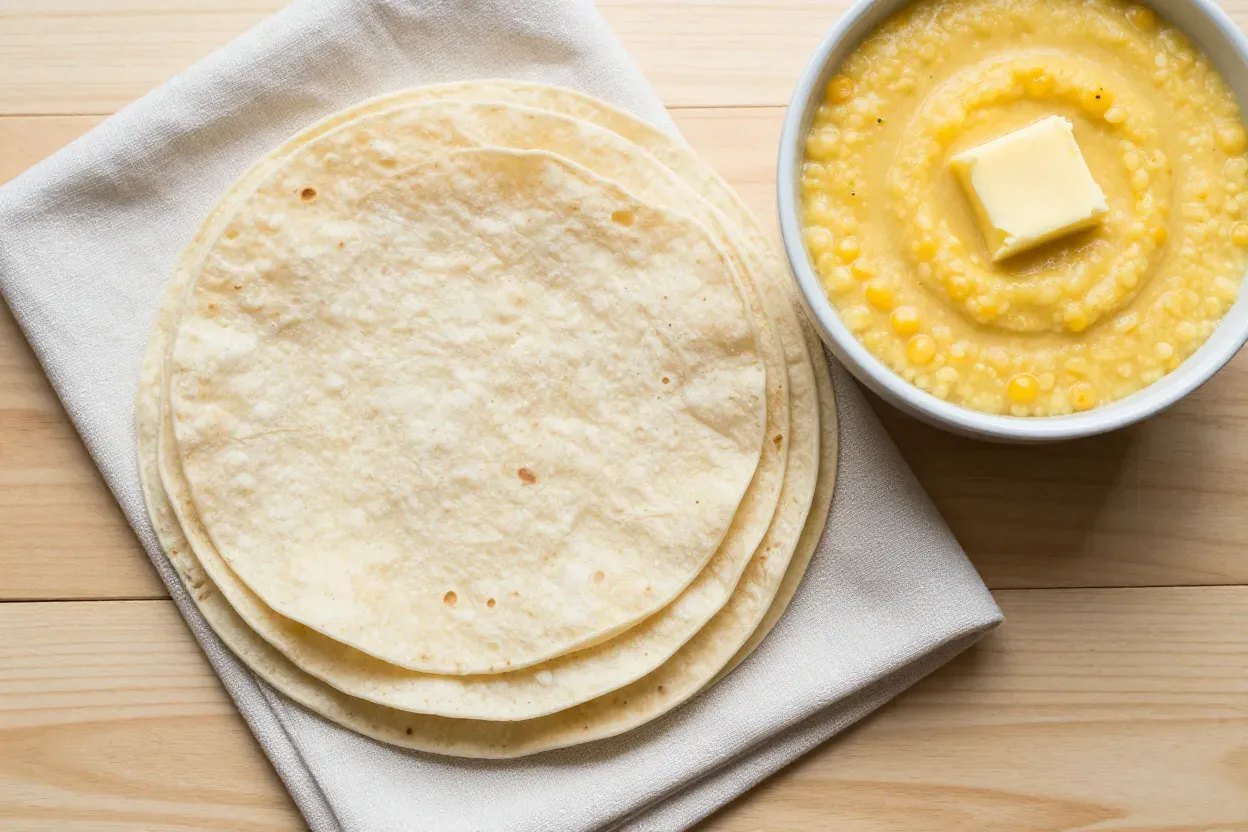
Cornbread and muffins made with fine cornmeal sit near the top of the list too. Fine meal bakes into a soft crumb, with the skins ground small.
How do you prepare corn for an ostomy?
A few choices in the kitchen do most of the work.
- Cut kernels off the cobA stainless steel corn stripper takes the kernels off in rows, and you choose the portion.
- Cook until tenderSimmered in soup or sautéed until soft and plump.
- Blend or mashA quick pulse in the blender or a few presses with a masher breaks the skins.
- Season it lightlyA pinch of unrefined mineral salt, a little butter, fresh herbs or a squeeze of lime.
- Chew each mouthful wellChewed until smooth, before the next bite.
- Drink as you goWater with a pinch of mineral salt and a squeeze of lemon or lime (the citrus alone if you limit salt).
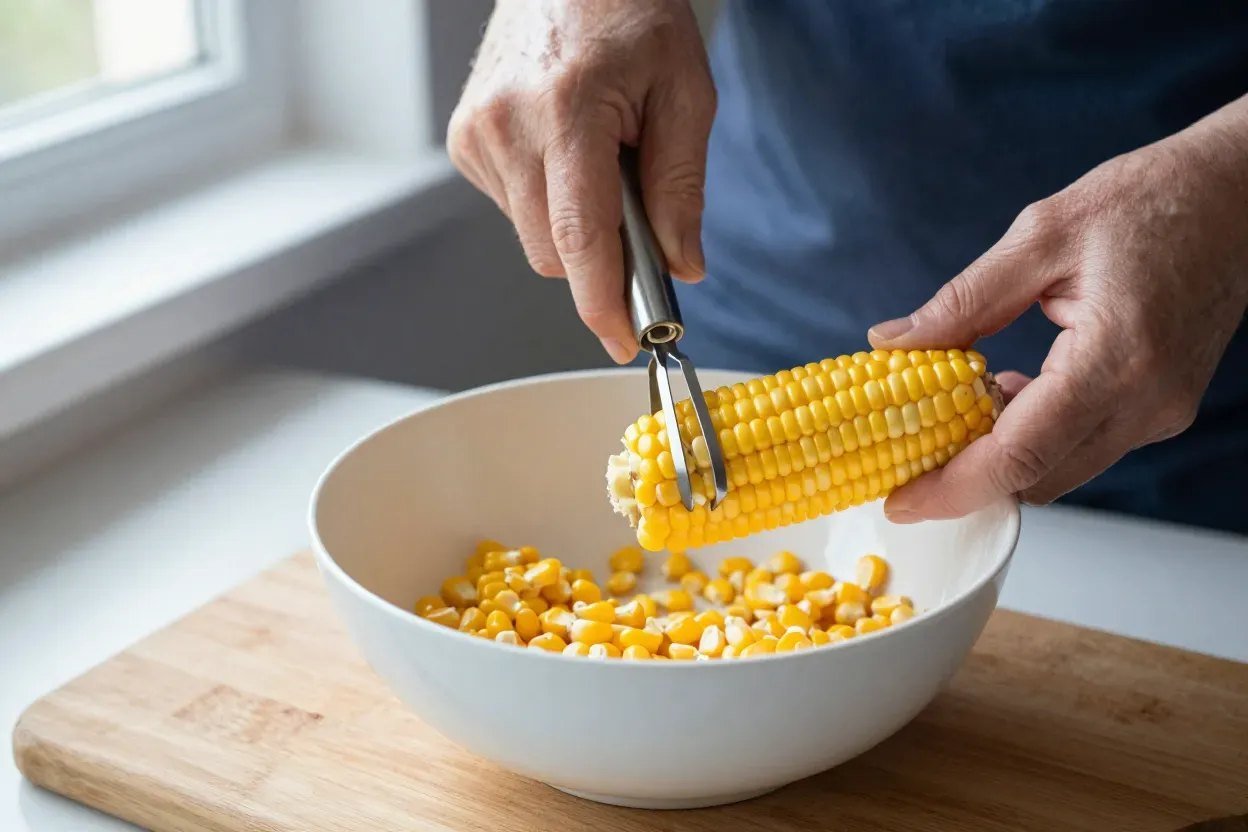
Homemade creamed corn takes three steps: cut the kernels off the cob, scrape the cob with the back of a knife for its sweet milk, then simmer and blend. It keeps the flavor of fresh corn with the skins in small pieces.
A few helpers for corn at home. Organic polenta and organic masa harina bring corn back in its smoothest forms, and a stainless steel stripper takes kernels off the cob in small, even rows.
Bob’s Red Mill Organic Corn Grits / Polenta
 View on Amazon
Organic corn grits for creamy polenta or a warm bowl of grits.
Bob’s Red Mill Organic Masa Harina
 View on Amazon
Organic masa harina for fresh corn tortillas and tamales at home.
Silvercorn Stainless Steel Corn Stripper
 View on Amazon
Stainless steel corn stripper that takes kernels off the cob in clean rows.
As an Amazon Associate, Stoma Stifler earns from qualifying purchases. Disclosure
How much corn can you eat?
Start with a spoonful and let your output guide the next portion. The test below works for any new food.
- 1A spoonful of tender kernels at lunch
- 2Chew each mouthful well
- 3A full glass of water alongside
- 4Watch output for 24 hours
- 5Went well? A little more next time
When corn usually comes back
At a cookout, kernels cut onto your plate are easier to pace than a whole ear. Bite by bite, an ear of corn goes fast, and fast is the habit that brings kernels down together.

What are the signs corn is not passing well?
Most of the time corn passes with nothing more than a few kernels in the pouch. Knowing the early signs of a partial blockage means you can act at the first cramp.
Usually normal
- Kernels or skins visible in the pouch
- Thicker output for a few hours
- A little more gas the same evening
Call your ostomy nurse
- Cramps that come in waves
- Thin, watery output with cramps, or much less output
- Nausea or a bloated, tight belly
- A stoma that looks swollen
Go to the emergency room for vomiting, strong steady pain, no output for 4 to 6 hours with an ileostomy, or a stoma that looks dark, purple or black.
For a partial blockage at home (stop solids, warm fluids, a warm bath, gentle massage around the stoma), see the step-by-step guide to an ostomy blockage.
A habit that helps
Pair corn with something smooth. A spoonful of kernels stirred into mashed potatoes, soup or rice is gentler than a bowl of kernels on their own.
Did corn come back for you?
If you found your way back to corn, the form you enjoy, the portion that works, the trick that helped, share it by email at info@stomastifler.com. Stories are shared only without your name, to help the next person at the cookout.
Research that supports these recommendations
Ostomy nutrition guidance points the same way: most foods come back after surgery, and a short list of foods that break down slowly, corn among them, is eaten in small amounts and chewed well.
Studies of people living with a stoma show that fruits and vegetables are the foods most often adjusted, and that clear eating guidance after surgery helps people eat with confidence.
| What the research found | Source |
|---|---|
| A hospital teaching sheet lists corn among the foods to eat in small amounts and chew well to prevent a blockage, and among the foods that can add gas. | Children’s Wisconsin, Colostomy/Ileostomy Diet teaching sheet, revised January 2024 |
| Dietary steps such as chewing well and adding fibrous foods slowly help prevent a food bolus obstruction with a stoma. | Burch J. Stoma care and diet in the community. British Journal of Community Nursing, 2024;29(4):195-198. doi.org/10.12968/bjcn.2024.29.4.195 |
| Among 103 people with a colostomy or ileostomy, fruits and vegetables were the foods most often avoided; avoiding foods because of leaks was more common with an ileostomy (20%) than a colostomy (4.8%). | de Oliveira AL et al. A cross-sectional study of nutritional status, diet, and dietary restrictions among persons with an ileostomy or colostomy. Ostomy Wound Management, 2018;64(5):18-29. PubMed 29847308 |
| A structured eating plan with counseling after ileostomy surgery lowered hospital readmissions, including readmissions for dehydration. | Fernández-Gálvez A et al. Nutritional and educational intervention to recover a healthy eating pattern reducing clinical ileostomy-related complications. Nutrients, 2022;14(16):3431. doi.org/10.3390/nu14163431 |
What this means for you: corn can be part of life with an ostomy. The form you choose, small portions and slow chewing are what make it comfortable.
Frequently asked questions
Can you eat corn with a colostomy?
Yes. Most people with a colostomy can eat corn again after the first 4 to 6 weeks of healing. Start with the smooth forms or a spoonful of tender kernels, chew well and drink alongside.
Can you eat corn with an ileostomy?
Yes, in the right form. Polenta, grits and corn tortillas usually come back earlier, while whole kernels and corn on the cob usually come back around six months after surgery, once softer foods have gone well and your care team agrees.
Is it normal to see corn in an ostomy pouch?
Yes. The skin of each kernel passes mostly unchanged, and often the starchy center has already been digested. Chewing well breaks the skins into smaller pieces.
Are corn tortillas okay with an ostomy?
Corn tortillas are one of the easier corn foods. Masa is made from corn soaked with lime, which loosens the skins, and most of them are rinsed away before grinding.
Can you eat corn with a urostomy?
Yes. With a urostomy, food takes its usual path through the bowel, and corn is yours to enjoy as before surgery. Drink plenty through the day.
Last updated November 2026. Written from 14 years of conversations with people living with an ostomy and the people who care for them.