
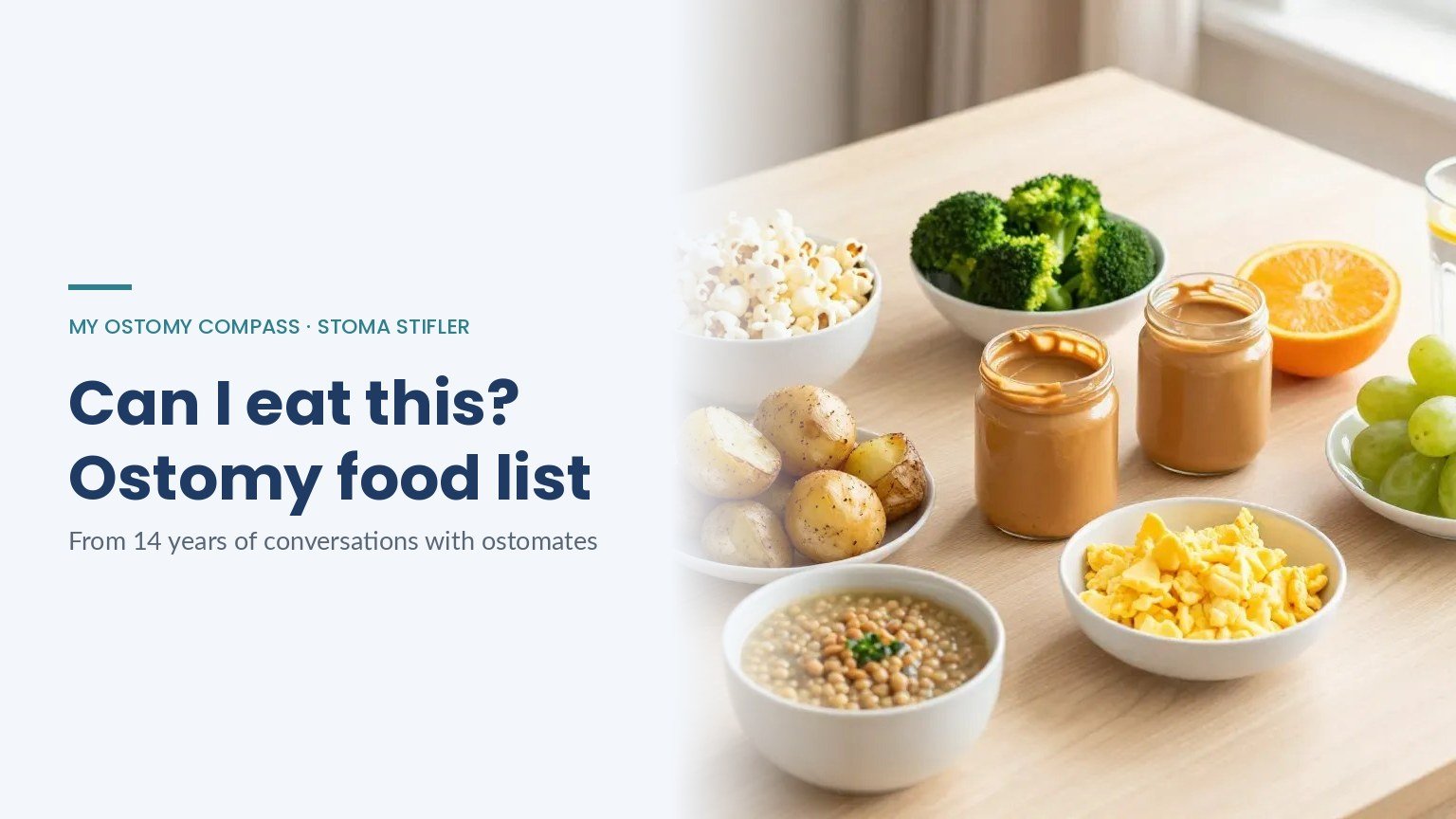
Most foods come back to the table after ostomy surgery. A short list asks for a little care: foods that break down slowly, foods that bring gas or odor, and foods that loosen or thicken output. Choose your ostomy and a food below to see how it usually goes and the easiest way to bring it back.
Food with an ostomy, in short
- Most foods come back after the first 4 to 6 weeks of soft, simple meals
- One new food at a time, a small portion, earlier in the day
- Chew each mouthful to a paste, with a drink beside you
- With an ileostomy, the chew-well foods need the most care
With a urostomy, food takes its usual path, and your meals are yours to enjoy as before surgery.
Find your food
Choose your ostomy, then tap a food. You’ll see how it usually goes and the easiest way to bring it back.
1. Your ostomy
2. The food

Your Blueprint brings back the foods you miss, in the right order, as part of a plan written from your own story.
Start My BlueprintHow do foods come back after ostomy surgery?
The first 4 to 6 weeks after surgery are for soft, simple foods while the bowel heals. After that, most foods come back one at a time, and the way back is the same for each one: a small portion earlier in the day, chewed to a paste, with a drink alongside. If it goes well, the portion grows next time. If a food doesn’t sit right, set it aside for a few weeks and try it again later.
- One new food at a time, at lunch rather than late in the evening.
- A small portion, about a small handful or a few spoonfuls.
- Chew each mouthful until it is soft.
- Drink alongside the meal and through the rest of the day.
- Notice how output looked and felt the next day.
Which foods need the most care with an ileostomy?
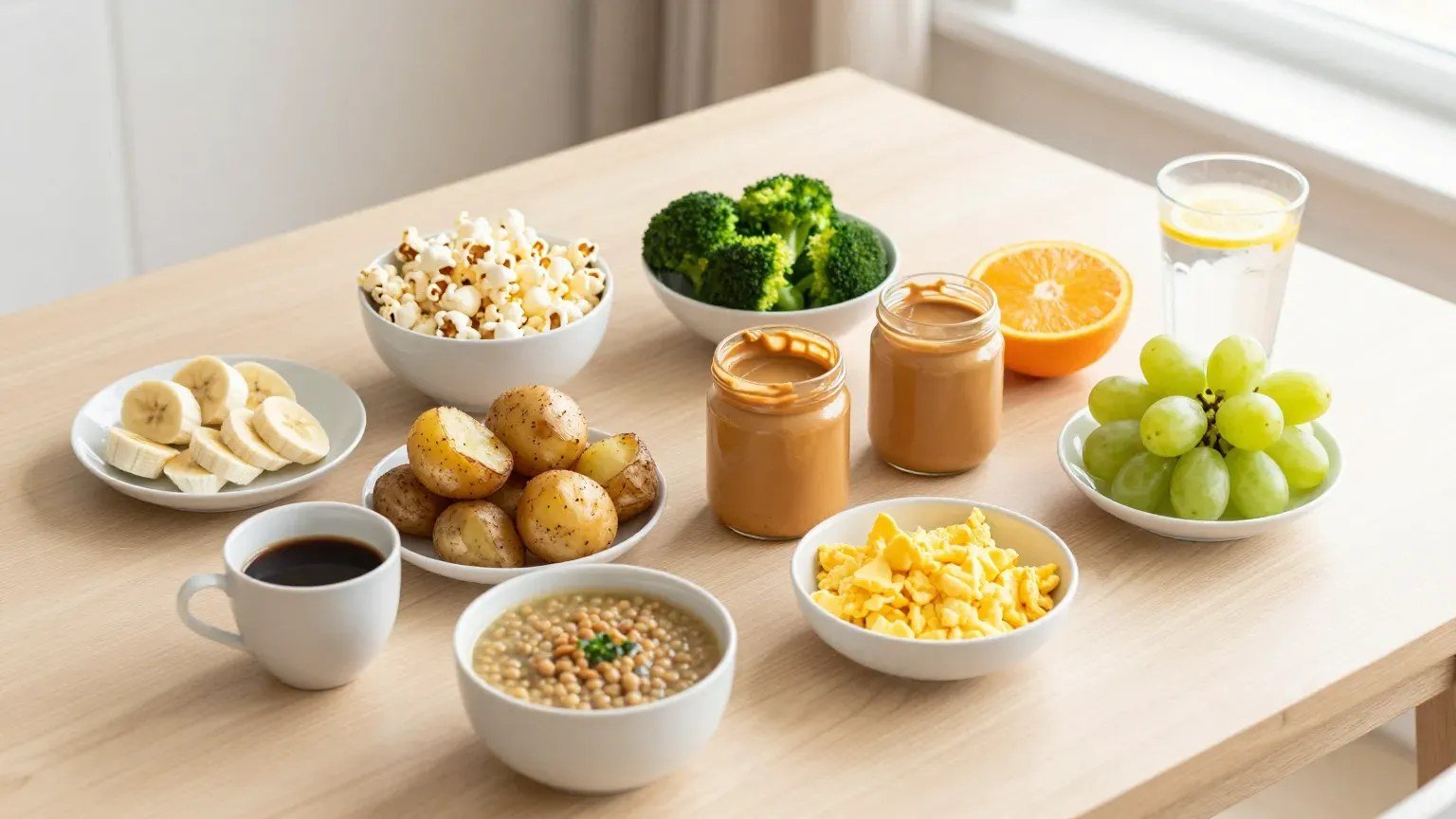
With an ileostomy, output leaves the small bowel through a narrower opening, and foods that break down slowly can gather into a clump. These are the foods most often named in ostomy nutrition guides:
- Nuts and seeds
- Popcorn and corn
- Coconut
- Dried fruit and pineapple
- Celery and coleslaw
- Mushrooms
- Fruit skins, grape skins and the white pith of citrus
- Peas and wild rice
Each of these can come back. Chopped fine, cooked soft, peeled, and eaten in small amounts, most of them pass comfortably. With a colostomy, the colon gives these foods more time to soften, and most people bring them back sooner. Popcorn has its own guide: Can you eat popcorn with an ostomy?
Which foods change gas, odor and output?
Some foods change what happens in the pouch more than others. This chart gathers the ones most often named, which makes it easier to plan a meal around your day.
| Can add gas | Beans, broccoli, cabbage, cauliflower, onions, eggs, corn and fizzy drinks, plus swallowed air from gum and straws |
|---|---|
| Can add odor | Eggs, fish, onions and garlic, cabbage, broccoli, beans, asparagus and strong cheese |
| Can loosen output | Raw fruit and vegetables, leafy greens, fried foods, fruit juice and soda, beans and chocolate, and spicy food for some |
| Helps thicken output | Bananas, smooth peanut butter, applesauce, oatmeal, peeled potatoes, white rice and pasta, cheese and yogurt, and marshmallows |
| Helps with odor | Yogurt, kefir, buttermilk, parsley and cranberry juice |
Gas and odor are part of digestion, and they ease for many people as the gut settles. Timing helps too: a meal that adds gas is easier at lunch than right before an outing. The guide to stoma sounds covers the rest.
A habit that helps
Keep a short food note on your phone: the food, the portion, the time, and how the next day went. After a few weeks it becomes your own food list, shaped by your body rather than anyone else’s chart.
What are the signs a food is not passing well?
Usually normal
Pieces of corn, skins or seeds showing in the pouch, a little more gas the same evening, or a change in color after foods such as beets.
Call your ostomy nurse
- Cramps that come in waves
- Little or no output for several hours along with cramps
- Nausea or vomiting
- A swollen stoma
- Watery output that keeps coming, with thirst or dark urine
The guide to ostomy blockage walks through the early signs and the home steps. On loose days, sip water with a pinch of mineral salt and a squeeze of lemon or lime through the day; the salt helps your body absorb the water and hold on to it. More in hydration with a high-output ostomy.
Which food surprised you?
If a food on this list came back for you, or one gave you trouble that is missing here, share it by email at info@stomastifler.com. Stories are shared only without your name, to help the next person deciding what to put on their plate.
Research that supports these recommendations
Ostomy nutrition guides agree on the big picture: a balanced diet comes back after surgery, new foods are tried one at a time, and a short list of slow-to-break-down foods is eaten in small amounts and chewed well.
Studies of people living with a stoma show fruits and vegetables are the foods most often adjusted, and that clear eating guidance after surgery helps people eat with confidence.
| What the research found | Source |
|---|---|
| Nuts, seeds, popcorn, dried fruit, mushrooms and raw crunchy vegetables are the foods most likely to give trouble after ostomy surgery; the advice is small amounts, chewed well, and new foods tried one at a time. | United Ostomy Associations of America, Ostomy Diet Guidelines After Surgery |
| A hospital teaching sheet lists foods to chew well (nuts and seeds, popcorn, coleslaw, celery, dried fruit, pineapple, coconut, corn, fruit peels and citrus pith), foods that can add gas or odor, foods that loosen output and foods that thicken it. | Children’s Wisconsin, Colostomy/Ileostomy Diet teaching sheet, revised January 2024 |
| Dietary steps such as chewing well and adding fibrous foods slowly help prevent a food bolus obstruction with a stoma. | Burch J. Stoma care and diet in the community. British Journal of Community Nursing, 2024;29(4):195-198. doi.org/10.12968/bjcn.2024.29.4.195 |
| Among 103 people with a colostomy or ileostomy, fruits and vegetables were the foods most often avoided; avoiding foods because of leaks was more common with an ileostomy (20%) than a colostomy (4.8%). | de Oliveira AL et al. A cross-sectional study of nutritional status, diet, and dietary restrictions among persons with an ileostomy or colostomy. Ostomy Wound Management, 2018;64(5):18-29. PubMed 29847308 |
| A structured eating plan with counseling after ileostomy surgery lowered hospital readmissions, including readmissions for dehydration. | Fernández-Gálvez A et al. Nutritional and educational intervention to recover a healthy eating pattern reducing clinical ileostomy-related complications. Nutrients, 2022;14(16):3431. doi.org/10.3390/nu14163431 |
What this means for you: most foods come back. The order, the portion and the chewing are what make them comfortable.
Frequently asked questions
What can you eat with an ostomy?
Most of what you ate before surgery. After the first 4 to 6 weeks of soft, simple foods, foods come back one at a time. A short list, such as nuts, popcorn, corn, coconut and dried fruit, is eaten in small amounts and chewed well.
What foods cause a blockage with an ileostomy?
The foods most often named are nuts and seeds, popcorn, corn, coconut, dried fruit, pineapple, celery, coleslaw, mushrooms, and fruit skins or citrus pith. Chopped fine, cooked soft and chewed well, most of them come back in small amounts.
What foods thicken ostomy output?
Bananas, smooth peanut butter, applesauce, oatmeal, peeled potatoes, white rice and pasta, cheese and yogurt, and marshmallows.
What foods cause gas with a colostomy?
Beans, broccoli, cabbage, cauliflower, onions, eggs, corn and fizzy drinks add gas for many people, and chewing gum and straws add swallowed air. Gas often eases as the gut gets used to a food.
Can you eat salad with an ostomy?
Yes, most people do. Chop the leaves small, start with soft lettuce as a side portion, and chew well. Raw greens loosen output for some people, and with an ileostomy, small pieces pass more easily than large ones.
Last updated November 2026. Written from 14 years of conversations with people living with an ostomy and the people who care for them.