

Stoma noise is not a moral failing. It is data, gas plus liquid plus the geometry of a small opening, all reporting on what your gut did in the last 90 minutes. Once you can decode the sound, you can change it.
Last updated: October 2026
Most ostomates spend the first six months bracing every time their stoma makes a sound in public. The body learns to flinch. Strangers nearby do not notice as often as you think, but you notice, and the flinch itself becomes part of the problem. So before we talk about how to make a stoma quieter, let’s talk about what each kind of noise is.
This is a field guide to the four sound types ostomates report most often, what each one means about your digestion that day, and the specific small change that quiets it down by tonight. For the full noise-suppression product approach Stoma Stifler was built around, see how Stoma Stifler quiets a noisy stoma.

Sound #1, The rumble
A low, slow gurgle that sounds like it’s coming from inside a kitchen pipe. The rumble is the most common stoma sound and it scares new ostomates the most, because it can be loud and it often happens at the worst moment, a quiet meeting, a yoga class, a first date.
What it is. The rumble is gas moving through liquid output. Both are present, the gas is pushing through the liquid, and the bag itself is acting like a tiny resonance chamber.
The fix that works tonight. Reduce the volume of swallowed air. Most rumble is not gas your gut produced, it is air you swallowed while eating, drinking, talking, or chewing gum. The single biggest lever:

- Eat with your mouth closed and chew thoroughly
- Stop drinking through straws (one of the worst offenders)
- Stop chewing gum, especially sugar-free gum with sorbitol
- Take 30 seconds to settle before you start eating, anxious fast eating triples swallowed air
Within 48 hours of changing these four things, most ostomates report the rumble drops by half. It is the closest thing to a one-day fix in ostomy life.
Stoma Noise Decoder
Sound #2, The squeak
A high-pitched, brief sound that often surprises even the person it’s coming from. Squeaks are short, sharp, and often happen when the stoma is “burping” a pocket of gas through a narrow opening or against the wafer.
What it is. A squeak is gas being expelled through a tight space. The stoma itself can act like the neck of a balloon when the opening compresses against the wafer or when output is thicker than usual.
The fix. Squeaks happen because gas is forced out through the stoma instead of escaping a different way. The Stoma Stifler design absorbs and dissipates that escape pressure across a wider surface area, which converts what would have been an audible squeak into a soundless dispersion. The full Stoma Stifler kit includes the molded cup, anchor plate, and snug bands designed for this exact problem.
Sound #3, The gurgle
A wet, bubbly sound, often happening in clusters. Gurgles are the soundtrack of a stoma that has too much liquid output and too little structure.
What it is. Watery output passing through the stoma, often after eating something that triggered fast transit (caffeine, alcohol, raw veg, certain artificial sweeteners) or in the first hour after a meal when your gut is processing fast.
The fix. Soluble fiber. A small daily dose of psyllium husk powder bulks output enough to dramatically reduce gurgles. Start with half a teaspoon stirred into a glass of water once a day, work up to a full teaspoon over a week. Avoid the gummy fiber chews, they have sugar alcohols that often make things worse.
If you are an ileostomate, fiber is especially powerful. Output that was watery can become applesauce-textured within 3-5 days, and that texture change alone resolves most of the gurgling and most of the leak risk too.
Sound #4, The pop
A brief, percussive sound, like a tiny champagne cork. Pops are usually a sign of pressure release.
The clinical context for distinguishing benign from concerning sound patterns:
- Quality of life is at stake, and nurse support helps. A 2018 review found ostomy surgery can impair quality of life, and that involving an ostomy nurse increases acceptance, reduces complications, and improves quality of life. According to PubMed (DOI 10.3238/arztebl.2018.0182).
- Your stoma type shapes your baseline. A 2025 systematic review comparing ileostomy and colostomy found meaningfully different complication profiles, with ileostomy showing fewer overall complications. According to PubMed (DOI 10.3389/fmed.2025.1610213). Output consistency differs by stoma type as well, which is part of why your noise pattern is partly set by which stoma you have.
- Most stoma issues respond to conservative care. A 2019 review documents that the majority of stoma complications are managed without surgery, through pouching technique, dietary adjustment, and skin care. According to PubMed (DOI 10.1055/s-0038-1676995). The same levers that manage those issues are the ones that quiet noise.
- Know what is worth a nurse check. A 2023 mapping review catalogs structural stoma complications, retraction, stenosis, prolapse, parastomal hernia, and notes most are managed conservatively while some need surgical revision. According to PubMed (DOI 10.1186/s13017-023-00516-5). If your sound pattern changes suddenly and stays changed, have a stoma nurse rule these out.
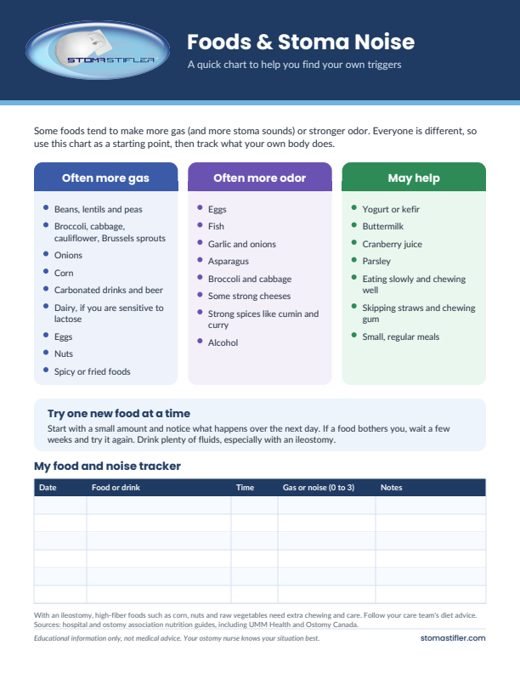
What it is. Gas pressure has built up faster than your appliance can release it, and a pocket of gas escapes through the stoma in a burst. Carbonated drinks and gas-forming foods (broccoli, cabbage, onions, beans, beer) are the usual culprits.
The fix. Identify your top three trigger foods and either eat them earlier in the day (so the gas resolves before you’re in a quiet setting) or pair them with the right cover and skip them entirely on days you have something important. The Stoma Stifler kit handles the pressure-release moments by absorbing the burst across the molded cup rather than letting it escape audibly through the stoma, that is the original problem the product was designed for.
Why your stoma gets louder at 3pm
Most ostomates notice an afternoon noise spike. There is a real reason: mid-afternoon is when most people hit the lowest point of hydration, when post-lunch processing peaks, and when you have probably consumed your most concentrated swallowed-air load (the rushed lunch, the second coffee, the chewing gum).
The 3pm fix is a tall glass of water at 2pm and a deliberate slow walk for 10 minutes. Water dilutes the concentrated output, walking moves the gas through without the resonance-chamber effect of sitting. Two simple inputs, one common outcome, a noticeably quieter afternoon.
The Stoma Stifler approach to what’s left
After the diet and habit changes, anything left is naturally going to be quieter, but you still need a physical cover that absorbs and dissipates gas escaping through the stoma. That is exactly what Stoma Stifler was invented for. It is not a fabric pouch wrap or a thin filter sticker, it is a molded cup-and-band system that converts audible gas release into silent dispersion across a wider surface area.
The kit includes the molded Stoma Stifler cup and arm, the anchor plate, two adjustable snug bands (long and short), and a roll of hypoallergenic breathable tape. See what’s included and order the kit here, or read reviews from ostomates who have used it. For insurance reimbursement options, see the insurance coverage page.
When to call your stoma nurse
Most noise is not a medical issue. But some sounds are worth a call:
- Sudden, persistent change in sound character (a previously quiet stoma now constantly loud), could indicate infection, blockage, or appliance issue
- Noise paired with output stopping for 12+ hours, or output going to pure water for 8+ hours
- Pain accompanying the noise (especially in ileostomates, possible partial blockage)
- Stoma color change paired with new noise patterns
If those are not present, the noise is almost always a diet, habit, or appliance issue, all of which are workable from home.
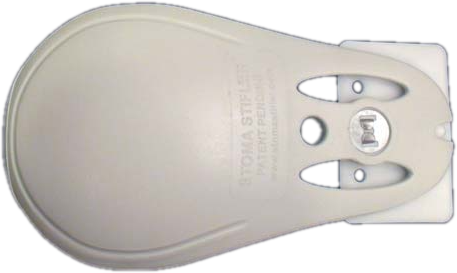
Stoma Stifler™, The Sound Suppressor + Stoma Guard Most Ostomates Wish They’d Found Sooner
The two-week noise reset
If you want a structured plan, here’s the version most ostomates respond to:
Decoding stoma sounds is mostly about learning YOUR baseline and recognizing departures from it. Most stoma sounds are benign and self-resolving. The handful that warrant a nurse visit (sudden silence, sudden much-louder pattern, persistent unexplained changes) are usually obvious in retrospect. The community pattern: readers who keep a brief daily log for the first 30 days develop pattern-recognition fast and rarely need to wonder afterward. The readers who feel chronically anxious about sounds usually skipped the tracking phase.
- Days 1-3: Stop straws, stop gum, eat with mouth closed, slow down at meals.
- Days 4-7: Add half a teaspoon of psyllium daily, increase to a full teaspoon by day 7.
- Days 8-10: Add the Stoma Stifler kit for the residual pressure-release sounds the diet changes can’t reach.
- Days 11-14: Identify your top three trigger foods (track for one week, simplest is a notes app entry after each meal noting any noise events). Either time them earlier in the day or trade them out.
By day 14, most ostomates report a dramatic drop in audible events. Not zero, your stoma is a working organ and it will always have some sound, but quiet enough that public life feels normal again.
The reframe that matters most
Stoma noise is information. Each sound is your gut telling you what it just did. The more you can decode the sound rather than fear it, the less power it has over your day.
You did not lose privacy because of an ostomy. You gained a more attuned relationship with your body’s signals. That is a strange kind of gift, but ostomates who lean into it almost always come out the other side with less anxiety than they had pre-surgery.
For the full noise-management framework see our companion guide on managing stoma noise and the broader first-year ostomy framework. To order the Stoma Stifler kit, head to the shop page.
Affiliate disclosure: Some links in this article are Amazon affiliate links. If you purchase through them, Stoma Stifler may earn a small commission at no extra cost to you. See our full affiliate disclosure.
More from the Ostomy Library
- How to muffle ostomy bag sounds: Practical ways to muffle pouch and stoma sounds.
- Quiet ostomy bag strategies: 8 strategies for a quieter pouch.
- Stoma noise in meetings: How to handle stoma sounds in meetings and quiet rooms.
Browse all Stoma Noise and Odor guides or the full Ostomy Library.
Further reading on The Wellthie One
- Keeping a health journal: What to track (food, symptoms, changes) and what to show your doctor.
Frequently Asked Questions
Is what I'm experiencing normal after ostomy surgery?
Most concerns ostomates have, bag noise, gas, occasional leaks, skin irritation, body-image adjustment, are normal in the first 6-12 months. The frequency and intensity drop significantly as your body adapts and your routine settles. Reach out to your ostomy nurse if anything feels worsening rather than improving.
When should I call my ostomy nurse or doctor?
Call promptly for: peristomal skin that's painful, bleeding, or breaking down; stoma color changes (dusky, purple, pale); no output for 4-6 hours with cramping (possible blockage); high output that won't slow despite reducing fiber and adding electrolytes; or a hernia bulge that becomes painful or won't reduce. Most other concerns can wait for your next scheduled appointment.
Does the Stoma Stifler help with this?
The Stoma Stifler is a stoma guard and noise suppressor in one. Its dense foam cup muffles stoma sounds and shields the stoma from bumps and pressure, without restricting output. It works with your existing pouching system and doesn't interfere with skin care or wafer adhesion. Pairing it with the basics, good skin routine, hydration, and any complementary supplies above, covers most daily-comfort challenges.