
Reintroducing foods after ostomy surgery can stir up two feelings at once: you miss a crisp salad, popcorn or a handful of nuts, and you fear that one wrong bite could cause a blockage. For many people those favorites do come back, one small, well-chewed portion at a time, and the tool below shows you which food to bring back first.
Bringing foods back, in short
- Often around weeks 5 to 8, with your care team’s go-ahead
- One new food at a time, small, at lunch, chewed well, with fluids
- With an ileostomy, peeled and cooked versions come first
- With a colostomy, there is usually more freedom
For what to eat day to day, see the ileostomy diet and the colostomy diet guides. This one covers weeks 5 to 8 and beyond.
Which food should you bring back first?
At a glance
| When to start | When your surgical team says you are ready, often somewhere in weeks 5 to 8 |
|---|---|
| How much | One new food at a time, in a small portion |
| Best time | Lunch or earlier in the day, not late at night |
| How to eat it | Chewed well, with plenty of fluid through the day |
| Go slow with an ileostomy | Nuts, seeds, popcorn, corn, raw fibrous vegetables, fruit skins, dried fruit, celery, mushrooms, coconut |
| With a colostomy | Usually more freedom, with gas and odor the main points to plan around |
| Call your care team | Cramping, swelling, or little or watery output. Call right away or go to the emergency room if there is no output for several hours with cramps, swelling, nausea or vomiting |
Pull up a chair
There’s a seat saved for you in a private Facebook group where ostomates and caregivers trade what works.
Members compare which foods they brought back first, how they tested them and what they learned along the way.
Pull Up My ChairPrivate group. Ask the questions you’d rather not ask out loud, even anonymously. Only members see what you share.
Why missing your favorite foods feels so big
Food is rarely just food. It is the toast you have every morning, the salad you order with a friend, the popcorn you share on the couch. After ostomy surgery, the bowel empties through a stoma (a small opening on your belly) into a pouch (the pouch that collects output, meaning whatever comes out of the stoma). Many of those small rituals pause at once, and every plate can start to feel like a question.
The small rituals that pause at once
People often describe the first month as everything arriving at once: healing from surgery, learning the pouch, concerns about leaks, and figuring out which foods are safe. The low-fiber plan most people go home with is there for good reason, but by weeks 5 to 8 it can feel like a fence around the foods you love.

When experienced ostomates share the good moments, a meal often makes the list: the first restaurant visit without concerns about the pouch, or enjoying a plate of something they had missed without bracing for what might follow.
The fear makes sense and deserves respect, because with an ileostomy some foods can cause a blockage. And a fear left untested tends to grow. The aim is not to rush you. It is to give the fear a plan.
 A peek inside
This is what an 8-Week Food Plan looks like: the foods you miss, placed on the right step of a week-by-week staircase.
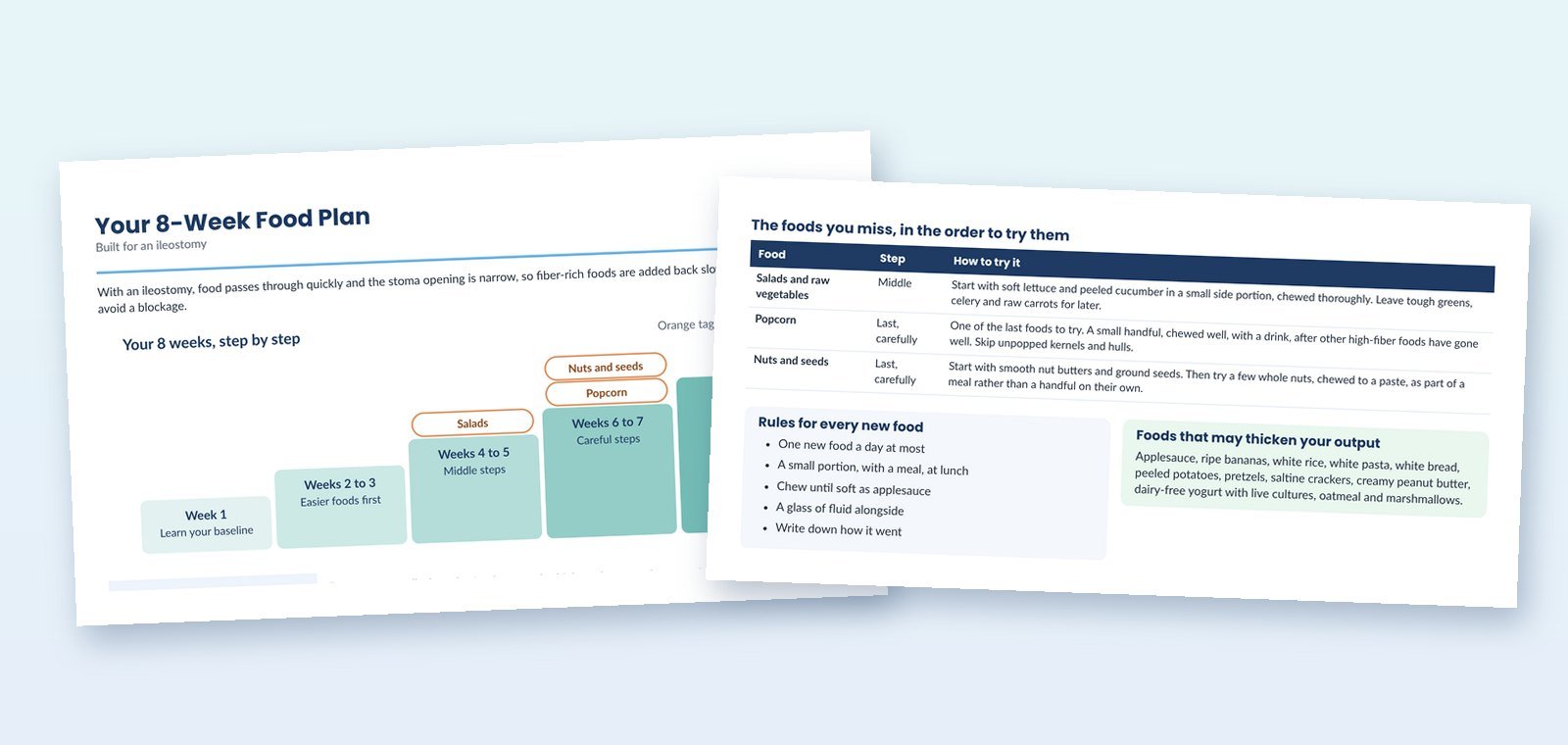
- The foods you miss, placed on the right step
- Rules for every new food you try
- Foods that may thicken your output
Answer a few questions and see your Confidence Score and top 3 priorities before you decide anything. Food and what to eat is already ticked for you. See more sample pages
When can you start reintroducing foods after ostomy surgery?
The first weeks belong to the eating plan your surgical team gave you, usually softer, lower-fiber foods while the bowel heals and swelling settles. For many people, somewhere around weeks 5 to 8 is when the team begins to widen the menu, though timing depends on your surgery, your recovery and your output. Signs it may be time to ask: output has settled into a rhythm you can mostly predict, small meals sit comfortably, and you are keeping up with fluids.
How the table usually opens
Questions worth bringing to your next visit
- Which foods should wait, and for how long?
- Does anything about the surgery change the usual advice?
- How much fluid to aim for each day, and whether some of it should be an oral rehydration drink.
- Who to call if cramping or a drop in output follows a new food.
The eating normal again guide lays out a week-by-week plan for adding foods back, and pairs well with the steps below.
How do you bring a favorite food back safely?
The method is simple, and that is its strength. Each step lowers the chance of trouble and makes any change easy to trace.
- 1One food
- 2Small portion
- 3At lunch
- 4Chewed well
- 5Fluids
- 6A note
One new food at a time. If three new foods share a meal, there is no way to know which one caused a change.
A small portion. A few bites, a spoonful or a small handful. You can always have more next time.
At lunch, not late at night. Earlier in the day, you are awake to notice how your body responds, with hours for the food to pass through before bed.
Chewed well. Chew each bite until it is soft before you swallow. Your teeth do the work fibrous food needs, which matters most with an ileostomy.
Plenty of fluid. Sip through the day, not only with the meal. UOAA, the United Ostomy Associations of America, advises good hydration and thorough chewing for everyone with an ostomy.
A note of how it went. The food, how much, the time, and what output was like over the next several hours: thicker, looser, more gas, any cramping.
Then leave a little space before the next new food, so each one gets a fair test. Over a few weeks, those notes become your own list: foods that work, foods to try again later, and foods to keep small.

Staying ahead on fluids
With an ileostomy, the colon, which normally absorbs much of the water from food, is removed or bypassed, so fluid losses through output can be larger. Plain water is not always enough, and some people need an oral rehydration drink with the right balance of salt and sugar. Ask your care team what suits you, and see the high-output and hydration guide if output runs high. Dark urine, dizziness, a dry mouth, passing little urine or muscle cramping are signs to call your care team.
In the glass
A small pinch of unrefined mineral salt and a squeeze of lemon or lime help the body absorb the water and hold on to it (the citrus alone if you have been told to limit salt).
On high-output days
With an ileostomy, the oral rehydration drink your care team suggests stays the main drink, since a little sugar helps the gut absorb salt and water.
Keeping up with fluids is one of the quiet supports of bringing fiber back, and it is easier when you can see your progress. A glass water bottle with measurement marks lets you glance at the counter and know whether you are on track for your care team’s goal. On a day a new food leaves your stomach a little unsettled, a warm cup of organic ginger tea is a gentle comfort, though cramping with less output is always a reason to call your care team.
KIVY Glass Water Bottle with Measurements
 View on Amazon
Borosilicate glass with measurement marks and a protective sleeve, so a daily fluid goal is easy to see.

As an Amazon Associate, Stoma Stifler earns from qualifying purchases. Disclosure
Your 8-Week Food Plan in My Ostomy Blueprint places the foods you miss on the right step of a week-by-week staircase, with rules for each new food you try. See your top 3 priorities
Which foods are most likely to cause a blockage with an ileostomy?
With an ileostomy, food leaves through the small intestine, which is narrower than the large intestine, and passes through the wall of the belly at the stoma. Foods that are fibrous, stringy or wrapped in a tough skin do not always break down fully, and pieces can bunch together at a narrow point. These are the foods most often linked to blockage:
The foods most often linked to blockage
Each of these can come back. They come back later and carefully, one at a time, once softer foods have gone well and your care team agrees.
Peeled and cooked versions first
Starting with a softer version of a favorite is one of the gentlest ways back. Cooking softens fiber, and peeling removes the toughest part.
- Missing salad?Start with well-cooked, peeled vegetables such as carrots or zucchini, or a smooth vegetable soup, before raw greens.
- Missing nuts?Smooth nut butter often comes first.
- Missing fruit with skins?Try a baked, peeled apple or applesauce before a whole apple.
- Missing popcorn or corn?These usually come back last, after many other foods have gone well.
- Missing dried fruit or coconut?Leave them for later, then try a small amount, chewed well.
In one online conversation about foods that surprised people after surgery, some ostomates said they now eat salads, nuts and even popcorn without trouble. Others in the same conversation found that mushrooms and fibrous vegetables stayed difficult. Both experiences were true for those people, and a slow, personal test matters more than anyone else’s list.
What are the signs of a blockage, and when should you call?
Knowing the signs ahead of time is calming in itself. You know when a food did not agree with you, and when it is time to call.
Signs of a partial blockage
- Cramping, often coming in waves
- Swelling of the belly, or a stoma that looks more swollen than usual
- Little output, or thin, watery output
Call your care team for advice. If you are not nauseated or vomiting, UOAA suggests stopping solid food and sticking to liquids such as warm broth or tea, and a warm bath or shower can help relax the belly muscles. If the stoma swells, a wafer (the sticky skin barrier) cut a little larger than usual makes room.
Signs of a full blockage
- No output for several hours
- Cramps and swelling
- Nausea or vomiting
No output for several hours together with cramps, swelling, nausea or vomiting means stop eating and drinking and call your care team right away. If you cannot reach them, go to the emergency room, say that you have an ileostomy and may have a blockage, and bring your pouching supplies. UOAA offers a printable emergency blockage card and a food journal on its diet and nutrition page.
A stoma that turns dark red, purple, black or unusually pale also needs a call right away. The full ostomy blockage guide walks through each sign in more detail.
Is it normal to see pieces of food in your pouch?
One ostomate was startled to see recognizable pieces of bell pepper and onion in the pouch several hours after eating. Another was alarmed when output turned an unexpected color after a brightly colored meal. Both are common surprises in the months after surgery.
Some foods pass through partly whole, especially skins, seeds and fibrous vegetables, and many foods change the color of output. On its own, that is not a blockage. What matters is whether output keeps flowing and you feel comfortable. A food that comes through mostly whole can be a hint to chew it longer, cook it softer or keep the portion smaller next time.
Common, and fine
Pieces of skin, seeds or fibrous vegetables, or a new color, while output keeps flowing and you feel comfortable.
A reason to call
Little or no output, with cramps or swelling.
Seeing food in the pouch is one of the reasons people most often give for avoiding a food long term. A softer version deserves a second try before you cross it off.
Do you have more freedom with a colostomy?
Usually, yes. With a colostomy, output comes from the large intestine, and blockage from food is less common than with an ileostomy, so many people return to most of their usual foods sooner. The small-step method helps here too, because it shows which foods bring gas, odor or firmer output. The colostomy diet guide covers the details, including ways to ease constipation.
Foods that bring more gas or odor
With any type of ostomy, gas and odor are harmless, and they do shape how at ease you feel at a meeting or a dinner out.
Foods people mention for extra gas
Foods people often mention for extra gas include beans, cabbage, broccoli, onions, fizzy drinks and sometimes dairy, and some notice a lot of gas after pizza or beer. Eggs, fish, garlic and onions can make output smell stronger for some.
None of these needs to go automatically. Many people time them, saving them for relaxed days at home rather than the day of an important event. A smell when you empty the pouch is expected; a smell from a closed pouch usually points to the seal, not the food. The guide to colostomy gas has more on timing.
Coffee shows how individual this is. Some ostomates say their morning coffee makes the stoma much more active, while others notice no difference at all.
The joy of a first salad again
For many people, the first salad back is about much more than lettuce. It is a sign that the table is opening again.
One person described eating a salad for the first time in years and finding that nothing unusual happened, apart from a little extra gas. Others in the same conversation said salads had become a regular part of their week.
If your care team agrees and cooked vegetables have gone well, a first salad might look like this:
- 1Soft greens
- 2A small handful
- 3No extras yet
- 4At lunch
- 5Chew, sip, note
Choose soft greens, such as butter lettuce, rather than crunchy or stringy leaves.
Keep it to a small handful, a side-plate portion rather than a big bowl.
Leave out the higher-risk extras for now: nuts, seeds, celery, mushrooms, corn and dried fruit.
Have it at lunch, on a day you can be at home or close to home that afternoon.
Chew each bite well, sip fluids through the afternoon, and note how it went.
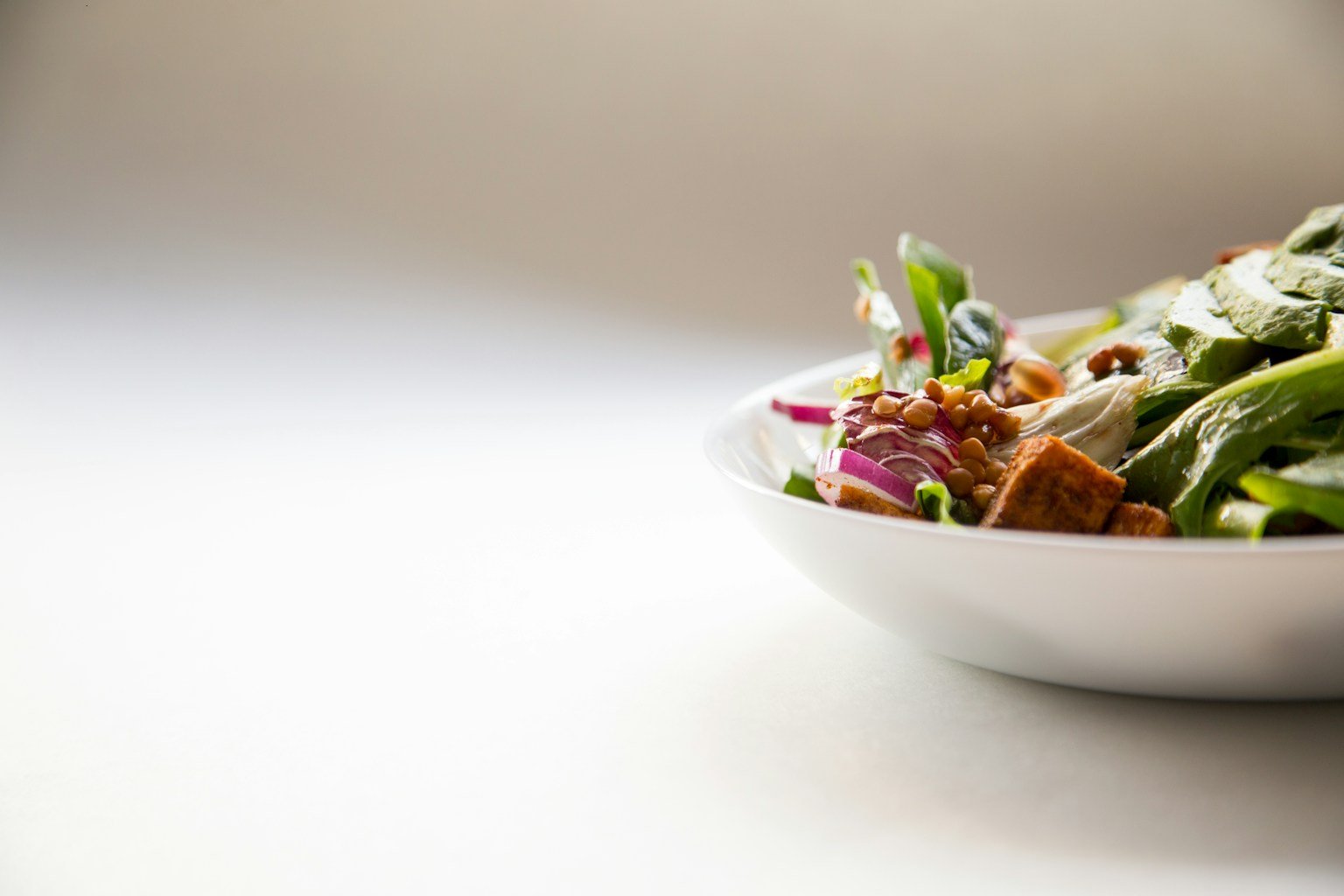
Then let yourself enjoy it. Celebrating small victories is one of the habits experienced ostomates recommend most.
What if a food does not agree with you?
It happens to almost everyone, and it is not a failure. A food that disagrees with you this month may sit well a few months from now, cooked differently or in a smaller portion. Some people do need to avoid a particular food long term, and that is a normal part of an individual diet too.
Not yet
A food that disagrees this month may sit well a few months from now, cooked differently or in a smaller portion.
A short list of exceptions
One or two foods may stay off the plate, and that is a normal part of an individual diet.
Bodies vary more than food lists suggest. In support groups, one person swears bananas help thicken output, while another says they make almost no difference. Your own notes and your care team’s advice matter more than anyone’s experience online.
From 14 years of conversations with ostomates
The people who end up with the widest table are rarely the boldest eaters. They tried one food at a time, kept a simple note, and treated a food that did not agree with them as “not yet” rather than “never,” trying again later with their care team’s blessing. They also accepted, without guilt, that one or two foods might stay off the plate. A short list of exceptions is not a small life.
If you are cooking for someone you love
Caregivers often ask what their loved one should be eating. It depends on the type of ostomy, the surgery and the stage of recovery. With a new ileostomy, watch fluids, output and the foods most linked to blockage; with a colostomy, gas and constipation are more often the focus. Offering one new food at a time, in a small portion at lunch, helps without taking over the plate.
Your first bite back could steady someone else
If you have brought a favorite food back after ostomy surgery, what you tried first, what surprised you and what you wish you had known, share it by email at info@stomastifler.com. Stories are shared only without your name, to help the next person missing the foods they love.
Research that backs up this guidance
Research on eating with an ileostomy shows that food avoidance, mostly of fruits and vegetables, is common and often lasts well past the healing weeks. Early on, the most common reason people gave was being told to, and many feel anxious about their diet or receive conflicting advice.
Researchers increasingly point to a gentler path once healing is done: bring foods back one at a time, set aside only those that cause problems, and use softer or cooked textures to include fiber. Professionals see this careful, personal testing as central to learning what works.
| What the research found | Source |
|---|---|
| In a survey of 291 people with an ileostomy, over half felt anxious about managing their diet with a new ileostomy, and 62% said at least some advice they received was conflicting. | Mitchell et al., Colorectal Disease, 2020PubMed ID 32668070 |
| Among 53 people with an ileostomy or a reversal, over 85% avoided foods, mostly fruits and vegetables; the authors concluded that after healing, foods should not be excluded unless they cause problems once reintroduced. | England et al., Journal of Human Nutrition and Dietetics, 2023PubMed ID 36932682 |
| Interviews with 21 healthcare professionals found that, because people differ, careful trial and error with food is key to managing an ileostomy, encouraged in a controlled way. | Mitchell et al., Journal of Human Nutrition and Dietetics, 2023PubMed ID 36944550 |
| A review of updated guidance in inflammatory bowel disease, including people with an ileostomy, favored softer, cooked or otherwise modified fiber-rich foods over cutting them out, with gradual fiber reintroduction after surgery. | Gold et al., Current Gastroenterology Reports, 2025PubMed ID 40131665 |
| A review found that dietary restriction often continues well past the post-surgery period for people with an ileostomy, and that personalized dietary advice has shown some benefit for quality of life and nutrition. | Magee et al., Proceedings of the Nutrition Society, 2026PubMed ID 41502376 |
| A review for community nurses set out dietary steps for people with a stoma, including ways to ease constipation and to help prevent a food blockage (food bolus obstruction). | Burch, British Journal of Community Nursing, 2024PubMed ID 38564441 |
What this means for you: Your fear of a blockage makes sense and deserves respect, and it does not have to keep your table small. With your care team’s go-ahead, one small, well-chewed portion at a time, many favorite foods can find their way back.
This article covers what most people share. My Ostomy Blueprint is one plan written from your answers, and it goes further:
- A staircase with the foods you miss on the right steps
- Rules for every new food
- The blockage signs to know
Plus everything else you ask for help with, from food and hydration to sleep and travel, in one place.
Build My BlueprintFrequently asked questions
How long after ileostomy surgery can you eat salad?
It depends on your surgery and your care team’s advice. Many people stay on a lower-fiber plan for the first several weeks, then begin adding foods back, often around weeks 5 to 8 or later. Start with well-cooked vegetables, then a small handful of soft lettuce at lunch, chewed well, with plenty of fluid. Ask your care team before trying raw vegetables.
Can you ever eat popcorn with an ileostomy?
Some people with an ileostomy do eat popcorn again, while others find it stays difficult. Because it is one of the foods most often linked to blockage, it usually comes back last, once softer foods have gone well and your care team agrees. Try a small bowl at lunch, chew each mouthful well, drink plenty of fluid and note how output looks afterward.
What does a partial ostomy blockage feel like?
It often starts with cramping that comes in waves, a swollen belly or stoma, and less output than usual, or thin, watery output. Stop solid food and call your care team for advice. If there is no output for several hours with cramps, swelling, nausea or vomiting, stop eating and drinking and call right away, or go to the emergency room.
Do people with a colostomy need to avoid the same foods?
Usually not as strictly. Blockage from food is less common with a colostomy, so many people return to most of their usual foods sooner. Gas, odor and firm output are what people most often plan around. Bringing foods back one at a time, in small portions, helps you learn your own body, and your surgical team’s advice comes first.
Last updated November 2026. Written from 14 years of conversations with people living with an ostomy and the people who care for them.