

A prolapsed stoma looks longer or bigger because the bowel slides outward, and most cases settle at home with rest, gentle support and a good fit. The checker below shapes the next steps around your stoma.
A prolapsed stoma, in short
- The nine common causes, and the ones you can change
- What a prolapse looks like, and the signs that need care today
- Home steps: lie down, gentle pressure, cold and sugar
- Support belts, a better fit and softer stool
A pink, soft stoma that slips back in gives you time to plan calmly.
Prolapse checker: what does your stoma need today?
Quick facts
| What it is | The bowel pushes out through the stoma so the stoma looks longer, larger or swollen. |
|---|---|
| How common | The most common late ostomy complication, reported in 8% to 75% of people depending on stoma type and surgical technique (2018 review). |
| Common causes | Straining, extra abdominal weight or pregnancy, chronic coughing or sneezing, heavy lifting, weak core muscles, or a stoma opening that is too large. |
| Usual treatment | Conservative first: lie down, gentle pressure, cold compress, sugar to reduce swelling, a support binder. Surgery only if these fail. |
| Get same-day care if | The stoma turns dark red, purple or black, feels cold, will not go back in, or stops draining. |
Pull up a chair
There’s a seat saved for you in a private Facebook group where ostomates and caregivers trade what works.
Members living with a prolapse share the belts, pouch sizes and daily habits that help them feel secure.
Pull Up My ChairPrivate group. Ask the questions you’d rather not ask out loud, even anonymously. Only members see what you share.
What is a prolapsed stoma?
A prolapsed stoma for an ostomate is when your stoma, which is the opening on the outside of your torso for waste to pass through, protrudes from the body telescopically, with the potential to become quite large. This can happen for a variety of reasons, and a prolapsed stoma on its own is rarely an emergency.
A prolapsed stoma is when the bowel telescopes out through the stoma, so it looks longer or larger than usual. It is the most common late ostomy complication and is usually harmless: most cases are managed at home by lying down, applying gentle pressure or a cold compress, and wearing a support binder. Get same-day care if the stoma turns dark red, purple or black, feels cold, will not go back in, or stops draining.
What causes a prolapsed stoma?
Nine common causes lead to a prolapsed stoma:
- Straining during a bowel movementWhen you strain during a bowel movement or because of constipation, it puts extra pressure on your stoma and can cause it to bulge out.
- Being overweight or obeseExtra weight puts pressure on your abdominal walls and can cause the body to push out on the stoma opening, causing a prolapse.
- Pregnancy The extra weight of pregnancy that pushes outward from the body can also put pressure on the abdominal wall and cause a prolapse.
- Connection of the ostomy pouchThe way that the ostomy pouch is attached to the body could put undue pressure on the stoma. A too-tight fit or even too-loose fit, depending on the setup of the attachment, can cause a prolapsed stoma.

- Chronic coughing and/or sneezingIf you have a chronic cough, it can put extra pressure on your stoma and cause it to prolapse. Having the flu, symptoms from a cold, or other respiratory illnesses can cause a person to sneeze and cough more frequently. The pressure from sneezing and coughing can push the stoma out past its regular place of rest.
- Lifting heavy objectsLifting heavy objects can also put extra pressure on your core muscles, which puts pressure on your stoma and may cause it to prolapse. Doctors recommend lifting no more than 10 pounds, give or take, depending on the person.
- Weak core musclesA prolapsed stoma can occur if the core of the patient, the abdominal support of the body itself, is poorly developed. This can happen in infants and in those who have a weaker core muscle structure. The muscles may not be strong enough to hold the bowels in place, and this can cause a prolapsed stoma.
- TumorDeveloping a tumor in the region close to the stoma can put pressure on the stoma if the tumor is growing, causing the stoma to prolapse.
- An excessively large stoma opening on the bodyIf during surgery the surgeon created an opening for the stoma on the torso that was excessively large, this can cause the stoma to prolapse. Surgical steps to correct this may be determined by a doctor if it is necessary.

What does a stoma prolapse look like?
If your stoma starts to look different or larger, these are the signs of a prolapse to watch for:
- The stoma is protruding from the body more than it has in the past. It may look more like telescoping in some cases.
- The stoma color may change from its most usual color to a darker pink, red, or even purple. This can be a sign that the blood is not able to access the full stoma; something may be blocking it. Be sure to have your stoma checked by a healthcare professional to determine if this is the case or not.
- The stoma should feel warm, but if it starts feeling cool to the touch, it can mean the blood flow is reduced, and that needs same-day care.
- The stoma is swollen and larger than before.
- Be aware that the stoma and its shape can change depending on your body’s position. For example, when lying down, the stoma’s length and size go back to a more normal appearance, but when you get up, you notice the signs that it is prolapsed.
Settles when you lie down
Pink, moist and soft. Rest, support and a good fit, with a nurse visit on the calendar.
Dark, cold or silent
Dark red, purple or black, cool to the touch, or no output. Same-day care.
With nine possible causes, your next step depends on which ones fit you, and your Blueprint lays out When to Call for Help, questions for your ostomy nurse, and lifting and support wear guidance. See your top 3 priorities
A Quick Guide to Prolapses
Cecily of Living Beyond the Bag gives a helpful guide to stoma prolapses from her own experience:
 A peek inside
This is what When to Call for Help looks like: green, amber and red signs, so the next step is clear.
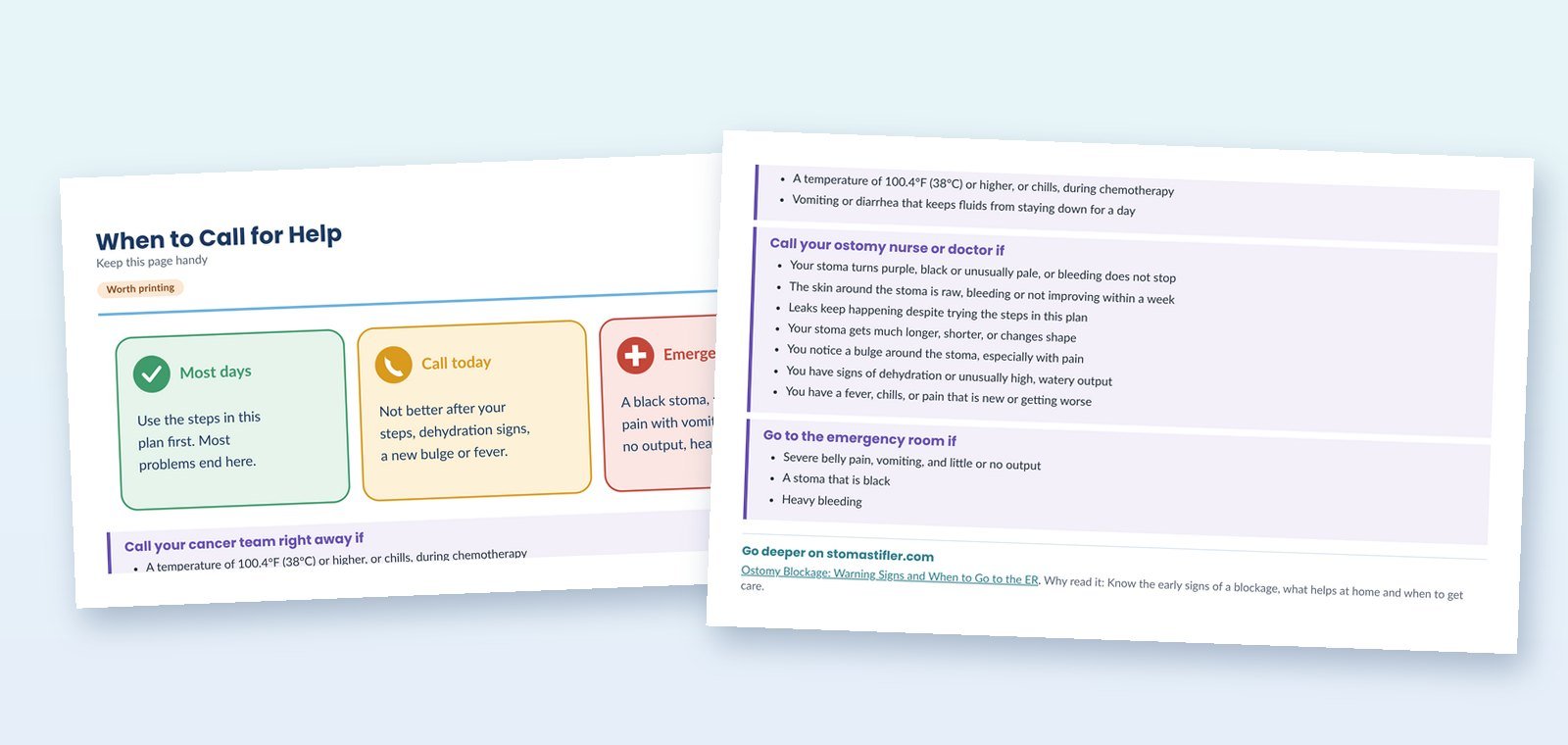
- Green, amber and red signs at a glance
- Who to call for each, from your nurse to the emergency room
- Questions for your ostomy nurse, from your own story
Answer a few questions and see your Confidence Score and top 3 priorities before you decide anything. See more sample pages
When is a prolapsed stoma serious?
Typically, a prolapsed stoma is harmless. It can cause complications for the process of putting on and taking off your pouch, and it makes your torso area look different.
A prolapsed stoma is cause for concern if the blood supply has been cut off, even slightly, and then waste cannot pass through. There is an increased risk of infection when the tissue around the stoma area is irritated.
Fine to manage at home
- Pink to red and moist
- Slips back when you lie down
- Output is flowing
- No pain beyond mild aching
Get same-day care
- Dark red, purple or black
- Cold to the touch
- Will not go back in and keeps growing
- No output, with cramping or vomiting
Also, a prolapsed stoma may make it more difficult to have a bowel movement, which can further irritate the tissue around the stoma and the stoma itself.
If you have a prolapsed stoma and you have not been able to bring it back in with much success, it is important to see a doctor so they can treat the condition before it becomes more serious.
How do you fix a prolapsed stoma at home?
The following offers advice on 7 options on how to fix a prolapsed stoma:
- 1Lie down
- 2Gentle pressure
- 3Cold compress
- 4Sugar for swelling
- 5Softer stool
- Lie down and press gentlyLie down in a comfortable position. Using the palm of your hand, apply flat, gentle pressure to the stoma to see if you can push it back into its usual position.
- Add a cold compressYou can also try using a cold compress while your pouch is in place while also using the palm of your hand to gently direct your prolapsed stoma back into its original position.
- Use sugar on swellingTo treat a swollen, prolapsed stoma, you can use granulated sugar to draw out the excess fluid from the swollen stoma and help reduce its size. Be mindful that when the sugar draws fluid out of the stoma, the output in the pouch will look syrupy for a while, which is expected.
- Keep stool softTo help relieve the pressure on a prolapsed stoma, softer stool means less straining during bowel movements, which lowers the risk of further prolapse. Water with a pinch of mineral salt and a squeeze of citrus, plus a gentle natural fiber such as psyllium, keeps stool soft.
Be aware that alcohol consumption can cause constipation and thus put a strain on your bowel movements. Vasopressin is a hormone that helps your body hold fluid by preventing it from exiting in the urine.
Alcohol has the ability to reduce your body’s ability to release vasopressin, which will make you urinate more. When you urinate more, the risk of dehydration is higher, and you are also more likely to become constipated as a result. Constipation and the straining required for a bowel movement under these circumstances can then lead to a prolapsed stoma.
A swollen prolapse, step by step
What if home care does not bring it back?
- Weight lossIf you are overweight or obese, losing weight may help reduce pressure on your abdominal wall and help treat the prolapse. Losing weight also works towards preventing a prolapsed stoma.
- SurgeryIn some cases, surgery may be necessary to treat a prolapsed stoma.
How common is a prolapse?
A 2018 review of intestinal ostomies, doi.org/10.3238/arztebl.2018.0182
How do you live well with a prolapsed stoma?
Prolapsed stomas can be annoying or even concerning if not treated properly, and there are methods you can take to prevent and reduce the prolapse on your own.

If you have a prolapsed stoma that is not responding to the methods mentioned in this article, see a doctor so they can treat the condition before it becomes more serious.
Three simple helpers cover most of daily life with a prolapse: support for the belly wall, a soft seal for a stoma that has changed size, and a gentle fiber against straining.
Adjustable Ostomy Belt with Stoma Opening
 View on Amazon
A breathable support belt with an adjustable opening for the stoma. Put it on lying down, when the stoma is settled.
Safe n’ Simple Moldable Barrier Rings
 View on Amazon
Soft, moldable rings that fill the space around a stoma that has changed size and keep output off the skin.
Viva Naturals Organic Psyllium Husk Powder
 View on Amazon
Organic psyllium husk, a gentle natural fiber. A teaspoon a day with a full glass of water keeps stool soft.
The Stoma Stifler stoma guard
 See the Stoma Stifler
The Stoma Stifler’s firm foam cup sits over the stoma to absorb bumps during sports, work or sleep, and it also muffles stoma sounds. It fits over one-piece and two-piece pouches and slips under an elasticized undergarment, no belt needed. It does not treat a prolapse, so ask your stoma nurse whether extra protection makes sense for you.
As an Amazon Associate, Stoma Stifler earns from qualifying purchases. Disclosure
The short version
Stoma prolapse looks more alarming than it usually is. The literature confirms it’s one of the most common late complications, 8-75% depending on stoma type, and that most cases respond to conservative management before requiring surgery. The reader pattern that matches the clinical data: lie down to reduce, use cold to manage swelling, get provider guidance on manual reduction, and adopt an abdominal binder to reduce recurrence. The people who end up in emergency surgery are typically the ones with vascular compromise (purple-black tissue), strangulation, or unmanageable size, not the ones with visible bulging alone. If yours is pink, soft, and reducible, you almost certainly have time to make a calm decision with your stoma nurse.
What helped your prolapse settle?
If a belt, a routine or a small habit made your prolapse easier to live with, share it by email at info@stomastifler.com. Stories are shared only without your name, to help the next person who notices their stoma has changed.
Evidence Stack, What the Research Shows
Stoma prolapse has been studied as one of the most common late ostomy complications:
A prolapsed stoma, when the bowel telescopes out and looks longer, is one of the most common late ostomy complications, and most cases are managed conservatively rather than with surgery.
Reduce strain, support the area with a binder, and use the risk checker to gauge your situation. A prolapse that will not reduce, changes color, or stops draining needs same-day medical attention.
| What the research found | Source |
|---|---|
| Incidence baseline. A 2018 review of intestinal ostomies reports stomal prolapse as the most common LATE complication, with an incidence of 8-75% depending on stoma type, surgical technique, and patient factors. | doi.org/10.3238/arztebl.2018.0182 |
| Conservative-first management. A 2023 MISSTO-WSES mapping review confirms most stoma prolapses are managed conservatively (manual reduction, binders, lifestyle modification) before considering surgical revision. | doi.org/10.1186/s13017-023-00516-5 |
| Complication profile. A 2019 review of ostomy complications places stomal prolapse alongside parastomal hernia, retraction, and stenosis as the late complications requiring ongoing monitoring. | doi.org/10.1055/s-0038-1676995 |
| Type-dependent risk. A 2025 systematic review found ileostomy and colostomy carry meaningfully different complication profiles, with ileostomy showing fewer overall complications. Prolapse risk in particular is shaped by stoma type and how the stoma is constructed (loop versus end). | doi.org/10.3389/fmed.2025.1610213 |
| Pilot study of a peristomal support device used with a compression binder found parastomal hernia incidence of only 10% over 12 months (typical rates run 30-60% in the first 2 years). Confirms the value of intentional peristomal support during the high-risk first year after surgery. | García-Manzanares ME, et al. (2024). Proof of concept of an experimental prototype for the prevention of parastomal hernia. Updates in Surgery. doi.org/10.1007/s13304-024-01898-0 |
What this means for you: rest, support and a good fit are the first and most common care for a prolapse.
This article covers what most people share. My Ostomy Blueprint is one plan written from your answers, and it goes further:
- When to Call for Help, with green, amber and red signs
- Questions for your ostomy nurse
- Lifting guidance and support wear
Plus everything else you ask for help with, from food and hydration to sleep and travel, in one place.
Build My BlueprintFrequently Asked Questions
Can a prolapsed stoma go back in on its own?
Often, yes. Many prolapses slide back when you lie flat and relax for 10 to 15 minutes. Gentle, steady pressure with a flat palm and a cool compress help a swollen one. If it stays out and darkens, or output stops, get same-day care.
Can you exercise with a prolapsed stoma?
Most people keep walking, swimming and gentle core work, with a support belt on for anything active. Ask your stoma nurse before heavy lifting or strong ab exercises, and stop if the stoma swells or changes color.
Is what I’m experiencing normal after ostomy surgery?
Most concerns ostomates have, such as pouch noise, gas, occasional leaks, skin irritation and body-image adjustment, are normal in the first 6 to 12 months. The frequency and intensity drop significantly as your body adapts and your routine settles. Reach out to your ostomy nurse if anything feels worsening rather than improving.
When should I call my ostomy nurse or doctor?
Call promptly for: peristomal skin that’s painful, bleeding, or breaking down; stoma color changes (dusky, purple, pale); no output for 4-6 hours with cramping (possible blockage); high output that won’t slow despite reducing fiber and adding electrolytes; or a hernia bulge that becomes painful or won’t reduce. Most other concerns can wait for your next scheduled appointment.
Browse all Care and Complications guides or all of My Ostomy Compass.
Last updated November 2026. Written from 14 years of conversations with people living with an ostomy and the people who care for them.