
If you miss the water and have stayed on the shore since surgery, you are far from alone, and most people can swim with an ostomy once they have healed. Your wafer is made to stay on in water, and the tool below finds what will help you get back in.
Back in the water, in short
- Time your wafer change around the swim
- Swimwear that does the quiet work
- A simple plan for the changing room
- Water with a pinch of salt and citrus on sunny days
Ask your surgeon or ostomy nurse when swimming is safe for you.
What would help you get back in the water?
At a glance
| What you may feel | Missing the water, self-conscious in a swimsuit, afraid the wafer will lift |
|---|---|
| Can you swim with an ostomy? | Yes, most people can once healed and their surgeon or nurse agrees |
| Will the wafer stay on? | Wafers are designed to stay on in water; a fresh one applied hours ahead holds best |
| Before you swim | Empty the pouch, cover the filter, and eat a few hours ahead if output concerns you |
| What to wear | A higher waist, a pattern or ruching, a tankini, swim shorts with a liner, or a swim wrap |
| After you swim | Pat the wafer edge dry, change in a private cubicle, and drink well in the sun |
| When to call your nurse | Edges that lift after every swim, sore skin under the wafer, or signs of dehydration |
Pull up a chair
There’s a seat saved for you in a private Facebook group where ostomates and caregivers trade what works.
Members swap swimsuit picks, waterproof tape tips and stories from their first time back in the pool or the ocean.
Pull Up My ChairPrivate group. Ask the questions you’d rather not ask out loud, even anonymously. Only members see what you share.
When missing the water feels personal
Many people living with an ostomy describe quietly avoiding swimming in the months after surgery, along with dating and social gatherings, because they felt self-conscious. For many of them, the turning point was going back to one activity they had loved before surgery, a walk, a dinner out or a swim, and discovering that life was not entirely centered on the ostomy.
Water often carries a lot of meaning, and a swimsuit can feel more exposed than anything else you wear. Feeling self-conscious about that is a natural response to a big change in your body. You might feel grateful that surgery helped you and also feel sad sitting on the side of the pool. Both feelings can exist together, and you do not have to completely accept your ostomy before you start enjoying your life again.
Several ostomy advocates on social media have described how wearing swimsuits, going to events, exercising and sharing photos of themselves helped them become more accepting of their bodies. The confidence did not arrive first. It grew out of doing what they had been avoiding.
Can you swim with an ostomy?
Yes. Most people can swim once their wounds have healed and their surgeon or ostomy nurse agrees. People living with an ostomy swim laps, play in the waves with their grandchildren and float in the sea. Water itself will not harm a healthy stoma, and water does not flow into the opening.
The one step to wait for is healing, so ask your surgeon or ostomy nurse when swimming is safe for you. If you are early in recovery, the guide to exercise after ostomy surgery walks through how people build back up.
Pool, ocean or lake
- A poolis often the gentlest place to start: calm water, a changing room and a shower nearby.
- The oceanbrings waves, sand and sun. Waves can tug at a pouch, so a snug swimsuit or wrap helps it stay close.
- A lake or riveroften means fewer facilities, so plan where you will change and empty before you go.
UOAA (the United Ostomy Associations of America) has a helpful page on swimming with an ostomy, with more swimwear ideas.
 A peek inside
This is what Back to What You Love looks like: your own activities, lined up from gentle to active and built from your answers.
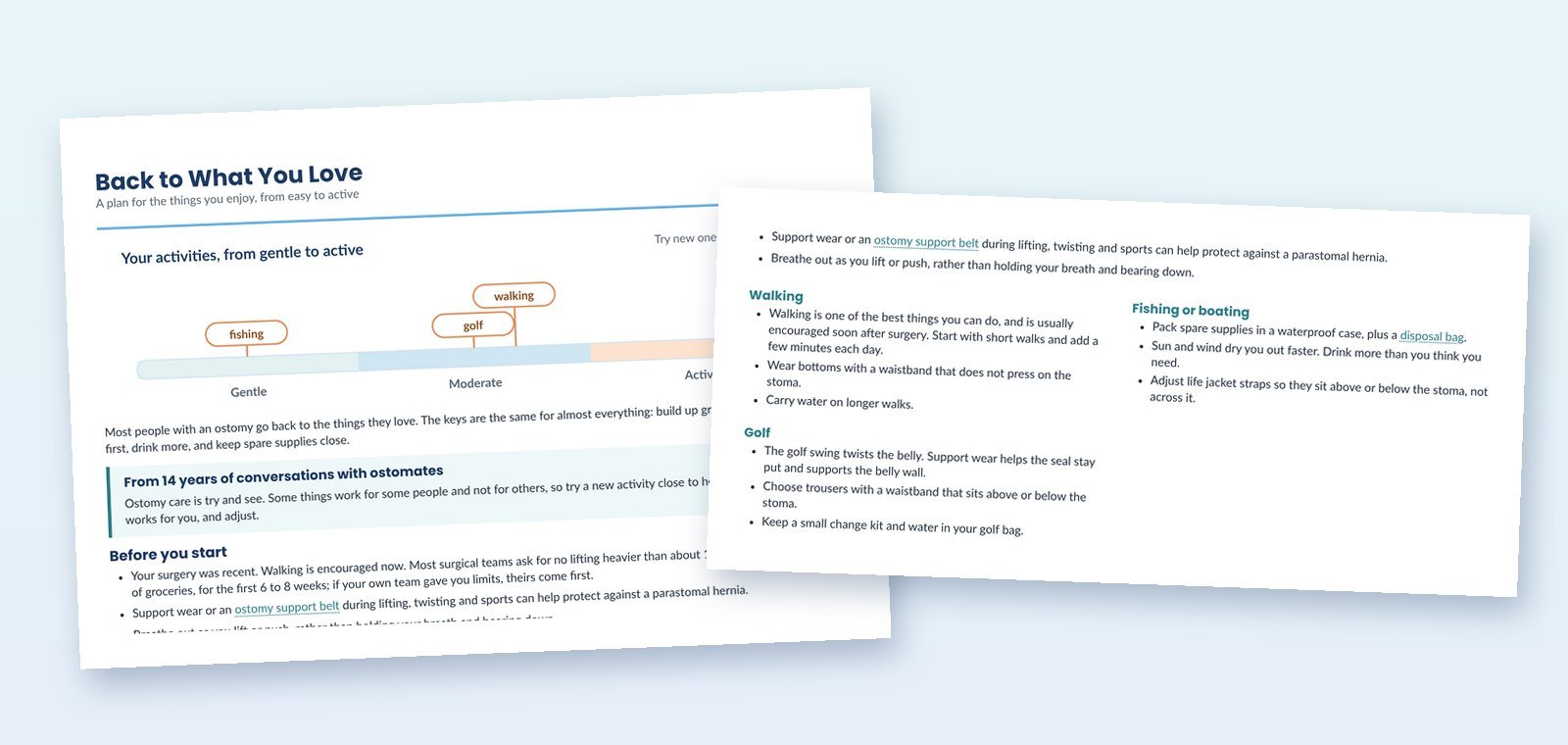
- The activities you name, lined up from gentle to active
- Lifting guidance and support wear for active days
- Notes for each activity, from the first walk to the full game
Answer a few questions and see your Confidence Score and top 3 priorities before you decide anything. Exercise is already ticked for you. See more sample pages
Will your wafer stay on in the water?
This is usually the biggest concern, and it makes sense. You have spent weeks protecting that seal. Wafers are designed to stay on in water, and with a good fit, a pool or the sea is something your wafer is made to handle. What makes the difference is mostly timing and a few small habits.
Give a fresh wafer time to settle
Your wafer, timed around the swim
A wafer bonds more firmly in the hours after you apply it, as it warms to your skin. So rather than changing it right before a swim, change it a few hours before, or the evening before. Make sure your skin is completely dry first, since moisture, oils and lotion residue stop the adhesive from bonding, then rest a warm hand over the new wafer for a few minutes. On a beach day, put your wafer on before your sunscreen, and keep sunscreen clear of the wafer edges.
From 14 years of conversations with ostomates
Plan your wafer change around the swim, not the other way around. Many ostomates change their wafer before eating, when output is less likely to arrive mid-change, and the evening before a swim day is a good time for that. If your wafer usually starts to break down by a certain day, do not stretch it to cover a beach trip. Change it a day early, so you go into the water with a fresh, settled seal.
Before you get in
- Empty your pouch shortly before you swim, so it lies flat and light.
- If your pouch has a filter (a small vent that lets gas out), cover it with the sticker that comes with your pouches, so the filter stays dry and keeps working.
- If output concerns you, eat a few hours before swimming rather than right before, so your stoma is likely to be quieter in the water.
- Run a finger around the wafer edge and gently press down any spot that feels loose.
Try a practice soak at home
If you are unsure how your wafer will hold, a bath at home is a gentle test. Soak for about as long as you plan to swim, then check the edges. Seeing your wafer come through intact, in the privacy of your own bathroom, often does more for your confidence than any reassurance can.

A smaller pouch or a stoma cap
Some people use a smaller pouch for swimming, which lies flatter under a swimsuit. A few people with a colostomy and predictable output use a stoma cap (a small, closed cover) for a short swim. A stoma cap is not suited to an ileostomy or a urostomy, where output flows more often, so ask your ostomy nurse before trying either.
What should you wear swimming with an ostomy?
Swimwear is often where the self-conscious feeling sits most heavily. The right cut and fabric do most of the quiet work. A freshly emptied pouch lies flat, and a few simple choices make it unlikely anyone will notice it.
- A higher waistHigh-waisted bottoms and swim shorts sit over the pouch rather than cutting across it.
- A pattern or a darker colorPrints and darker shades hide the outline of a pouch far better than pale, plain fabric.
- Ruching or a skirtGathered fabric across the tummy, a ruffle or a swim skirt softens the line of the pouch.
- A tankiniA tankini top with high-waisted bottoms lets you reach your pouch to empty it without taking off your whole suit.
- Swim shorts with a supportive linerMany men choose trunks with a higher waist, longer legs and a snug liner, sometimes with a swim shirt.
A wrap made for swimming adds one more layer. It holds the pouch close so it does not float or shift in the water, and smooths its outline under your suit. Some people wear one every time. Others wear one for the first few swims, then find their swimsuit alone feels fine.

Some people find that ostomy-friendly underwear, wraps or pouch covers help them feel more confident. Others discover that the clothes they already owned work perfectly well and they need nothing special at all. Both are good outcomes.
If you have a parastomal hernia (a bulge around the stoma), ask your ostomy nurse whether a support garment or wrap would help while you swim, and see the guide to preventing a parastomal hernia. For clothes in general, the outfit audit for dressing with an ostomy covers what works and why.
How do you handle the changing room?
For many people, the changing room feels more daunting than the water. Open benches, mirrors and strangers can make you feel watched, even when no one is paying attention.
- Choose a private cubicleMost pools have private cubicles or a family changing room, and a toilet stall works too.
- Wear your swimsuit under your clothes,so there is less to change.
- Empty before you change,then step into your cubicle with a flat pouch.
- Bring a large towel or a changing robeto change under at the beach or by a lake.
You do not owe anyone an explanation. If you need to empty your pouch, you can excuse yourself and use the toilet like anyone else. Unless you choose to tell someone, no one needs to know you have an ostomy, and most people around you are far less focused on you than you might imagine.
Packing your swim kit
A small emergency kit is one of the most recommended confidence boosters in ostomy communities. Many people carry one for years and rarely use it, yet knowing it is packed is what lets them relax.
- A spare wafer and pouch, already cut to size
- Adhesive remover wipes and soft dry wipes
- A disposal bag, and a small towel for patting your wafer dry
- Dry underwear and clothes, and water to drink
Keep your supplies out of the hot sun and out of a hot car, since too much heat can damage some ostomy products. At the beach, a sealed zip-top bag keeps sand out.
Two helpers make a swim day easier to settle into. The FSUHHIAD wrap is sold for sport and swimming, with an inner pocket that holds your pouch close, so it stays put in the water and lies smooth under your suit. For the sun, the KIVY glass bottle has measurement marks and a protective sleeve, so you can see at a glance how much you have had to drink before and after your swim.
FSUHHIAD Ostomy Wrap and Pouch Cover
 View on Amazon
A soft wrap with an inner pocket that holds the pouch close, sold for sport, swimming and closeness.
KIVY Glass Water Bottle with Measurements
 View on Amazon
Borosilicate glass with measurement marks and a protective sleeve, so a daily fluid goal is easy to see.
Already wear an ostomy belt? The Stoma Stifler connects to it with the optional belt-clip kit included with every Stoma Stifler.
As an Amazon Associate, Stoma Stifler earns from qualifying purchases. Disclosure
How do you stay hydrated on a sunny swim day?
Sun, warm air and exercise all draw fluid from your body, and in the water you may not notice you are thirsty. Drink before you swim, during breaks and afterward. If your pool does not allow glass on the deck, keep your bottle with your towel and drink each time you step out.
In your bottle
A small pinch of unrefined mineral salt and a squeeze of lemon or lime help the body absorb the water and hold on to it (the citrus alone if you have been told to limit salt).
With a high-output ileostomy
The oral rehydration drink your care team suggests stays the main drink, since a little sugar helps the gut absorb salt and water.
With an ileostomy, take extra care
With an ileostomy (a stoma made from the small intestine), your body loses more fluid and salts through your output, so a hot day can tip you toward dehydration faster. Plain water is not always enough when output is high. Ask your care team whether you need an oral rehydration drink on active, hot days.
The guide to staying hydrated with a high-output ostomy explains more. With a urostomy (a stoma that drains urine), drinking well keeps urine flowing and diluted, which matters even more in the heat.
Get out of the water and into the shade if you notice signs of dehydration: dark urine, much less urine than usual, dizziness, a dry mouth or cramping. Call your care team if they do not ease once you rest and drink.
Starting with a quiet swim
Your first swim does not need to be a crowded beach on a holiday weekend. Many people rebuild confidence the way they rebuild it for any outing: start small, prepare for the unexpected, and add a little more each time.
One person on an ostomy forum described being too anxious to leave home for more than a couple of hours. Experienced ostomates suggested starting with something tiny, a drive around the neighborhood or a coffee at a nearby shop. Another member shared that in four years with an ostomy, they had not once needed to change their whole appliance while out in public.
A quiet way back in, one step at a time
When you climb out and find your wafer holding, take a moment to notice it. That small proof carries over to the next swim. Some people feel at ease in the water within weeks, and others take months or longer.
Your Back to What You Love chapter lists the activities you choose, swimming included, from gentle to active, with notes on lifting and support wear. See your top 3 priorities
What should you do after a swim?
- Rinse off in the shower if you like.
- Pat the wafer and its edges dry with a towel. Some people finish with a hair dryer on its cool setting.
- Change into dry clothes. Hours in a wet suit keep moisture against the wafer edge, which can loosen it.
- Check the edges. If one has lifted, or the skin underneath itches or burns, change your wafer when you get home.
- Empty your pouch and drink a glass of water with a pinch of salt and a squeeze of citrus.
If the edges lift after every swim, mention it to your ostomy nurse. A different wafer shape, a better fit, or a barrier ring (a soft, moldable ring that fills small gaps) can make a big difference. For keeping your skin comfortable between changes, see the gentle routine for the skin around your stoma.
What if your wafer lifts or leaks while you are out?
Even with good preparation, a wafer may lift or leak at some point. Fear of what might happen is often much bigger than what does happen. If it does, you deal with it: wrap your towel around you, head to the changing room, use your kit, and decide whether to swim again or call it a day.
One person called with leaks that kept starting in exactly the same spot. An ostomy nurse found the stoma leaned slightly to one side, and a deeper convex pouch (one with a gently curved wafer that helps the stoma sit into the pouch) with part of a barrier ring over the uneven area stopped the leaks. The answer was not more adhesive. It was understanding the shape of that one stoma.

If a lift or leak keeps happening, it is a fit question with practical answers. Your stoma may have changed size since surgery, and the guide to why ostomy pouches leak and what helps walks through the common causes. And one unexpected moment often shows people they are more capable than they realized.
When should you check in with your ostomy nurse?
Most swimming concerns ease with a little practice. Some deserve a professional look. Contact your WOC nurse (a nurse trained in wound, ostomy and continence care) or your care team if you notice:
- A wafer that lifts after every swim, even when applied well ahead
- Itching, burning or sore skin under the wafer
- A new bulge around your stoma, or discomfort when you swim
- Signs of dehydration that do not ease with rest and fluids
Seek care right away for a stoma that turns dark red, purple, black or unusually pale, for severe pain, or for no output along with cramping and swelling for several hours.
If a beach holiday is the goal, the guide to traveling with an ostomy helps you pack for the whole trip.
Share what helped you back into the water
What helped you swim again after ostomy surgery? Maybe it was a swimsuit that made you feel like yourself, a quiet early swim, or the first time you climbed out and found your wafer holding. Email your story to info@stomastifler.com. It will be shared only without your name, so the next person standing at the edge of the pool feels less alone.
Research that backs up this guidance
Research matches what people living with an ostomy describe. Many people become less active after stoma surgery, held back by fear and by not knowing what is safe. Concerns about clothing and appearance can last for years, and people tend to find their own answers through trial and error.
It also points toward what helps. In one large study, stoma type made no difference to how active people were, and those without a support garment were more likely to fall short of activity guidelines. In a small water-gymnastics course for people with a urostomy, well-being and self-esteem improved.
| What the research found | Source |
|---|---|
| In a pilot water-gymnastics course for people with a urostomy, led by a physiotherapist and a stoma nurse, every participant described the course as positive and enriching, and their well-being and self-esteem improved. | Putz et al., Urologie, 2022PubMed ID 35175364 |
| In a UK survey of 2,631 people with a stoma, many had become less active and fearful of exercise after surgery, and most could not recall being given any advice about exercise or physical activity. | Russell, British Journal of Nursing, 2017PubMed ID 28328269 |
| Among 571 colorectal cancer survivors living with a stoma, about half met physical activity recommendations, stoma type made no difference to activity level, and those without a support garment were more likely to fall short. | Krogsgaard et al., Supportive Care in Cancer, 2021PubMed ID 34342750 |
| Written survey answers from 598 people with a bowel stoma showed support garments being used to prevent or manage a hernia, to conceal the pouch and to handle appliance problems, with ill-fitting garments the main complaint. | Hubbard et al., BMJ Open Gastroenterology, 2019PubMed ID 31275585 |
| Colorectal cancer survivors living with an ostomy for more than five years described clothing restrictions and adaptations, and their solutions tended to be individual, found through trial and error. | Sun et al., Journal of Wound, Ostomy and Continence Nursing, 2013PubMed ID 23222968 |
| Interviews with 15 rectal cancer survivors living with a stoma described both reasons for and deterrents to being physically active, and identified practical strategies that helped them stay active with a stoma. | Saunders et al., Supportive Care in Cancer, 2018PubMed ID 30368673 |
What this means for you: if you have stayed out of the water, you are in large company. A wafer applied ahead of time, a swimsuit you like, a plan for the changing room and a quiet first swim give you good reasons to go back in.
This article covers what most people share. My Ostomy Blueprint is one plan written from your answers, and it goes further:
- Your activities lined up from gentle to active, swimming among them
- Support wear for active days
- A seal check from your Leak Plan before every swim
Plus everything else you ask for help with, from food and hydration to sleep and travel, in one place.
Build My BlueprintFrequently asked questions
How long after ostomy surgery can you swim?
There is no single timeline. Your incisions and the skin around your stoma need to heal first, and your surgeon or ostomy nurse should agree that swimming is safe for you, so ask at your next visit. Once you have that yes, many people start with a practice soak in the bath or a quiet pool swim before a longer swim or a beach day.
Can you swim in the ocean or a chlorinated pool with an ostomy?
Yes. Water will not harm a healthy stoma, whether it is a pool, the sea or a lake, and water does not flow into the opening. Your wafer is designed to stay on in water. Apply a fresh one a few hours before, or the evening before, empty your pouch before you go in, and pat the wafer edges dry afterward.
Can people tell you have an ostomy in a swimsuit?
Most of the time, no. An emptied pouch lies flat, and a higher waist, a pattern or darker color, ruching across the tummy, a tankini or swim shorts with a supportive liner all soften its outline. A wrap made for swimming smooths it further. Unless you choose to tell someone, no one needs to know, and most people are far less focused on you than you might imagine.
Should you use a smaller pouch or a stoma cap for swimming?
Some people do. A smaller pouch lies flatter under a swimsuit, and a few people with a colostomy and predictable output use a stoma cap, a small closed cover, for short swims. A stoma cap is not suited to an ileostomy or a urostomy, so ask your ostomy nurse first. Many people swim with their usual pouch, emptied first.
Last updated November 2026. Written from 14 years of conversations with people living with an ostomy and the people who care for them.