
Sore skin around stoma sites is one of the most common concerns people living with an ostomy describe, and one of the most wearing. When the skin around your stoma (the small, moist opening on your belly) is raw or burning under the wafer (the sticky skin barrier that holds your pouch, or bag, in place), every change stings. It is natural to start dreading each one and to wonder whether your skin will ever heal.
It often can, once the cause is found. The most common cause is output (the stool or urine that comes out of the stoma) touching the skin, because the opening in the wafer is a little too big or the seal has lifted. That cause is also the most fixable. A yeast rash, irritated hair follicles or a reaction to a product each look a little different, and each has its own next step.
This guide helps you read what your skin is telling you, change in ways that let it rest, and know when to call your ostomy nurse, drawing on what people living with an ostomy have shared about the stretch before their skin calmed down.
What is your sore skin telling you?
Answer a few short questions about what your skin looks like, how often your wafer leaks, how long it stays on and how much it hurts. Your answers point to the most likely cause and the steps that help that kind of soreness settle.
What does the sore skin look like?
How often does output get under your wafer?
How long does your wafer usually stay on?
How much does your skin hurt right now?
At a glance
| Most common cause | Output touching the skin, from an opening that is too big or a seal that lifts |
|---|---|
| Opening size | About 1/8 inch (2 to 3 mm) larger than the stoma, unless your nurse said otherwise |
| Clean with | Warm water only, then dry completely |
| Under the wafer | No oily soaps, lotion wipes or moisturizers; a no-sting barrier film if your nurse agrees |
| Change the wafer | As soon as it itches or burns underneath, even before your usual day |
| Hair | Trim with scissors or clippers, never a blade razor |
| Call your nurse | Broken, weeping or bleeding skin, a spotty itchy rash, redness in the shape of a product, or no improvement in a few days |
Why sore skin can make you dread every change
Adhesive touches the skin around your stoma every hour of every day, so sore skin never gets a break. Peeling the wafer off stings, cleaning stings, and the new wafer can sting again. Many people describe a loop: sore skin makes it more difficult for the wafer to stick, a loose wafer lets output through, and output makes the skin sorer.
Feeling discouraged in that loop is understandable. You can be thankful for the surgery that saved your life and still be fed up with skin that burns. Both feelings can exist together, and neither means you are doing this wrong.
One ostomate shared through UOAA that they lived with daily leaks and painful skin irritation for years before seeing a specialized ostomy nurse. At that appointment, they found pouching products that suited their stoma far better, and their comfort and confidence improved dramatically.
Sore skin is a sign that something needs to change, not something to put up with quietly. There is a lot you can do, starting with your next change.
What causes sore skin around the stoma?
Most often, output is reaching the skin. Stool and urine both irritate skin they sit on, and output from an ileostomy (a stoma made from the small intestine) carries digestive enzymes that are especially harsh. It usually gets there in one of these ways:
- The opening is too big. The stoma usually shrinks over the first six to eight weeks as swelling goes down, so an opening that fit in the hospital can leave a ring of bare skin.
- The seal is lifting. Creases, folds, a stoma that sits level with the skin, or a change in weight can let output tunnel under the edge.
- The wafer stays on too long. If yours usually starts breaking down after three days, pushing it to four or five gives output time to creep underneath.
- The skin was damp. Moisture, oils or soap residue keep a new wafer from bonding.
Less often, soreness comes from pulling the wafer off too fast, pulled hairs, a yeast rash or a reaction to a product. The next section shows how each one looks.
One common trap is adding more. Extra paste, powder, tape and spray do not make a stronger seal, and some keep the wafer from sticking. You have options, and a better-fitting wafer often does more than any extra product.
How can you tell what kind of sore skin you have?
At your next change, look at the skin in good light, with a mirror if the stoma is low or difficult to see. Notice where the redness is, what shape it makes and how it feels.
Red, raw or sore right next to the stoma
This is the most common pattern. Redness that hugs the stoma, often worse in one spot, points to output reaching the skin. The answer is a snug opening, a better seal and changing before the seal wears out. If it is always in the same place, note the position like a clock face (for example, 6 o’clock) so your nurse can match it to a leak path.
An itchy red rash with small red dots at the edges
A rash that itches more than it stings, with tiny red spots scattered around its outer edge, can be a yeast (fungal) rash. Yeast grows well in warm, damp skin like the space under a wafer. It is common and treatable: your ostomy nurse can confirm it and suggest a treatment that will not stop the wafer from sticking. Hold off on creams or powders from the medicine cabinet, since many keep the adhesive from holding.
Small red bumps around the hairs
Bumps right where hairs grow may be folliculitis, irritated hair follicles from hairs pulled out each time the wafer comes off. Trim the hair with small scissors or electric clippers rather than a blade razor, and peel the wafer off slowly with adhesive remover. If the bumps turn painful, spread or fill with pus, call your nurse.
Redness in the exact shape of the wafer or tape
Redness with clear edges that match the outline of your wafer or tape, rather than circling the stoma, suggests a reaction to the product itself. It is less common than irritation from output, and careful fitting alone will not calm it. Tell your ostomy nurse which products you use, so a different one can be tried.
Broken, weeping or bleeding skin
Open, oozing or bleeding skin needs your ostomy nurse, whatever caused it. Your nurse may suggest a treatment or a technique that protects the skin while still letting the wafer hold. Call before your next change if you can.

How to take the wafer off without hurting your skin more
When skin is sore, how the old wafer comes off matters as much as how the new one goes on.
- Loosen, do not pull. Apply adhesive remover at the top edge and peel slowly downward, pressing the skin away from the wafer.
- Clean with warm water only. Oily soaps, lotion wipes and moisturizers leave a film that weakens the next seal.
- Dry completely. Pat dry, wait a minute and check again.
- Protect with a no-sting barrier film. If your nurse agrees, wipe on an alcohol-free film and let it dry fully before the wafer goes on.
- Warm and hold. Warm the new wafer between your hands, press it on from the stoma outward, and rest your palm over it for 30 to 60 seconds.
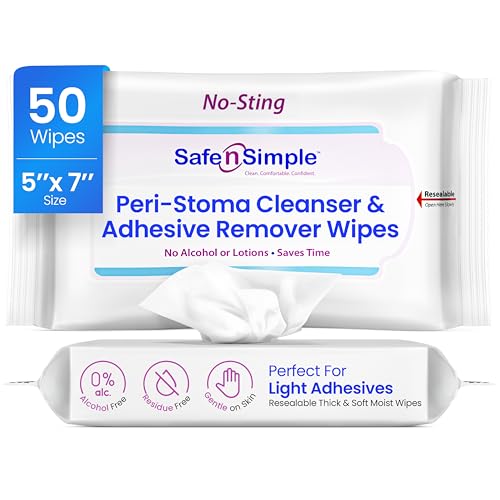
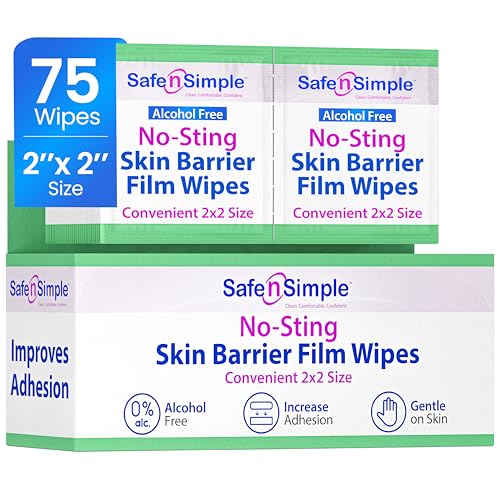
Two small products make the first and fourth steps gentler on skin that already hurts. Both come from Safe n’ Simple, an independent, family-run maker in Michigan. The adhesive remover wipes loosen the wafer so it lifts off gently, without pulling at sore skin. The no-sting barrier wipes leave an alcohol-free film that protects the skin under the wafer.
Safe n' Simple Adhesive Remover Wipes
 View on Amazon
Loosens the wafer so it lifts off gently, without pulling the skin. Safe n' Simple is an independent, family-run maker in Michigan.
Safe n' Simple No-Sting Skin Barrier Wipes
 View on Amazon
An alcohol-free film that protects the skin under the wafer.
As an Amazon Associate, Stoma Stifler earns from qualifying purchases. Disclosure
Beyond that, keep it simple, and keep remover and barrier wipes on your ostomy supply list so a sore-skin day never catches you without them. Once your skin calms down, the gentle routine for the skin around the stoma helps keep it that way.
How do you re-measure your stoma and cut a snug opening?
If the soreness hugs the stoma, re-measure, even if you measured a few weeks ago. Stomas often shrink over the first six to eight weeks after surgery, and size can change later too, for example with changes in weight.
- Find the circle on your measuring guide that fits around the base of the stoma without touching it. If the stoma is oval or uneven, trace its shape onto paper and use that as your pattern.
- Cut about 1/8 inch (2 to 3 mm) larger than the stoma, unless your nurse said otherwise: snug enough that output cannot sit on bare skin, roomy enough that the edge does not rub.
- Hold the cut wafer up to the stoma to check the fit before peeling off the backing.
- Measure at every change in the first weeks after surgery, and whenever sore skin appears.
One person had leaks in exactly the same place, change after change. An ostomy nurse noticed that the stoma leaned slightly to one side, and a deeper convex wafer (one with a gentle outward curve) plus part of a barrier ring stopped the leaks. The answer was understanding the stoma, not adding more adhesive.
So soreness that keeps returning to one spot is worth showing your nurse, since creases or a stoma level with the skin may need a different wafer shape. Seeing clearly helps too: one older adult with a low stoma described using a mirror and still struggling to line the wafer up, which led to leaks. Good light and a mirror propped at stoma height make lining up easier. The guide to ostomy bag leaks covers more of what helps when the seal keeps lifting.
How often should you change your wafer when your skin is sore?
Follow the schedule your ostomy nurse gave you, but treat sore skin as a reason to change sooner. If you feel itching, burning or stinging under the wafer, change it as soon as you can instead of waiting for your usual day, because output has often crept underneath.
It can feel wasteful to remove a wafer that still looks fine. Experienced ostomates often suggest a predictable schedule instead: if your wafer usually starts to break down after three days, change it at three, not four or five.
Signs it is time to change now
- Itching, burning or stinging under the wafer
- A damp feeling under the edge
- An odor while the pouch is closed
- The edge lifting, or the part around the stoma looking puffy or worn away
Changing every day because of leaks is a sign the fit needs a fresh look from your nurse, not a sign that you are failing.
From 14 years of conversations with ostomates
The people whose skin finally calms down rarely find the answer in a new cream. They re-measure, cut snugly, peel slowly with remover, use warm water and nothing else, and change the moment it itches or burns. Most of all, they call their ostomy nurse early. Sore skin is a reason to get help, not something to tolerate.
Will the skin around your stoma heal?
Skin around a stoma often heals well once the cause is found and the skin is kept covered, clean and dry. Mild redness from output often starts to look and feel better within a few days of the leak being stopped. If yours is not improving in a few days, or is getting worse, call your ostomy nurse.
While it settles, change at a calm time before eating, so the stoma is less likely to be active while the skin is uncovered, and keep the routine steady. Trying a new product at every change makes it difficult to tell what is working.
Some days will feel like progress and others like a setback. One person who had lived with a stoma for 40 years described spending decades focusing on gratitude while rarely admitting, even to themselves, that they disliked having an ostomy. You do not have to love your stoma, or feel cheerful about your skin, to take good care of it.
If you are still in the early weeks after surgery, the guide to your first 30 days with an ostomy covers what else to expect while your stoma settles into its size.
When should you call your ostomy nurse about sore skin?
Call your ostomy nurse (also called a WOC nurse, for wound, ostomy and continence) if:
- The skin is broken, weeping, bleeding or raw
- It is not improving after a few days of careful changes, or it is getting worse
- You see an itchy red rash with small red spots at the edges, so a yeast rash can be confirmed and treated
- Bumps around the hairs become painful, spread or fill with pus
- The redness matches the shape of your wafer, tape or another product
- Output gets under the wafer at most changes, or in the same spot every time
Call your surgeon’s office or care team right away if redness spreads, feels hot or comes with a fever, or if the stoma itself turns dark red, purple, black or unusually pale.
Bring a photo of the skin on its worst day and a list of the products you use. Your nurse may suggest a treatment for the skin, a different wafer or a new way to fit it. Many people with sore skin around the stoma never ask for help. You do not have to be one of them.
If you do not have an ostomy nurse, the office that did your surgery can usually connect you with one, and UOAA-affiliated support groups, found through ostomy.org, can point you to local help. The American College of Surgeons Ostomy Home Skills Program offers short videos on changing a pouch.

Steps for the skin you have, not skin in general
The My Ostomy Blueprint’s Skin plan gives steps for the exact kind of skin problem you describe, alongside your change routine and when to call your nurse, in one calm plan written from your own story.
Start My BlueprintWhat finally helped your skin?
If you have been through raw, sore skin around your stoma and found what helped, share it by email at info@stomastifler.com. Stories are shared only without your name, to help the next person who is dreading their next change.
Research that backs up this guidance
Research on the skin around the stoma keeps finding the same thing: sore skin is common, and output touching the skin is the leading cause, far ahead of yeast rashes and true allergies. Where leaks are more frequent, skin problems take more to treat.
Sore skin also lowers quality of life, more so when it is severe, yet many people never ask for help. Itching or burning under the wafer is an early warning, which is why changing at the first itch or burn, and calling your nurse early, matters.
| What the research found | Source |
|---|---|
| Among 89 people seen by ostomy nurses within two months of surgery, 47% had a skin problem around the stoma, most often chemical irritation, with fewer cases of injury from pulling or pressure, yeast infection or allergic reaction. | Ratliff, Journal of Wound, Ostomy and Continence Nursing, 2010PubMed ID 20736859 |
| Of 325 people surveyed after stoma surgery, 73% reported a skin problem that had affected wearing their pouch, most often irritation from leaking urine or stool; infections and allergies were far less common. | Lyon et al., British Journal of Dermatology, 2000PubMed ID 11122029 |
| Among 202 people with permanent stomas, 77% of diagnosed skin problems around the stoma could be linked to contact with output, and more than 80% had not sought professional care. | Herlufsen et al., British Journal of Nursing, 2006PubMed ID 17108855 |
| In 141 people with an ostomy, those with skin problems around the stoma had lower quality of life scores, and the more severe the skin problem, the lower the scores. | Nybaek et al., European Journal of Gastroenterology and Hepatology, 2010PubMed ID 19918185 |
| In a global data set of about 3,000 people with a stoma, nearly 6 in 10 had skin complications around the stoma, and more frequent leakage was tied to higher costs of treating them. | Meisner et al., PLoS One, 2012PubMed ID 22679479 |
What this means for you: The raw, burning skin you are living with is common, it has a cause, and the most common cause is also the most fixable. Re-measure, cut snugly, remove the wafer gently, keep the skin clean and dry, and bring your ostomy nurse in early. Comfort at every change is a fair thing to expect.
Frequently asked questions
Why is the skin around a stoma red and sore?
Most often, output is touching the skin, because the opening in the wafer is a little too big or the seal has lifted or worn out. Stomas often shrink in the first weeks after surgery, so an opening that once fit may not anymore. Less often, the cause is a yeast rash, irritated hair follicles or a reaction to a product. Re-measuring and cutting snugly are the first steps.
Can you put cream on sore skin around a stoma?
Not without your nurse’s advice. Most creams, ointments and lotions leave a film that keeps the wafer from sticking, which can lead to more leaks and more soreness. Clean with warm water only and dry completely. A no-sting barrier film can protect the skin under the wafer, and if the skin needs more, your ostomy nurse may suggest a treatment that works under a wafer.
How do you know if a stoma rash is a yeast rash?
A yeast (fungal) rash is often red and itchy, with small red dots or bumps scattered around its outer edge. It tends to appear where skin stays warm and damp under the wafer. Because it can look like other rashes, ask your ostomy nurse to confirm it. If it is yeast, your nurse can suggest a treatment that still lets your wafer stick.
Should you shave the skin around your stoma?
Trim the hair under your wafer with small scissors or electric clippers rather than shaving with a blade razor, which can leave tiny nicks that sting under adhesive. Short hair helps the wafer stick and means fewer hairs are pulled out at each change, which can cause small red bumps called folliculitis. Peeling the wafer off slowly with adhesive remover helps too.
Last updated October 2026. Written from 14 years of conversations with people living with an ostomy and the people who care for them. General education only; it does not replace your surgeon, ostomy nurse or dietitian.