

Returning to work after ostomy surgery is one of the most predictable confidence inflection points. Most ostomates land in the new rhythm within two weeks. The ones who set up their disclosure decisions, bathroom logistics, and desk-drawer kit in advance get there in one.
Last updated: October 2026
This is the “quiet confidence” playbook for the return-to-work transition, what to do the week before you go back, how to think about disclosing (or not), how to handle the bathroom logistics, and what to keep in the desk drawer that makes the rest of the day not a worry.
The week before: prep the body and the kit
The week before your first day back, three things to lock in:

- Wear the workday clothes for a full day at home first. The combination of structured pants, blazers, tucked-in shirts, and being upright for 8 hours is different from your recovery loungewear. Run a dress rehearsal at home so you discover any pinch points or wafer-edge issues without an audience.
- Practice the workday food rhythm. If you’ve been eating five small meals while recovering and you’ll be back to two-meal-and-a-snack at the office, transition to that pattern at home for 3-4 days first. Your gut will adapt; better it adapts at home than at your desk.
- Pre-stage the desk-drawer kit. Build it at home, take it in on day one. List below.
The disclosure decision (yours alone)
Whether to disclose your ostomy at work is entirely your call. There is no right answer. There are tradeoffs in either direction, and the right answer depends on your workplace, your role, and what you actually need.
Disclosing has these benefits: you can leave meetings to handle a leak without explaining; you can ask for accommodations that improve your daily life (an aisle seat in open offices, the bathroom closest to your desk, flexibility on long conference days); HR and your manager can document your medical condition for any future attendance or accommodation discussion.
Not disclosing has these benefits: you don’t have to manage other people’s reactions, questions, or assumptions; the ostomy stays private the way other medical conditions stay private; you don’t risk being subtly treated differently in performance reviews, project assignments, or social events.
The middle path most ostomates land on: tell one person you trust, usually a direct manager or one close colleague, and don’t make a broader announcement. The one person knows enough to cover for you in a pinch and to be discreet about anything they observe; everyone else just sees a colleague who occasionally takes longer bathroom breaks.
If you do disclose, the script is short: “I want to let you know I had ostomy surgery. It means [factual]. It doesn’t mean [factual]. I might need [specific, small thing]. I’m telling you so you’re not surprised if I’m in the bathroom longer than usual or need to step out of a long meeting.” Two minutes. Done.
Bathroom logistics: scout on day one
The first thing to do on your first day back, before you sit down at your desk, is identify the bathroom situation. The three things you need to know:
- Which bathroom is most private? Single-occupancy bathrooms (often the accessible/family stall, or a one-room employee bathroom) are gold. Use them when you can.
- What’s the timing of peak bathroom use? Morning (8:30-9:30am) and lunch (12-1pm) are usually the busiest. Schedule appliance changes outside those windows when you can.
- Where’s the closest sink for hand-washing after a quick empty? Some workplaces have bathrooms with stalls that have integrated sinks; most don’t. Knowing the layout means you’re not figuring it out at 3pm during a leak.
Most ostomates report by week two they have a default bathroom (the most private one) and a backup (closer to their desk for quick empties). The system becomes invisible once it exists.
The desk-drawer kit (your office insurance policy)
Build this at home, bring it on day one, and forget about it until you need it. The contents:
- 2 pre-cut spare appliances
- 1 box of adhesive remover wipes (small)
- 1 small bottle of stoma powder
- 3-4 small ziplock pouches for used appliances
- 5-10 disposable wet wipes
- 1 spare pair of underwear (for the worst-case leak scenario)
- 1 spare shirt (in a sealed bag in the desk; you’ll thank yourself someday)
- A small natural eucalyptus room spray (for the bathroom after, not the appliance)
Store it all in an opaque box or fabric organizer at the back of a desk drawer. Nobody needs to see it. You need to know it’s there.
Meetings, lunches, and travel days
Meetings. Empty before, sit near the door if possible, schedule a discreet break after every 90 minutes if it’s a long block. If you’ve disclosed to one trusted colleague, they can run interference if you need to slip out. If you haven’t, “quick break” is a sufficient explanation that nobody questions.
Lunches with colleagues or clients. Stick to safe-list foods (see our eating reset guide). Avoid the food adventure on the day of an important client lunch. If the menu is unfamiliar, choose the simplest protein-and-vegetable option and skip the bread basket. The afternoon is too important to risk on a trigger food.
Conference rooms in quiet buildings. The acoustics in modern conference rooms, open ceilings, hard surfaces, glass walls, amplify sound dramatically. This is one of the strongest use-cases for the Stoma Stifler kit. The molded cup absorbs the pressure-release sounds that would otherwise be audible across a quiet table during a presentation. Most ostomates who do client-facing work or sit in long meetings name this as one of the highest-value purchases they made.
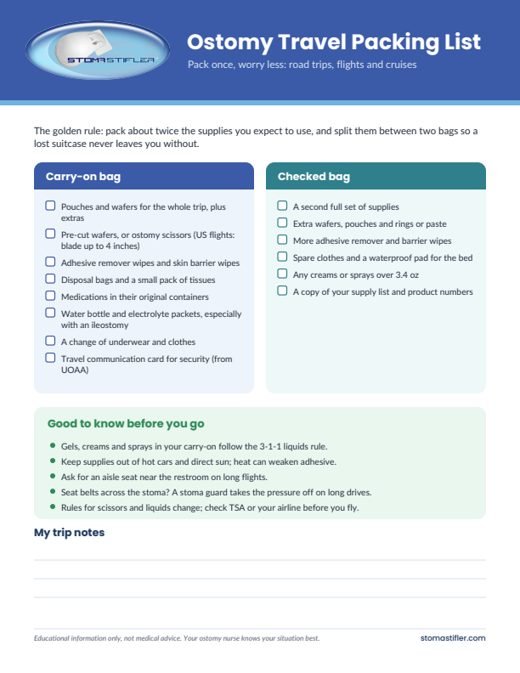
Business travel days. See our travel guide. The TSA notification card lives in your wallet for as long as you fly for work; the doubled supply kit lives in your carry-on; the desk-drawer kit lives in your hotel-room dresser drawer.
Open-office floor plans (the hardest case)
If you work in an open office without private spaces, these specific tactics help:
- Negotiate a desk near the bathroom. If you’ve disclosed to anyone, this is a small accommodation that makes a real difference; if you haven’t, find a “quiet preferences” framing that lands the same outcome.
- Take your laptop to a private call room or empty conference room for any extended work session. Reduces the strangers-within-3-feet-while-output-happens scenario.
- Use noise-canceling headphones liberally. They’re broadly accepted in open offices and they create both an audio buffer and a visual “do not interrupt” signal.
The two-week reset
Most ostomates report that by the end of week two back at work, the rhythm is set and the worry has dropped from “front of mind” to “background noise.” If you’re at end of week two and still anxious every meeting, two adjustments help:
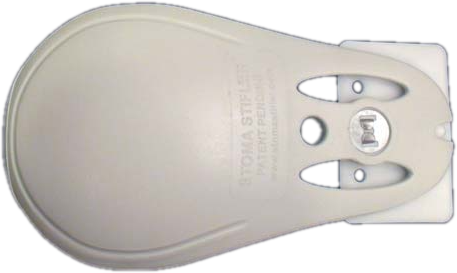
Stoma Stifler™, The Sound Suppressor + Stoma Guard Most Ostomates Wish They’d Found Sooner
- Rebuild the desk drawer. Nine times out of ten, ongoing anxiety traces to a kit that’s missing something. Audit it; add what’s missing.
- Add the discretion piece. If you haven’t tried the Stoma Stifler kit yet for the meeting and quiet-room moments, this is when most ostomates add it. The sound-suppression piece tends to dissolve the residual “what if it makes a noise” anxiety more than any amount of mental prep.
Annual reviews and difficult conversations
If you’ve disclosed and worry about being judged in performance reviews, document your work output independently. Track contributions, results, and feedback monthly. The data short-circuits any subtle bias because the answer to “did this person do good work this year?” stops being subjective.
If you have not disclosed and are concerned about attendance, most ostomates have a leak or appliance issue maybe 2-3 times in a typical year that disrupts a workday, keep a low profile around it: come in late or work from home that day if you can, don’t volunteer details, return to normal the next day.
Once you know what to do next, your whole body settles. My Ostomy Blueprint brings the answers that fit you into one plan, written from your own story.
Start My BlueprintThe bottom line
Going back to work is one of the milestones that proves “ostomy life is normal life with one extra logistic.” The first week is the steepest. The second week is recognizably your old work life. By month two, most ostomates report they’ve stopped thinking about the ostomy at work the way they did at week one, it’s just a piece of equipment that happens to be on their body.
For the broader confidence framework, see our first-year guide.
Affiliate disclosure: Some links in this article are Amazon affiliate links. If you purchase through them, Stoma Stifler may earn a small commission at no extra cost to you. See our full affiliate disclosure.
First 30 Days Companion
More from the Ostomy Library
- Dressing with an ostomy: Clothes that fit, flatter and keep your pouch discreet.
- Intimacy after ostomy surgery: Talking with a partner and feeling confident again.
- Traveling with an ostomy: Flights, road trips and what to pack.
Browse all Daily Life With an Ostomy guides or the full Ostomy Library.
Further reading on The Wellthie One
- How to calm anxiety naturally: Simple ways to settle a stressed nervous system.
Frequently Asked Questions
Is what I'm experiencing normal after ostomy surgery?
Most concerns ostomates have, bag noise, gas, occasional leaks, skin irritation, body-image adjustment, are normal in the first 6-12 months. The frequency and intensity drop significantly as your body adapts and your routine settles. Reach out to your ostomy nurse if anything feels worsening rather than improving.
Returning to work with an ostomy is mostly a logistics problem disguised as an emotional one. The logistics: where’s the bathroom, what’s in the desk drawer emergency kit, when do you eat, how do you handle a leak. The emotional layer dissolves once the logistics are dialed in. The readers who report the smoothest return tend to do three things: phase their return rather than jumping back to full-time week 1, set up the workplace bathroom and emergency kit on day one, and tell exactly the right number of people (HR + direct supervisor, often no one else). The folks who struggle are usually the ones who jumped back too fast and tried to hide every aspect of the ostomy until something went wrong.
When should I call my ostomy nurse or doctor?
Call promptly for: peristomal skin that's painful, bleeding, or breaking down; stoma color changes (dusky, purple, pale); no output for 4-6 hours with cramping (possible blockage); high output that won't slow despite reducing fiber and adding electrolytes; or a hernia bulge that becomes painful or won't reduce. Most other concerns can wait for your next scheduled appointment.
Does the Stoma Stifler help with this?
The Stoma Stifler is a stoma guard and noise suppressor in one. Its dense foam cup muffles stoma sounds and shields the stoma from bumps and pressure, without restricting output. It works with your existing pouching system and doesn't interfere with skin care or wafer adhesion. Pairing it with the basics, good skin routine, hydration, and any complementary supplies above, covers most daily-comfort challenges.